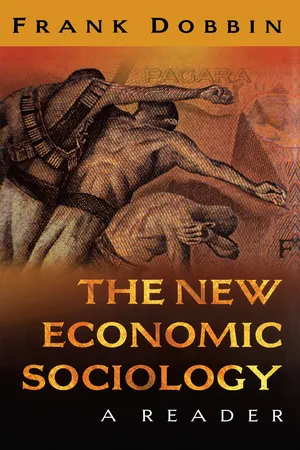
Economic sociology is a rapidly expanding field, applying sociology's core insight--that individuals behave according to scripts that are tied to social roles--to economic behavior. It places homo economicus (that tried-and-true fictive actor who is completely rational, acts only out of self-interest, and has perfect information) in context. In this way, it places a construct into a framework that more closely approximates the world in which we live. But, as an academic field, economic sociology has lost focus. The New Economic Sociology remedies this.
The book comprises twenty of the most representative and widely read articles in the field's history--its classics--and organizes them according to four themes at the heart of sociology: institutions, networks, power, and cognition. Dobbin's substantial and engagingly written introduction (including his rich comparison of Yanomamo chest-beaters and Wall Street bond-traders) sets a clear framework for what follows. Gathering force throughout is Dobbin's argument that economic practices emerge through distinctly social processes, in which social networks and power resources play roles in the social construction of certain behaviors as rational or optimal. Not only does Dobbin provide a consummate introduction to the field and its history to students approaching the subject for the first time, but he also establishes a schema for interpreting the field based on an understanding of what economic sociology aims to achieve.
- 576 pages
- English
- ePUB (mobile friendly)
- Available on iOS & Android
eBook - ePub
About this book
Information
Publisher
Princeton University PressYear
2021Print ISBN
9780691049069
9780691049052
eBook ISBN
9780691229270
Chapter 1
THE SOCIOLOGICAL VIEW OF THE ECONOMY
FRANK DOBBIN
AFTER SPENDING eighteen months among the Yanomamo of northern Brazil, Napoleon Chagnon (1968) described them as a fierce people respectful of quick tempers and casual violence. After spending a bit longer among the bond traders of Salomon Brothers, Michael Lewis (1987) described them as a guileful people respectful of quick wits and casual deception.
These peoples have different sorts of economies—systems for producing that with which they sustain life. They have different mechanisms for socializing the young. They have different cosmologies, or frameworks for making sense of the world. Both cosmologies tie social customs and physical objects to something bigger than society itself, in one case to a spirit world, in the other to a corpus of natural laws. The Yanomamo envision a world of departed ancestors that exists immediately above the visible sky and trace economic conventions (chest-beating contests) and physical objects (yams) to specific mythical ancestors. The bond traders envision a roster of social and physical laws that transcend time and space, and trace conventions (arbitrage) and objects (blowfish sushi) to specific laws. In each tribe, the average man on the street may not know everything about the ancestor spirits or scientific laws that govern the world, but he trusts that the experts know.
As a social scientist, what would you want to know to predict an episode of chest beating or bond trading? Chest beating and bond trading are economic behaviors, to be sure, for they determine how much of the group’s resources one can claim. To predict an episode of either, it would help if you understood the basics of the local cosmology, embodied in customs and rituals. Is it broadly mystified, religious, philosophical, or rational? What are the established social roles—hunter, warrior, trader, investor? What is the meaning of the particular custom within the local cosmology? Is the chest beater or bond trader engaged in a show of plumage, of force, of business savvy? What is the wider role of the custom—to display a penchant for violence, to raise capital? The more you know, the better you will be at predicting episodes.
For the purpose of prediction, the concept of self-interest, which is at the center of most theories of economic behavior, does not get you very far. The Yanomamo and the bond trader may be self-interested, but their behavior is largely shaped by social institutions. Chest beating can only be understood in the context of the tribe’s very particular cosmology. It is not that the Yanomamo warrior is a puppet of his culture. He reinterprets, challenges, and builds on his culture. He jokes about the ancestors who rule the earth and sky, rails at those ancestors when life treats him poorly, and devises new theories of fertility and weather. But the cosmology provides the lens through which he sees the world and the starting point for cultural change. The same goes for the bond trader. What the trader does makes sense only in the context of her special cosmology. She knows of no other way to interpret experience than through the lens of natural laws. She may chuck it all to join a Buddhist monastery, but she is not likely to question the laws of gravity or of supply and demand.
It is not just that the bond trader is rational and the Yanomamo belongs to a deluded cult that, incidentally, consumes a local hallucinogenic substance in large quantities. Economic practices also vary widely among modern, rationalized societies. Bond traders in Tokyo, Paris, and New York see the world through rationalized lenses, but through very different rationalized lenses. The same spirits do not rule the worlds of the Ndembu and the Yanomamo, and likewise the same laws of supply and demand do not obtain in Tokyo and New York. People in all of these places may be self-interested, but the concept of self-interest is of little use in explaining why people behave differently in different places.
SOCIOLOGY’S DISTINCT APPROACH TO ECONOMIC BEHAVIOR
Economic modernization can be seen as a series of societal projects. There was the project of developing intercontinental trade routes, spearheaded by Europe’s East India trading companies and colonizing monarchs. There was the project of building large-scale factories with wage labor forces nearby, spearheaded by early industrialists in Massachusetts and Manchester. There was also the project of divorcing the economy from society and polity, spearheaded by capitalists and politicians but also by philosophers and social observers. As Karl Polanyi argued in The Great Transformation (1944), British industrialization depended on the idea that the economy could be wrenched free of society—that a free labor market could be constructed by breaking traditional links between lords and serfs—as well as on the concrete public policies and capitalist practices.
One manifestation of the intellectual side of the project of splitting economy from society was the division of economics and sociology into distinct disciplines. In the nineteenth century, the dividing line between economics and sociology was difficult to draw. Most of the people who are now part of sociology’s heritage studied economic behavior, and called themselves economists. Karl Marx was interested in how capitalism emerged from feudalism; Max Weber in how religious institutions hastened the development of capitalism; Émile Durkheim in the consequences of the division of labor. Empirical studies typically showed that the economy was not a distinct realm—that it was enmeshed in social life. In their struggle against this idea, economists increasingly turned to abstract theorizing in which they modeled behavior “as if” the economy could be treated as a world apart.
Sociologists continued to see economy and society as intertwined, but even sociologists came to accept the emerging division between the disciplines. Sociologists were inductive, deriving theories of social behavior by observing behavior. Economists were deductive, deriving theories of economic behavior from the axiom that self-interest drives individual behavior.
Economics thus came increasingly to resemble physics. As Paul Krugman (1994, xi) jokes, “An Indian-born economist once explained his personal theory of reincarnation to his graduate economics class. ‘If you are a good economist, a virtuous economist,’ he said, ‘you are reborn as a physicist. But if you are an evil, wicked economist, you are reborn as a sociologist.”’ For the economist, the pinnacle of the academic pyramid had become the most pristine science with the most immutable laws. Economists spelled out how people would behave if they followed pure principles of self-interest. Like physicists, they thought they were identifying universal laws. Like philosophers, they imagined an ideal world and worked out the details of how people would behave in it. They came to play the role that prophets played in another age, conjuring up a perfect world and its rules of behavior.
Sociology became increasingly empirical, based on in-depth studies of communities and corporations and sectors of the economy. Robert and Helen Lynd’s Middletown (1929) depicted the changed economic institutions, changing network structure, and slowly changing culture of an average American city circa 1925. Philip Selznick’s in-depth study of the agency established to fight Appalachian poverty during the depression, TVA and the Grass Roots (1949), showed how officials and corporations could subvert public policy’s economic goals. C. Wright Mills’s The Power Elite (1956) showed that power was becoming increasingly concentrated in business, government, and the military and that links between the elites in those sectors were increasing. Meanwhile Digby Baltzell’s The Protestant Establishment (1964) showed the declining exclusivity of the Protestant elite and the rise of other groups in business and society.William H. Whyte’s The Organization Man (1956) showed that corporate customs made middle managers conformist and complacent, undermining the work ethic and entrepreneurialism that Max Weber had described among capitalists. In these and other studies, sociologists found economy and society inextricably enmeshed, but left it to economists to theorize economic behavior.
Since about 1980, both sociologists and economists have been challenging this division of intellectual labor, in which economists explain economic behavior using deductive models and sociologists explain all other kinds of social behavior using inductive methods. Economists see economic behavior as shaped by society. Sociologists see family relations, religious systems, and political institutions as shaped by economics. And in particular, sociologists see social processes shaping economic behavior, not only at the margins, but at the center.
Sociologists began to explain economic behavior in terms of the same four social mechanisms they had observed shaping all sorts of social behavior. These mechanisms entered the common lexicon under the terms institution, network, power, and cognition.
Sociology’s core insight is that individuals behave according to scripts that are tied to social roles. Those scripts are called conventions at the collective level and cognitive schemas at the individual level. Conventions and schemas make sense within a wider institutional framework, be it rational or religious or mystical. These conventions and schemas shape individual behavior, and so predicting economic behavior is a matter of comprehending conventions, schemas, and institutions. But prediction requires more than that, because conventions change. Understanding why they change is job one, and change can usually be traced to institutions, power, networks, and cognition. Economic institutions offer broad prescriptions for behavior. Institutions are sustained by occupational, industrial, and community networks that define social roles. Power shapes the evolution of new customs, when the powerful sanction the behavior of others and when they shape legal institutions. At the individual level, cognition is the carrier of conventions—it provides the schemas through which we make ongoing sense of conventions and through which we challenge them.
This anthology outlines the sociological view of economic behavior. It is divided into four parts, each focused on one of the social mechanisms that sociologists have discovered at the root of economic behavior. Each of the four groups of readings traces one social mechanism from its intellectual origins through studies that demonstrate its importance to studies that show how it meshes with the other mechanisms.
In this introductory chapter I endeavor to show that sociologists see these mechanisms as operating together to produce economic behavior patterns. I do so because it is easy to miss the forest for the trees. The economist Michael Piore describes economic sociology as “an enormous hodge-podge of ideas and insights, existing at all sorts of different levels of abstraction, possibly in contradiction with one another, possibly just incommensurate, without a basic theory or structure to sort them out, or order them” (1996, 742). This is a fair critique, to the extent that individual studies tend to focus on one of the four mechanisms, holding the others constant, and tend not to describe the big picture. Sociologists evaluate the effect of networks by artificially holding power constant just as physicists estimate the effect of gravity by holding atmospheric pressure constant. But sociologists have in fact been working toward an integrated theory of how economic customs arise and change. All four of these mechanisms play roles in that theory. My goal is to shine some light on that integrated theory.
Institutions
In common parlance people use institution to refer to sectors of society—the institution of organized religion. Sociologists use the term when talking about particular conventions, some defined by law and some by tradition. Institutions range in complexity from simple customs of exchange to elaborate modern states. The American state is, in the end, a huge agglomeration of smaller conventions, some informal and others codified. Institutions, large and small, shape human behavior not only by providing behavioral scripts, but by representing the relationships among things in the world—between the local totem and the harvest, or between antitrust and progress. For sociologists as for anthropologists (Geertz 1983; Douglas 1986), conventions and routines influence behavior in rationalized societies much as they do in mystified and religious societies. While social life in modern settings may be organized around ideas of progress rather than around ancestor worship, the individual makes particular decisions based on convention, just as she did when it was frog totems and not mathematical formulas that ruled the world. Today we reenact most conventions with an understanding of their rational purposes, but this is not to say that we actually make rational calculations every time we act. Our conventions may revolve around rationality and self-interest, but they are conventions just the same.
Networks
We learn how to be warriors, bond traders, teachers, witch doctors through social networks. What do you do when a buyer fails to pay, or when a drought fails to succumb to incantations? The prescriptions come from networks of others. Network theory builds on early French sociologist Émile Durkheim’s idea that social location shapes identity and behavior. Your network influences how you behave and your understanding of how people in other roles should behave. Role behavior is defined by conventions, which take the form of conditional prescriptions for behavior; to wit, if you are a chief information officer in a large automobile company, then you should advocate the transfer of the firm’s purchasing function to a Web-based bidding system. Other actors in your network define how you should dress (Brooks Brothers or loincloth), talk, comport yourself, and respond to bids for bonds. Social networks are the carriers of new economic practices and new ideas of what it means to be rational and efficient. Social networks also reward role-appropriate behavior, such as making good on a promise to sell bonds at a certain price, and sanction behavior that breaks norms, such as larceny.
Power
Karl Marx first defined power not merely as coercion, but as the ability to shape how others view the world and their own interests. From the dawn of capitalism, successful entrepreneurs and managers have defined economic conventions by proselytizing, telling the world that the best way to run a business is their way. Success itself gives these people the authority to define what rational behavior is. Economic power also goes hand in hand with the political power to determine public policies that shape how people see their interests and how they can behave. For instance, in chapter 16, William Roy finds that at the beginning of the twentieth century, a group of financiers who wanted to consolidate American manufacturing shaped the American view that oligopoly is natural and large firms are more efficient than small ones. In this way, power shaped the public policies that govern competition between firms and the pricing conventions of firms. This sort of power over economic institutions and economic norms operates through political networks, industry networks, and professional networks that serve as the conduits for new policy ideas and business strategies.
Cognition
Sociologists use the term cognition to refer to the psychological process of making sense of the world and its social conventions. Max Weber and Émile Durkheim articulated theories of social psychology as part of their theories of economic behavior. For them, the human mind is programmed to develop categories, causal frameworks, and maps of the world. Rather than looking for a single human cognitive archetype, Durkheim and Weber were interested in how “human nature” varies across social settings. Weber saw that many social systems produce individual psyches oriented to tradition rather than progress. He traced both the traditional and the modern psyche to the structure of religious institutions. In sociology, but also in cognitive psychology, behavioral economics, and cognitive science, the idea that core aspects of the psyche are situational rather than hard-wired has become commonplace. Economic sociologists are particularly interested in how ideas of rational self-interest vary with exposure to what Erving Goffman (1974) called different “frames” for understanding the world. For Goffman as for cognitive psychologists, cognitive frameworks are situated in individual consciousness, but they are shared among groups of people exposed to common institutions. Bond traders share a culture that shapes individual cognitive structures, and the same can be said for Yanomamo warriors. In modern social systems, people are exposed to different frameworks—market efficiency, economic justice, and so on (Boltanski and Thevenot 1991)—in different realms.
W...
Table of contents
- Cover Page
- Title Page
- Copyright Page
- Contents
- Acknowledgments
- Chapter 1: The Sociological View of the Economy
- Institutions
- Networks
- Power
- Cognition
- Index
Trusted by 375,005 students
Access to over 1.5 million titles for a fair monthly price.
Study more efficiently using our study tools.
Frequently asked questions
Yes, you can cancel anytime from the Subscription tab in your account settings on the Perlego website. Your subscription will stay active until the end of your current billing period. Learn how to cancel your subscription
No, books cannot be downloaded as external files, such as PDFs, for use outside of Perlego. However, you can download books within the Perlego app for offline reading on mobile or tablet. Learn how to download books offline
Perlego offers two plans: Essential and Complete
- Essential is ideal for learners and professionals who enjoy exploring a wide range of subjects. Access the Essential Library with 800,000+ trusted titles and best-sellers across business, personal growth, and the humanities. Includes unlimited reading time and Standard Read Aloud voice.
- Complete: Perfect for advanced learners and researchers needing full, unrestricted access. Unlock 1.5M+ books across hundreds of subjects, including academic and specialized titles. The Complete Plan also includes advanced features like Premium Read Aloud and Research Assistant.
We are an online textbook subscription service, where you can get access to an entire online library for less than the price of a single book per month. With over 1.5 million books across 990+ topics, we’ve got you covered! Learn about our mission
Look out for the read-aloud symbol on your next book to see if you can listen to it. The read-aloud tool reads text aloud for you, highlighting the text as it is being read. You can pause it, speed it up and slow it down. Learn more about Read Aloud
Yes! You can use the Perlego app on both iOS and Android devices to read anytime, anywhere — even offline. Perfect for commutes or when you’re on the go.
Please note we cannot support devices running on iOS 13 and Android 7 or earlier. Learn more about using the app
Please note we cannot support devices running on iOS 13 and Android 7 or earlier. Learn more about using the app
Yes, you can access The New Economic Sociology by Frank Dobbin in PDF and/or ePUB format, as well as other popular books in Economics & Economic Theory. We have over 1.5 million books available in our catalogue for you to explore.