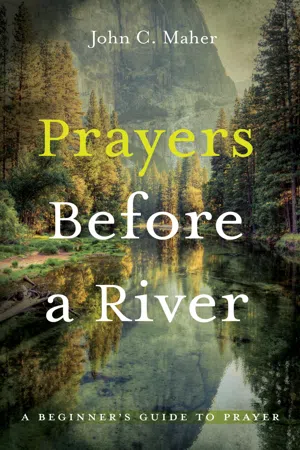
This is a book of prayers, with reflections on the act of praying. The prayers are scenes from daily life touching upon different topics: a prayer for animals; a prayer before a Christmas Tree; a prayer of the agnostic, of the unemployed, and of a college student; and a prayer against pessimism. Prayer is a rapport between heaven and earth, between God and humanity. There is no certified method of praying but some prayers offer a methodology, like the psalms. Your prayers are just you. Learning to pray is like when children learn to dance, to become the wind or a tree. They just let go. Prayer is the creative capacity of every soul, a deep structure, a language art, a reinvention of language that makes it possible for the spirit to sing and speak, to praise, petition, and weep.
- 78 pages
- English
- ePUB (mobile friendly)
- Available on iOS & Android
eBook - ePub
About this book
Information
Topic
Theology & ReligionSubtopic
Religion1
On Praying
In the Main of Light
What am I doing when I pray? Prayers are words, and the silences between words. Words and silence become prayer when we make them so. They are made sacred by us. Heaven touches earth. The spirit of the divine gives itself through language. Prayer is always more than language can contain, more than we (can) say, more like a flooding river.
Praying calls upon an unnamable divine spirit that races through our mortal bodies to tend the immortal being of our souls—to make infinite use of finite means. In religious talk, we say that prayer shines a light in our darkness. In Shakespeare talk, prayer is a little nativity that “puts us in the main of light.”1
Praying is not meant to last. Prayer moves on. Imagine a hell of continuous prayer. We are in transit. Pray, move on.
French literary theorist Roland Barthes entitled his study of St. Ignatius of Loyola Comment parler à Dieu? (How to Speak to God?). Barthes suggested that prayer—an interlocution divine, “a divine conversation,” is not the search for great or even good words. Rather, when praying we find ourselves in a kind of “linguistic vacuum” necessary for the “triumph of a new language.”2 We can say that such a vacuum is a space of holding. This squares with the Quaker approach to prayer, which consists of silent waiting—for new language. A Friend may ask the group to “hold someone in the light”—a person who is sick or struggling. In Quaker worship this is more than simple intercessionary prayer, i.e., praying for a person. It is a call by just one little gathering, a society of friends, at one moment in time, to clear the way, to make a road, to hold another, to bear them towards love.
Feelings: Making Space for the Real
You don’t want prayer that makes you feel worse. But prayer is not meant to fill us with nice feelings. It does not enfold us in petals. Praying does demand of us deep feeling, or to feel deeply. In fact, praying empties us of emotion, sometimes suddenly. Like emptying a folder stuffed with useless emails that hang out so many emotions—fear, nostalgia, regret, shame. Press. Pray. Delete. Praying off-loads things. It makes space for the holy, the sacred spirit. Praying permits us to “feel” more truly and in a different way. We feel trustful in the divine presence. We are safe because this presence comes to us with no conditions.
The Desire for the Sacred
Praying is a struggle. No, it can get worse than that. It’s a beast. As Jean Danielou writes, “to make space for prayer is a battle because prayer is . . . at cross-currents with the habits of the world . . . which gives it less and less space . . . Prayer finds difficulty in securing space.”3
To pray is a thing of beauty. It is the desire for the sacred. There is liturgy old and new. There are soaring choirs and community hymns, litanies and incantations, prayers with beads, congregational shoulder-to-shoulder prayer, or intimate family devotions; prayer with lit candles and incense, spontaneous prayer, and private silence. There is no single, “certified” method of prayer. It is culturally diverse. Your prayers are just you and the ultimate reality—God. Prayer is a disposition—making yourself open to the divine. Is a fissure in the flux of existence, a pause in the claustrophobia of the self. You make it so. Your prayer is the truth of you.
When we pray we balance forces: an equilibrium of heaven and earth. To stay put in either place is to get stuck, either in life’s zigzag or in the self-absorption of religion. This is what Simone Weil called in Gravity and Grace “obedience to the power of gravity . . . the greatest sin.”4 Through prayer we accept willingly, with feet on the ground, the gravitational pull of heaven as it comes together, self-delighting and manifesting recognition.
Through the Doors
Each person has an impulse, deep inside, to look for meaning in life. It is an impulse to see through the tossing and turning of everyday life and death. Prayer is a door that leads through and beyond. “Lift up your heads, O gates!And lift them up, O ancient doors” (Ps 24:5). That is why Orthodox religious icons are painted only on doors. These doors, of red, black and gold, bid us enter. Whether you are awake or distracted, content or unhappy, these are the doors to reality. Your prayers are just you.
When we walk—run, scream—through the doors of prayer we may find on other side nothing much at all. It may be a dull place, unfrequented by the sun. A remote darkness, even. Yet, it is darkness that glows. Because this is a sacred place. It is a place of re-creation. On the fourth of day of creation, darkness, together with light, is declared good. Let there be darkness.
Without explanation, this dull place of prayer makes me just a bit more real, more visible to myself than before. The old images—the old me—start to blur. A kind of nativity stirs among the silence and words. Something is there, something in there. I am not sure what or who it is. It strives to “lighten our darkness.” The Jesuit poet Gerard Manley Hopkins (1844–1889) pointed to a second creation of the sacred darkness in “Christmas Prayer,”
Moonless darkness stands between.
Past, the Past, no more be seen!
But the Bethlehem star may lead me
To the sight of Him who freed me
From the self that I have been.
Espresso and Prayer’s Erasure
Praying adds time—moments or hours—to our daily life but otherwise subtracts from it. Prayer doesn’t rev us up. It isn’t an espresso in the morning. In fact, prayer might send us back into the world curiously unsatisfied, unfinished. As though we didn’t quite do it properly. This is a good. Erasure is how the divine works. Something was removed inside of us, in order to make room for the divine. We do not fill our soul with prayer. We pray in order to empty our soul. Then we are ready to fill it with the world. God’s world—the one I was given to live in. Learning to pray is like when children are taught to dance. They must let go of the body in order to turn into a bird or a tree or the wind. The discipline of prayer shifts our pattern of doing and moving—towards freedom. Then we can become anything. Then, as Thomas Cranmer writes resonantly in the Book of Common Prayer, we draw closer to God, “not in bondage of figure or shadow, but in the freedom of the Spirit.”5
The Hip-Hop of Prayer
The Psalms are a mash-up of beauty and brutality. They are methodology. They teach us how to pray. Psalm is from the Greek word psalmoi, meaning instrumental music and words. The Psalms express many different things, from praise and thanksgiving to dramatic dissatisfaction with how the world is ordered. The Psalms—the longest book of the Bible—are an interesting genre. They show two special qualities: hope and unpredictability. In a slab of psalm we notice a peculiar style: prose and poetry—full of rhythmic messages, delightful turns of phrase, aggressions and contradictions. They teem with poetry, microaggressions, calls for death and divine vengeance on “our enemies,” curses, and exquisite tenderness. Mercy! Mercy! The Psalms tell it all. Read the Psalms for what they are. Don’t wish for what they are not. Read the Psalms and hear hip-hop.
The Uncertainty of Being Me
Prayer is the language of the precarious. The English word prayer is related to the not...
Table of contents
- Title Page
- Acknowledgements
- Preface
- Chapter 1: On Praying
- Chapter 2: Prayers
- Chapter 3: On Praying
- Chapter 4: Prayers
- Chapter 5: On Praying
- Chapter 6: Prayers
- Bibliography
Trusted by 375,005 students
Access to over 1.5 million titles for a fair monthly price.
Study more efficiently using our study tools.
Frequently asked questions
Yes, you can cancel anytime from the Subscription tab in your account settings on the Perlego website. Your subscription will stay active until the end of your current billing period. Learn how to cancel your subscription
No, books cannot be downloaded as external files, such as PDFs, for use outside of Perlego. However, you can download books within the Perlego app for offline reading on mobile or tablet. Learn how to download books offline
Perlego offers two plans: Essential and Complete
- Essential is ideal for learners and professionals who enjoy exploring a wide range of subjects. Access the Essential Library with 800,000+ trusted titles and best-sellers across business, personal growth, and the humanities. Includes unlimited reading time and Standard Read Aloud voice.
- Complete: Perfect for advanced learners and researchers needing full, unrestricted access. Unlock 1.5M+ books across hundreds of subjects, including academic and specialized titles. The Complete Plan also includes advanced features like Premium Read Aloud and Research Assistant.
We are an online textbook subscription service, where you can get access to an entire online library for less than the price of a single book per month. With over 1.5 million books across 990+ topics, we’ve got you covered! Learn about our mission
Look out for the read-aloud symbol on your next book to see if you can listen to it. The read-aloud tool reads text aloud for you, highlighting the text as it is being read. You can pause it, speed it up and slow it down. Learn more about Read Aloud
Yes! You can use the Perlego app on both iOS and Android devices to read anytime, anywhere — even offline. Perfect for commutes or when you’re on the go.
Please note we cannot support devices running on iOS 13 and Android 7 or earlier. Learn more about using the app
Please note we cannot support devices running on iOS 13 and Android 7 or earlier. Learn more about using the app
Yes, you can access Prayers Before a River by John C. Maher in PDF and/or ePUB format, as well as other popular books in Theology & Religion & Religion. We have over 1.5 million books available in our catalogue for you to explore.