eBook - ePub
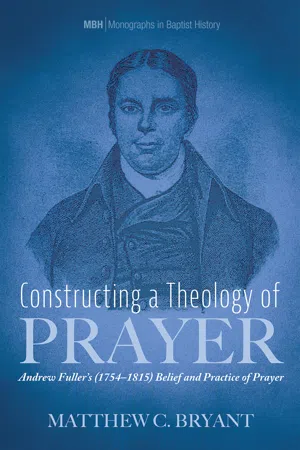
Constructing a Theology of Prayer
Andrew Fuller’s (1754–1815) Belief and Practice of Prayer
- 236 pages
- English
- ePUB (mobile friendly)
- Available on iOS & Android
eBook - ePub
Constructing a Theology of Prayer
Andrew Fuller’s (1754–1815) Belief and Practice of Prayer
About this book
Constructing a Theology of Prayer: Andrew Fuller's (1754-1815) Belief and Practice of Prayer fills a lacuna in Fuller studies. Bryant's work is the first full treatment of Fuller's theology of prayer, demonstrating the vitality of prayer for Fuller's ministry and theological reflection. Bryant constructs Fuller's theology of prayer through a systematic analysis of six major doctrines: the doctrine of God, the Son, the Spirit, Humanity, the Church, and Last Things. Each chapter explores both how Fuller's doctrine influences his belief and practice of prayer, and how belief and practice of prayer influence doctrine. The study convincingly demonstrates how each major doctrine finds prayer as its corollary. As Fuller states, "Holy practice has a necessary dependence on sacred principle."
Information
Topic
Theology & ReligionSubtopic
Christian Denominations1
Foundational Considerations for Fuller’s Theology of Prayer
The following chapter sets out to accomplish two things: (1) situate Fuller within his ecclesial context, especially as it relates to prayer; and (2) introduce Fuller’s practice of prayer. Situating Fuller within his ecclesial context means briefly surveying beliefs and practices regarding prayer from late-seventeenth and early-eighteenth-century Britain in general and specifically those within the Particular Baptist tradition and the Northamptonshire Baptist Association. Finally, introducing Fuller’s practice of prayer means surveying the pertinent literature regarding his thoughts and actions regarding prayer with respect to his private duty as a Christian and public duty as a pastor. The reader will be introduced to Fuller’s major works concerning prayer and his practice of prayer through a brief spiritual biography. Fuller’s ecclesial context and personal practice of prayer are foundational for considering his theology of prayer.
Fuller’s Ecclesial Context
The following section explores Fuller’s ecclesial context concerning basic beliefs and practices regarding prayer. Surveying the beliefs and practices regarding prayer in Britain’s broader ecclesial landscape in the late-seventeenth century sets the stage for understanding Baptist beliefs and practices regarding prayer from the late-seventeenth to early-eighteenth century.
The brief survey will progress chronologically from the Act of Uniformity 1662 to the mid-eighteenth century. Additionally, the survey will move from more general beliefs and practices regarding prayer to the specific beliefs and practices of the Particular Baptist tradition. The survey concludes by considering Fuller’s immediate context: the early years and figures of the Northamptonshire Baptist Association.
Prayer in Britain
In the late-seventeenth century, Britain was divided broadly into two ecclesial groups, Anglicans and Nonconformists. The Anglicans were those belonging to the Establishment, that is, the Church of England. The Nonconformists, or Dissenters, as they were lumped together, included Baptists, Congregationalists, and Presbyterians.106 The divide between eighteenth-century Anglicans and Nonconformists may be traced to the seventeenth-century divide between Anglicans and Puritans. Horton Davies traces the divide between Puritans and Anglicans to the liturgical divide between the Magisterial Reformers, Luther and Calvin. He states,
The results of the Lutheran and Calvinist liturgical reforms are admittedly different . . . The real difference between Lutheran and Calvinist reforms in worship may be summed up as follows: Luther will have what is not specifically condemned by the Scriptures; whilst Calvin will have only what is ordained by God in the Scriptures. That is their fundamental disagreement. It is of vital importance in the history of Puritan worship, since the Puritans accepted the Calvinist criterion, whilst their opponents, the Anglicans, accepted the Lutheran criterion.107
In the seventeenth century, the divide between Anglicans and Nonconformists continued along these same lines and was accentuated by differing opinions regarding prayer. Davies states, “If the main theological difference between Puritan and Anglican worship consists in the attempt of the Puritans to model their worship more closely on the Biblical criterion, this resolved itself practically in the Puritan emphasis on free prayer over against the ‘stented forms’ of the Establishment.”108 Although some Puritans advocated for their own prayer books or various revisions of the BCP, their use and appropriateness was a source of controversy in the British Isles for nearly a century prior to the Act of Uniformity.109 John Bunyan’s dialogue with the several Justices during his imprisonment reflects the divide in belief regarding set and extemporaneous forms of prayer. The clerk read the charge against Bunyan. Among other items, Bunyan was accused of not atten...
Table of contents
- Title Page
- Acknowledgments
- Abbreviations
- Introduction
- Chapter 1: Foundational Considerations for Fuller’s Theology of Prayer
- Chapter 2: The Father and Prayer
- Chapter 3: The Son and Prayer
- Chapter 4: The Spirit and Prayer
- Chapter 5: Humanity and Prayer
- Chapter 6: The Church and Prayer
- Chapter 7: Eschatology and Prayer
- Conclusion: Evaluation of the Multifaceted Approach
- Appendix 1: Chronology of Prayer Quotations or Entries Associated with Prayer in Fuller’s Diary, January 1780–July 1800
- Appendix 2: Timeline of Fuller’s Expositions, June 6–August 29, 1784
- Vita: Matthew C. Bryant
- Bibliography
Trusted by 375,005 students
Access to over 1.5 million titles for a fair monthly price.
Study more efficiently using our study tools.
Frequently asked questions
Yes, you can cancel anytime from the Subscription tab in your account settings on the Perlego website. Your subscription will stay active until the end of your current billing period. Learn how to cancel your subscription
No, books cannot be downloaded as external files, such as PDFs, for use outside of Perlego. However, you can download books within the Perlego app for offline reading on mobile or tablet. Learn how to download books offline
Perlego offers two plans: Essential and Complete
- Essential is ideal for learners and professionals who enjoy exploring a wide range of subjects. Access the Essential Library with 800,000+ trusted titles and best-sellers across business, personal growth, and the humanities. Includes unlimited reading time and Standard Read Aloud voice.
- Complete: Perfect for advanced learners and researchers needing full, unrestricted access. Unlock 1.5M+ books across hundreds of subjects, including academic and specialized titles. The Complete Plan also includes advanced features like Premium Read Aloud and Research Assistant.
We are an online textbook subscription service, where you can get access to an entire online library for less than the price of a single book per month. With over 1.5 million books across 990+ topics, we’ve got you covered! Learn about our mission
Look out for the read-aloud symbol on your next book to see if you can listen to it. The read-aloud tool reads text aloud for you, highlighting the text as it is being read. You can pause it, speed it up and slow it down. Learn more about Read Aloud
Yes! You can use the Perlego app on both iOS and Android devices to read anytime, anywhere — even offline. Perfect for commutes or when you’re on the go.
Please note we cannot support devices running on iOS 13 and Android 7 or earlier. Learn more about using the app
Please note we cannot support devices running on iOS 13 and Android 7 or earlier. Learn more about using the app
Yes, you can access Constructing a Theology of Prayer by Matthew C. Bryant in PDF and/or ePUB format, as well as other popular books in Theology & Religion & Christian Denominations. We have over 1.5 million books available in our catalogue for you to explore.