Step-by-step guide to learning the role of E-commerce in our economy Key Features
Hands-on with the concept of E-Commerce and E-Business.
Understand the know-how of working of E-Commerce framework.
Learn the type of E-Payment system and its mechanism.
Understanding Brand building and Digital Marketing methods.
Description Electronic Commerce (E-Commerce) is a new way of carrying out business transactions through electronic means in general and the Internet environment by supporting this industry in particular, has been proving its potential benefits and effective contribution to the socio-economic growth. As an essential part of the "Digital Economy", E-Commerce plays a key role in opening the door to the 21st century, the new era of the knowledge-based economy. In this book, you will understand the basic concepts of E-Commerce and E-Business. The Internet has the broadcasting capability and is a mechanism for information dissemination and a medium for collaboration and interaction between individuals through computers irrespective of geographic locations. The motive of this book is to present an introduction to E-Commerce and E-Banking industry. What you will learn
Understand the different models of E-Commerce.
Get to know more about the various types of Electronic Payment Systems.
Understand the security issues in Electronic Payment Systems.
Get familiar with the concept of Electronic banking and Online publishing
Who this book is for This book is for everyone interested in knowing more about E-Commerce. Existing professionals associated with the E-Commerce industry can use this book as a reference guide. Table of Contents 1 Describe the concept of E-commerce and E-business 2 Understand the E-commerce framework 3 Learn the various functions of E-commerce 4 Describe the models of E-commerce 5 Describe the concept of the Internet and its use in E-commerce 6 Define the various types of electronic payment systems 7 Understand the security issues in electronic payment system 8 Learn the concept of electronic banking and online publishing 9 Describe the methods of brand building in the market 10 Understand the role of digital marketing in brand building About the Authors Dr. Sudeshna Chakraborty has 15+yrs of experience in mostly all academic and industry-academia interface processes, including teaching UG, PG, and Ph.D. scholars. She had the remarkable role of exam dep. supervisor, academic and department placement coordinator and has published 10 patents and filed two others. She has published papers in 50 national and international journals and conferences with remarkable citation. She was a key note speaker at SEAHF, Session Chair at ICCIKE -19, International Conference on Computational Intelligence & Knowledge Economy Held at Amity University, Dubai. Plus, she is an editorial member of NOVA, IJREM IJASRW, Research AAP CRC Francis NTaylor, and a professional member of IEEE, Chair IETA, and IEI. LinkedIn Profile: https://www.linkedin.com/in/dr-sudeshna-758a70176 Facebook Profile: https://m.facebook.com/Dr.sudesna.chakraborty Priyanka Tyagi is an assistant professor at Lingaya's Lalita Devi Institute of Management and Sciences, IP University. She is pursuing her P.hd (Computer Science), from Lingaya's Vidyapeeth (Deemed to be University). She completed her M.Tech. (Computer Science) from Banasthali Vidyapeeth, Rajasthan, with 77.2% in July 2009 and completed her B.E. (Computer Science) from Hindu College of Engineering, Sonipat, with an aggregate of 70.2% in 2006. LinkedIn Profile: https://www.linkedin.com/in/priyanka-tyagi-15885315a/ Blog links: https://twitter.com/home?lang=en
In the past few years, enterprises across the world have made vital changes in their business system. Immense investments were created in enterprise resources coming up with system implementations, but they are struggling to induce timely info required to form effective business calls and confirm the continuous growth of enterprises. Putting e before of any method or operation is perceived to be the magic prescription for the ne’er ending story of success and speedy returns for enterprises. E-business, e-procurement, e-sales, e-payment, e-banking, e-CRM, e-CAD, the e-delivery are simply many. The Internet, for instance, is becoming a popular medium of transmittal varied information. Users come across any info in much lesser time as compared to a standard methodology that consumes more time.
The emergence of the Web throughout the globe has been tributary such a range medium in doing business yet as individuals mode. In fact, the Internet is the essential requirement for the existence of E-commerce. Electronic commerce or e-commerce has been outlined because of its ability to perform transactions involving the exchange of products or services between two or more parties’ through electronic tools and techniques. The explosion of e-commerce has created new phenomena in our mode, particularly in searching for activities. Customers can simply obtain products or services like magazines and airline tickets via the Internet.
Structure
In this chapter, we will discuss the following topics:
Definition
Features of e-commerce
Interdisciplinary nature of electronic commerce
Levels of e-commerce
SWOT analysis
Future of e-commerce
Benefits of e-commerce
Limitations
Objectives
E-commerce is dynamic in the approach of doing business. The target of this chapter is to induce the scholars accustomed to the essential construct of e-commerce and e-business. This chapter highlights the essential components of e-commerce and the distinction between ancient and electronic business.
After reading this chapter, you’ll be in a position to:
Describe the construct of E-commerce and E-business
Explain the different levels of E-commerce and E-business
Perform a SWOT analysis of E-commerce and E-business
1.1 Definition
Electronic commerce, like all alternative business, deals with the exchange of cash for soft or exhausting products and services. E-commerce can be defined from multiple views:
Service perspective: E-commerce is defined as a tool that addresses the will of companies, shoppers, and management to chop service prices, improve the standard of goods/services, and increase the speed of service delivery.
Business methods perspective: This says that E-commerce is the application of technology for the automation of business transactions and workflow.
Communication perspective: According to this attitude, e-commerce is the delivery of data, products/services, or payments over telecommunication channels, laptop networks, or the opposite electronic mode of communication.
Online perspective: E-commerce provides the capability of shopping for and marketing merchandise and knowledge on the Internet and different online services.
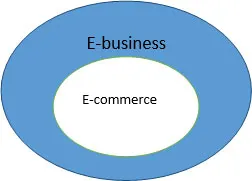
E-Business, or electronic business, is the administration of conducting business via the Internet. This enables us to embrace the shopping for and marketing of products and services, alongside providing technical or client support through the Internet. E-business could be a term usually employed in conjunction with e-commerce, but it also includes services in addition to the sale of products. E-business could be a general term that encompasses all kinds of uses of digital info and communication technologies to support and optimize business processes. In distinction, e-commerce describes solely the net commerce of merchandise and services and is solely a segment of e-business:
Figure 1.1
1.2 Parts of Electronic Business
The core parts of e-business area unit info, communication, and dealings. Business partners use digital networks (i.e. public or personal communication networks) to conduct business processes using innovative technologies to enhance potency. Three key area units are significantly necessary for e-business:
E-procurement: The electronic sourcing of merchandise and services by firms, centered on reducing prices and energy.
Online stores: The electronic sale of merchandise and services via applicable platforms, like online stores.
Online marketplaces: Electronic commerce via digital networks, connecting the consumers and suppliers of merchandise and services.
There are two any areas of e-business:
Online communities: Transmission network between people and organizations that supports knowledge and information sharing similarly because of the preparation of dealings choices.
Online companies: Electronic business cooperation for connecting individual company services, leading to a virtual business with a typical dealings supply.
To fully perceive the construct of e-business, you want to initially grasp the link between e-business and the web economy and understand the standard market participants’ area unit within the business. The vary of e-business is decided by the cyber web economy. This refers to the business use of digital knowledge networks for handling info, communication, and dealings processes via numerous platforms.
Since the late 90s, or maybe earlier, the event of medical aid not solely crystal rectifier to a serious structural modification in society, however conjointly within the economy. Since then, the main target has shifted to the knowledge sector. The systematic use of technology to gather and utilize info arranged the foundations of an alleged information economy, during which fight is achieved through information superiority.
Function of Electronic Business
The most necessary role of electronic business is electronic worth creation – the generation of electronic additional worth. The varieties of electronic additional worth area unit typically distinguished within the following way:
Structuring value: An Internet connection achieves a summary of an outsized amount of knowledge.
Selection value: An Internet connection provides specific info upon request.
Matching value: An Internet connection makes it doable to merge inquiries from providers and consumers expeditiously.
Transaction value: An Internet connection makes a business economical.
Coordination value: An Internet connection permits completely different suppliers to higher mix their services.
Depending on what a corporation decides to pursue, they’ll opt for one or a lot of worth activities – for instance, gathering, structuring, pre-selection, summary, or distribution of knowledge. An alleged digital info product may be created, giving additional values that the client is ready to buy. This info product could also be a website, web blog comparison portal, e-book, or a computer code application.
Examples of e-business:
Their area unit in numerous samples of completely different e-business activities, but there may be a temporary choice.
The e-procurement sector includes the following activities:
Organize the implementation of a Desktop Buying System (DPS) that supports the entire procurance method, like checking stock convenience and handling the order and payment.
Constructing and operating an Internet marketplace for merchandise and services. Integration numerous electronic provider catalogs into your enterprise resource coming up with (ERP) system to support procurance, warehouse management, order process, production management, and supplies.
The e-commerce sector includes the following activities:
Designing and maintaining a web presence and/or an online store with merchandise or services accessible from anyplace in at any time, multiple payment choices, automatic e-mail notifications on orders, and client support (live chat, hotlines, or facilitate centers).
Developing and provisioning extra content, like associate informational web blog or comparison portal.
Expanding online selling and targeting advertising to customers, for instance by using huge knowledge from cookies, purchase behavior, and client knowledge.
E-commerce has the potential to unleash monumental savings and business efficiencies, but the practicalities stay elusive. However, can e-commerce modify the worldwide transportation and supplying within the offer chain? Supplying has been delineated because it is the key enabler for e-business, but will individual supplying and transport firms ensure that they take pleasure in, instead of changing, the e-commerce revolution?
E-business is the new profitable, thanks to conducting business that works on the far side of the straightforward movement of knowledge and expands electronic transactions from location necessities, determination, and production programming, all the way through to invoicing, payment, and receipt. E-commerce uses key standards and technologies as well as Electronic Knowledge Interchange (EDI), Technical knowledge Interchange (TDI), machine-readable text nomenclature (HTML), and the commonplace Exchange of Product model knowledge (STEP).
The Internet may be a worldwide assortment of laptop networks, co-operating with one another to exchange knowledge employing a common computer code commonplace. Through phone wires and satellite links, web users will share info during a style of forms. The size, scope, and style of the web permit users to connect simply through standard personal computers and native phone numbers, exchange email correspondence (E-mail) with friends and colleagues with accounts on the web, post info for others to access and update it, access multimedia system info that has sound, photographic pictures, and even video, and access various views from around the world. Another attribute of the web is that it lacks a central authority—in other words, there’s no Internet, Inc. that controls the Web. On the far side, varied governing boards ascertain policies and standards and make a few rules, but the Web answers to no single organization that binds it.
1.3 Features of E-commerce Technology
Electronic commerce means that higher business communication and information interchange is important for businesses. The standard and amount {of info, data, and knowledge} that a business delivers to customers or uses this information to create choices will verify how competitive it is.
Businesses are also employing a range of electronic-based mostly tools to assist acquiring and extending info and communication desires. These could embody personal computers, word processors, courier, facsimile machines, telex services, cellular phones, pagers, and such. Sadly, several of today’s communication tools don’t seem to be extremely up to the speed of today’s business desires, and they may produce barriers to achieving the goals and idea developed by a corporation.
For instance, communicating facilities will keep business awaiting info for days or maybe weeks. Nightlong couriers could save time, but it is often an upscale proportion. Ancient telex Associate in nursing fax is fast but pricey, and human action by phone will become an endless game of tag.
Now, businesses can avoid these issues by using e-commerce as it is quick, economical, time-saving, and simple to use, i.e., it has economic palpability and sensible business generati...
Table of contents
Cover Page
Title Page
Copyright Page
Dedication Page
About the Authors
Acknowledgement
Preface
Errata
Table of Contents
1. Introduction to E-commerce and E-business
2. Structure of E-commerce
3. Need of Internet and Intranet for E-commerce
4. Need for Electronic Payment Systems in E-commerce
5. E-commerce Applications
6. Role of Technology in Brand Building of the Product in E-commerce
Index
Trusted by 375,005 students
Access to over 1.5 million titles for a fair monthly price.
Study more efficiently using our study tools.
Frequently asked questions
Yes, you can cancel anytime from the Subscription tab in your account settings on the Perlego website. Your subscription will stay active until the end of your current billing period. Learn how to cancel your subscription
No, books cannot be downloaded as external files, such as PDFs, for use outside of Perlego. However, you can download books within the Perlego app for offline reading on mobile or tablet. Learn how to download books offline
Perlego offers two plans: Essential and Complete
Essential is ideal for learners and professionals who enjoy exploring a wide range of subjects. Access the Essential Library with 800,000+ trusted titles and best-sellers across business, personal growth, and the humanities. Includes unlimited reading time and Standard Read Aloud voice.
Complete: Perfect for advanced learners and researchers needing full, unrestricted access. Unlock 1.5M+ books across hundreds of subjects, including academic and specialized titles. The Complete Plan also includes advanced features like Premium Read Aloud and Research Assistant.
Both plans are available with monthly, semester, or annual billing cycles.
We are an online textbook subscription service, where you can get access to an entire online library for less than the price of a single book per month. With over 1.5 million books across 990+ topics, we’ve got you covered! Learn about our mission
Look out for the read-aloud symbol on your next book to see if you can listen to it. The read-aloud tool reads text aloud for you, highlighting the text as it is being read. You can pause it, speed it up and slow it down. Learn more about Read Aloud
Yes! You can use the Perlego app on both iOS and Android devices to read anytime, anywhere — even offline. Perfect for commutes or when you’re on the go. Please note we cannot support devices running on iOS 13 and Android 7 or earlier. Learn more about using the app
Yes, you can access E Commerce for Entrepreneurs by Priyanka Tyagi,Dr. Sudeshna Chakraborty,Priyanka Tyagi in PDF and/or ePUB format, as well as other popular books in Computer Science & Computer Science General. We have over 1.5 million books available in our catalogue for you to explore.