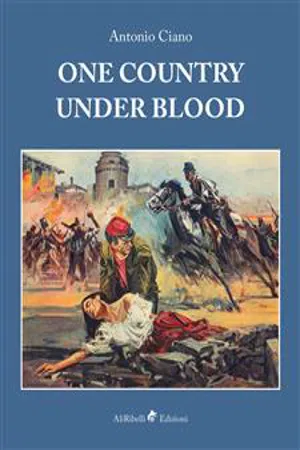
"One Country under Blood" debunks the myth of a happy unification of Italy. What was made to pass as a struggle for independence, was truly an invasion perpetrated by the House of Savoy and its masonic affiliates with the connivance of the Mafia and Camorra cartels. After the annexation of the Kingdom of the Two Sicilies, the riches of southern Italy were transferred to banks in the north to fuel the industrial development of Lombardy and Piedmont. Disfranchised and impoverished, millions of southern "Italians" had no other choice but to turn into outlaws or leave their ancestral homeland and immigrate to the United States, Australia and Southern America in search of a new beginning.
- English
- ePUB (mobile friendly)
- Available on iOS & Android
eBook - ePub
One Country Under Blood
About this book
Information
Topic
HistoireSubtopic
Histoire du 19ème siècleSOUTHERNISM AND CHRISTIANITY
The legend is that which would be the official story as built on their own account or on the behalf of others: with red, with Savoy blue, with black, in a hybrid mixture of hammers, masonic squares and compasses, plumes of the bersaglieri (sharpshooters), Phrygian caps, torches. And those who built it were the politicians and scholars of the North and South, in the name of Unification, of progress, of the revolution, of the king, the Duce. Not all together it is understood, not all with the same voice, but a little at a time, in harmonic disharmony.
Carlo Alianello
THE MASSONIC HORDE
In a world of mice, rodent people are born
Piedmont serves the will of Freemasonry, which has always directed Italian politics.
In 1861 Piedmont was headed by the Masonic Grand Master Sir Albert Pike and today by the Trilateral Commission.1
On March 12, 1849 in the Globe, a daily British newspaper, spokesman of the high initiated Palmerston, Minister of Queen Victoria, an article appeared that was practically a truly prophetic book and which we can say, without emphasis, had been secretly prepared at the Holy Temple of Freemasonry in London:
It is to be believed that the events of last year are only the first scene in a fruitful drama of wider and more peaceful results. The building erected by the Congress of Vienna was so arbitrary and contrived that each liberal statesman saw clearly that would not stand the first shock of Europe. The whole system established by the Congress of Vienna was dissolving and Lord Palmerston acted wisely when he opposed his competition by daming a flooding wave. The plan he devised is that of a new configuration of Europe through the establishment of a strong German kingdom that could constitute a wall of separation between France and Russia, the creation of a Polish-Hungarian kingdom intended to finish the work against a Northern Giant, finally a kingdom of upper Italy led by the House of Savoy. Palmerston has often been criticized for neglecting the alliance with Austria, but here the accusers have yet to do him justice. The Alliance of England and Austria has never been based on a commonality of principles: it exists simply because Austria was the main representative and the incarnation of the German nation. After the peace of Westphalia until that of Aix-Le Chapelle (1648, 1748) Austria has found itself to be the center of the German nation. But when the sword of Frederick did expand the boundaries of his kingdom which had previously been limited to the electorate of Brandenburg, when the true Germans recognized in this warrior the real representative of their strength and their nationality, Prussia became the natural ally of England on the continent. Which Austria was at the beginning of the last century and which later became Prussia, that which Germany may also become, that its capital is either Berlin or Frankfurt.
The design was clear, the Comenius prophecy as expressed in Lux in Tenebris (Light in the darkness) had to be implemented, according to which a Super-church would arise from the darkness as the source of light which would integrate all religions through a National Conformity, the national churches, to arrive in the name of a unifying humanism that is both philanthropic and tolerant, to proclaim equality and dignity of all religions.2
This project came up against a formidable obstacle: the Catholic Church with its hierarchy, the house of Habsburg of Austria, catholicism, the Holy Russia of the Czars and the Kingdom of the Two Sicilies, the latter, considered first state in the world, had been able to integrate Catholic dogma with the word of the Gospel into practice by laws that were not above the new ideas of the French Revolution or those of communists Campanella and Marx.
Holy Russia, the Austrian Emperor and the Kingdom of the Two Sicilies had to give way to the new Masonic order, but the common people do not know these things, nor do they know them today, as the official history is written by the victors and is always contrived.
This new order was to bring political and moral upheavals of unprecedented violence.
In Italy the task of overturning said order, as we saw in the Globe article, was assigned to Piedmont and the House of Savoy, voted for by the Grand Faction. In fact the other sovereigns were all very devoted to the Church of Rome. The most reactionary state of Italy would be needed to enlighten the boot of Italy! London’s masonry put men, money and resources towards task; especially money and gold.
The Masons knew that upon completion of Unification they would be paid for centuries. The House of Savoy had to ruthlessly execute the orders of London after decades of liberal preparation.
London sent Lord Gladstone to Naples and Lord Mintho and other emissaries throughout the various Italian provinces to prepare the liberal revolution at the orders of Giuseppe Mazzini, head of the Italian Carboneria (nineteenth century secret Republican organization), whose ultimate aim, according to its Genoese founder Antonio Maghella, was “that of Voltaire and of the French revolution: the complete annihilation of Catholicism and finally of Christianity.”3
This gentleman in 1809 was prefect and police chief of the Kingdom of Naples and he was able to initiate thousands of people into the sect and insert them in key posts.
The Carboneria was organized in sales.4 The summit was called high sales and it was composed of forty members and worked in close contact with supreme councils of the 33rd degree of the Scottish rite. Mazzini was a leading exponent of the extremist wing. In 1847, during an international conference of Freemasonry in Strasbourg, was prepared a plan for an enlarged European confederation of Germanic peoples, Latins and Slavs to be achieved through a series of well-orchestrated revolutions.
The English Prime Minister Palmerston spread throughout Europe emissaries for the uprising; Lord Mintho visited Turin, Rome and Naples.
In 1848 the revolutions erupted in an orderly sequence: on 22 february in Paris, 13 march in Vienna, 17 march in Berlin and Venice, 18 march in Milan, on 30 march in Naples, Tuscany, Rome, Prague and Croatia, leaving free only the secular countries.
GIUSEPPE MAZZINI (1805-1872)
Listed by the regime as one of the founding fathers of the homeland, was initiated into the Carboneria between 1827 and 1829, soon becoming one of the disciples of Mr. Pike.
In 1864 the Grand Orient of Palermo granted him the 33° degree. On 3 june 1868 he was proclaimed venerable perpetual ad honorem of the Lincoln Lodge of Lodi and he was raised to the office of Grand Master. On 24 july in Genoa, he was nominated honorary member of the Lodge The Star of Italy and on 1 october 1870, of the Lodge The Region of the same Orient.5
CAMILLO BENSO DI CAVOUR
Father of the Massonic Homeland
San Giovanni Bosco once said: « Here in Piedmont, Cavour was one of the leaders of Freemasonry.»6
Having said this, the qualities of a great statesman attributed to the Piedmontese prime minister fell as the whole of Savoyard politics was decided in London by Mr. Pike and Lord Palmerston.
Camillo Cavour, son of a Piedmontese police chief, grew up in Geneva, imbued with a Calvinist mentality and was educated in England where he enthusiastically joined the liberal thought that reserved a marginal role for the Church., purely theoretical and completely subject to the State. There he was initiated into Freemasonry.
According to the Masonic Branch of Acacia of February-March 1949, on page 81 Camillo Cavour, Minister and Head of the Piedmontese Government was the inspirer of Italian Freemasonry and took orders from the international one. The Savoyard participation in the Crimea alongside the British and the French was therefore not a shrewd intuition to sit alongside the European powers, in the Paris Congress of 1856 to raise the Roman and Italian question, as we have been taught at school.
This strategy was studied in secret rooms of the London Grand Lodge. Even Napoleon III, in Rome was affiliated to the Carbonari.7
In the Political History of Freemasonry, of april 1958, on page 15 we read: “The second empire (…) practice foreign policy supported by the lodges: systematically anti-Austrian and perfidely antipapal, it leads to the destruction of the Papal States. Do not forget that Napoleon III was a Carbonaro and that the Orsini attack reminded him a little abruptly of his oath before the Italian campaign.”
GIUSEPPE GARIBALDI
Father of the Homeland
Giuseppe Garibaldi was introduced to us as the blue-eyed, blond, tall, brave, romantic and idealist hero; one who jeopardized his life for the freedom of others. There is no city in Italy that has not dedicated a square or a street to him.
Garibaldi was not tall, was fair-haired and full of rheumati...
Table of contents
- Author’s Note
- Preface
- Preface
- THE KINGDOM OF THE TWO SICILIES
- FOR THE THRONE AND THE ALTAR
- SOUTHERNISM AND CHRISTIANITY
- THE SPARK
- FORWARD SAVOY!
- THE BUTCHERS GO TO WAR
- Chronology of Political Events in Southern Italy From 1830 to 1946
- Essential Bibliographic References
- Bibliography
Trusted by 375,005 students
Access to over 1.5 million titles for a fair monthly price.
Study more efficiently using our study tools.
Frequently asked questions
Yes, you can cancel anytime from the Subscription tab in your account settings on the Perlego website. Your subscription will stay active until the end of your current billing period. Learn how to cancel your subscription
No, books cannot be downloaded as external files, such as PDFs, for use outside of Perlego. However, you can download books within the Perlego app for offline reading on mobile or tablet. Learn how to download books offline
Perlego offers two plans: Essential and Complete
- Essential is ideal for learners and professionals who enjoy exploring a wide range of subjects. Access the Essential Library with 800,000+ trusted titles and best-sellers across business, personal growth, and the humanities. Includes unlimited reading time and Standard Read Aloud voice.
- Complete: Perfect for advanced learners and researchers needing full, unrestricted access. Unlock 1.5M+ books across hundreds of subjects, including academic and specialized titles. The Complete Plan also includes advanced features like Premium Read Aloud and Research Assistant.
We are an online textbook subscription service, where you can get access to an entire online library for less than the price of a single book per month. With over 1.5 million books across 990+ topics, we’ve got you covered! Learn about our mission
Look out for the read-aloud symbol on your next book to see if you can listen to it. The read-aloud tool reads text aloud for you, highlighting the text as it is being read. You can pause it, speed it up and slow it down. Learn more about Read Aloud
Yes! You can use the Perlego app on both iOS and Android devices to read anytime, anywhere — even offline. Perfect for commutes or when you’re on the go.
Please note we cannot support devices running on iOS 13 and Android 7 or earlier. Learn more about using the app
Please note we cannot support devices running on iOS 13 and Android 7 or earlier. Learn more about using the app
Yes, you can access One Country Under Blood by Antonio Ciano in PDF and/or ePUB format, as well as other popular books in Histoire & Histoire du 19ème siècle. We have over 1.5 million books available in our catalogue for you to explore.