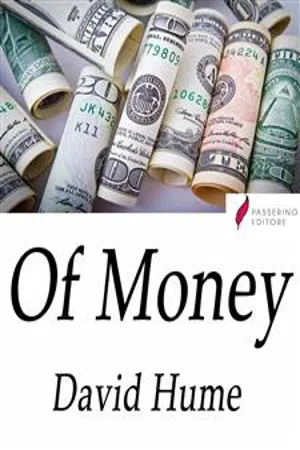
David Hume anticipated modern monetarism. First, Hume contributed to the quantity theory and interest rate theory. Hume has been credited with being the first to prove that, on an abstract level, there is no quantifiable amount of nominal money a country needs to thrive. He understood that there was a difference between nominal money and real money. Second, Hume has a theory of causation which fits in with the Chicago school "black box" approach. According to Hume, cause and effect are related only through correlation. Hume shared the belief with modern monetarists that changes in the money supply can affect consumption and investments. Lastly, Hume was a vocal advocate of the stability of the private sector. However, Hume also had some non-monetarist aspects to his economic philosophy. For example, he had a stated preference for rising prices and thought of government debt as a sort of substitute for actual money. He called government debt "a kind of paper credit." He also believed in heavy taxation because he thought it increases effort. As can be seen, Hume's economic approach resembles his other philosophies in that he does not choose one side indefinitely, but sees gray in the situation. David Hume (1711 - 1776) was a Scottish Enlightenment philosopher, historian, economist, and essayist, who is best known today for his highly influential system of philosophical empiricism, scepticism, and naturalism. Hume's empiricist approach to philosophy places him with John Locke, George Berkeley, Francis Bacon and Thomas Hobbes as a British Empiricist. Beginning with his A Treatise of Human Nature (1739–40), Hume strove to create a total naturalistic science of man that examined the psychological basis of human nature. Against philosophical rationalists, Hume held that passion rather than reason governs human behaviour. Hume argued against the existence of innate ideas, positing that all human knowledge is founded solely in experience.
eBook - ePub
Of money
About this book
Information
Topic
PhilosophySubtopic
Philosophy History & TheoryOf Money
Money is not, properly speaking, one of the subjects of commerce; but only the instrument which men have agreed upon to facilitate the exchange of one commodity for another. It is none of the wheels of trade: It is the oil which renders the motion of the wheels more smooth and easy. If we consider any one kingdom by itself, it is evident, that the greater or less plenty of money is of no consequence; since the prices of commodities are always proportioned to the plenty of money, and a crown in Harry VII.'s time served the same purpose as a pound does at present. It is only the public which draws any advantage from the greater plenty of money; and that only in its wars and negociations with foreign states. And this is the reason, why all rich and trading countries from Carthage to Great Britain and Holland, have employed mercenary troops, which they hired from their poorer neighbours. Were they to make use of their native subjects, they would find less advantage from their superior riches, and from their great plenty of gold and silver; since the pay of all their servants must rise in proportion to the public opulence. Our small army of 20,000 men is maintained at as great expence as a French army twice as numerous. The English fleet, during the late war, required as much money to support it as all the Roman legions, which kept the whole world in subjection, during the time of the emperors . The greater number of people and their greater industry are serviceable in all cases; at home and abroad, in private, and in public. But the greater plenty of money, is very limited in its use, and may even sometimes be a loss to a nation in its commerce with foreigners. There seems to be a happy concurrence of causes in human affairs, which checks the growth of trade and riches, and hinders them from being confined entirely to one people; as might naturally at first be dreaded from the advantages of an established commerce. Where one nation has gotten the start of another in trade, it is very difficult for the latter to regain the ground it has lost; because of the superior industry and skill of the former, and the greater stocks, of which its merchants are possessed, and which enable them to trade on so much smaller profits. But these advantages are compensated, in some measure, by the low price of labour in every nation which has not an extensive commerce, and does not much abound in gold and silver. Manufactures, therefore , gradually shift th...
Table of contents
- Cover
- Of Money
- Table of contents
- Of Money
Trusted by 375,005 students
Access to over 1.5 million titles for a fair monthly price.
Study more efficiently using our study tools.
Frequently asked questions
Yes, you can cancel anytime from the Subscription tab in your account settings on the Perlego website. Your subscription will stay active until the end of your current billing period. Learn how to cancel your subscription
No, books cannot be downloaded as external files, such as PDFs, for use outside of Perlego. However, you can download books within the Perlego app for offline reading on mobile or tablet. Learn how to download books offline
Perlego offers two plans: Essential and Complete
- Essential is ideal for learners and professionals who enjoy exploring a wide range of subjects. Access the Essential Library with 800,000+ trusted titles and best-sellers across business, personal growth, and the humanities. Includes unlimited reading time and Standard Read Aloud voice.
- Complete: Perfect for advanced learners and researchers needing full, unrestricted access. Unlock 1.5M+ books across hundreds of subjects, including academic and specialized titles. The Complete Plan also includes advanced features like Premium Read Aloud and Research Assistant.
We are an online textbook subscription service, where you can get access to an entire online library for less than the price of a single book per month. With over 1.5 million books across 990+ topics, we’ve got you covered! Learn about our mission
Look out for the read-aloud symbol on your next book to see if you can listen to it. The read-aloud tool reads text aloud for you, highlighting the text as it is being read. You can pause it, speed it up and slow it down. Learn more about Read Aloud
Yes! You can use the Perlego app on both iOS and Android devices to read anytime, anywhere — even offline. Perfect for commutes or when you’re on the go.
Please note we cannot support devices running on iOS 13 and Android 7 or earlier. Learn more about using the app
Please note we cannot support devices running on iOS 13 and Android 7 or earlier. Learn more about using the app
Yes, you can access Of money by David Hume in PDF and/or ePUB format, as well as other popular books in Philosophy & Philosophy History & Theory. We have over 1.5 million books available in our catalogue for you to explore.