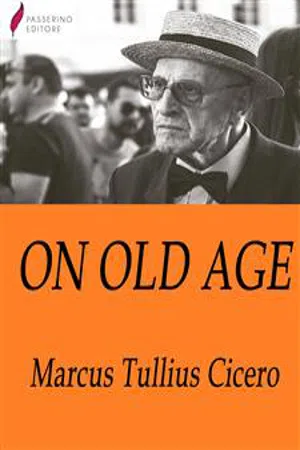
Cato Maior de Senectute (Cato the Elder on Old Age) is an essay written by Cicero in 44 BC on the subject of aging and death. The Latin title of the piece is Cato Maior de Senectute. To lend his reflections greater import, Cicero wrote his essay such that the esteemed Cato the Elder was lecturing to Scipio Africanus and Gaius Laelius Sapiens. Marcus Tullius Cicero (3 January 106 BC – 7 December 43 BC) was a Roman statesman, orator, lawyer and philosopher, who served as consul in the year 63 BC. He came from a wealthy municipal family of the Roman equestrian order, and is considered one of Rome's greatest orators and prose stylists. Translator: E. S. Shuckburgh
eBook - ePub
On old age
About this book
Information
Topic
PhilosophySubtopic
Philosophy History & TheoryOn old age
1. And should my service, Titus, ease the weight
Of care that wrings your heart, and draw the sting
Which rankles there, what guerdon shall there he?
FOR I may address you, Atticus, in the lines in which Flamininus was addressed by the man, who, poor in wealth, was rich in honour's gold, though I am well assured that you are not, as Flamininus was, kept on the rack of care by night and day.
For I know how well ordered and equable your mind is, and am fully aware that it was not a surname alone which you brought home with you from Athens, but its culture and good sense. And yet I have an idea that you are at times stirred to the heart by the same circumstances as myself. To console you for these is a more serious matter, and must be put off to another time. For the present I have resolved to dedicate to you an essay on Old Age. For from the burden of impending or at least advancing age, common to us both, I would do something to relieve us both though as to yourself I am fully aware that you support and will support it, as you do everything else, with calmness and philosophy. But directly I resolved to write on old age, you at once occurred to me as deserving a gift of which both of us might take advantage. To myself, indeed, the composition of this book has been so delightful, that it has not only wiped away all the disagreeables of old age, but has even made it luxurious and delightful too. Never, therefore, can philosophy be praised as highly as it deserves considering that its faithful disciple is able to spend every period of his life with unruffled feelings. However, on other subjects I have spoken at large, and shall often speak again: this book which I herewith send you is on Old Age. I have put the whole discourse not, as Alisto of Cos did, in the mouth of Tithonus—for a mere fable would have lacked conviction—but in that of Marcus Cato when he was an old man, to give my essay greater weight. I represent Laelius and Scipio at his house expressing surprise at his carrying his years so lightly, and Cato answering them. If he shall seem to shew somewhat more learning in this discourse than he generally did in his own books, put it down to the Greek literature of which it is known that he became an eager student in his old age. But what need of more? Cato's own words will at once explain all I feel about old age.
M. Cato. Publius Cornelius Scipio Africanus (the younger). Gaius Laelius.
2. Scipio. Many a time have I in conversation with my friend Gaius Laelius here expressed my admiration, Marcus Cato, of the eminent, nay perfect, wisdom displayed by you indeed at all points, but above everything because I have noticed that old age never seemed a burden to you, while to most old men it is so hateful that they declare themselves under a weight heavier than Aetna.
Cato. Your admiration is easily excited, it seems, my dear Scipio and Laelius. Men, of course, who have no resources in themselves for securing a good and happy life find every age burdensome. But those who look for all happiness from within can never think anything bad which nature makes inevitable. In that category before anything else comes old age, to which all wish to attain, and at which all grumble when attained. Such is Folly's inconsistency and unreasonableness! They say that it is stealing upon them faster than they expected. In the first place, who compelled them to hug an illusion? For in what respect did old age steal upon manhood faster than manhood upon childhood? In the next place, in what way would old age have been less disagreeable to them if they were in their eight-hundredth year than in their eightieth? For their past, however long, when once it was past, would have no consolation for a stupid old age. Wherefore, if it is your wont to admire my wisdom—and I would that it were worthy of your good opinion and of my own surname of Sapiens—it really consists in the fact that I follow Nature, the best of guides, as I would a god, and am loyal to her commands. It is not likely, if she has written the rest of the play well, that she has been careless about the last act like some idle poet. But after all some "last" was inevitable, just as to the berries of a tree and the fruits of the earth there comes in the fulness of time a period of decay and fall. A wise man will not make a grievance of this. To rebel against nature—is not that to fight like the giants with the gods?
Laelius. And yet, Cato, you will do us a very great favour (I venture to speak for Scipio as for myself) if—since we all hope, or at least wish, to become old men—you would allow us to learn from you in good time before it arrives, by what methods we may most easily acquire the strength to support the burden of advancing age.
Cato. I will do so without doubt, Laelius, especially if, as you say, it will be agreeable to you both.
Laelius We do wish very much, Cato, if it is no trouble to you, to be allowed to see the nature of the bourne which you have reached after completing a long journey, as it were, upon which we too are bound to embark.
3. Cato. I will do the best I can, Laelius. It has often been my fortune to bear the complaints of my contemporaries—like will to like, you know, according to the old proverb—complaints to which men like C. Salinator and Sp. Albinus, who were of consular rank and about my time, used to give vent. They were, first, that they had lost the pleasures of the senses, without which they did not regard life as life at all; and, secondly, that they were neglected by those from whom they had been used to receive attentions. Such men appear to me to lay the blame on the wrong thing. For if it had been the fault of old age, then these same misfortunes would have befallen me and all other men of advanced years. But I have known many of them who never said a word of complaint against old age; for they were only too glad to be freed from the bondage of passion, and were not at all looked down upon by their friends. The fact is that the blame for all complaints of that kind is to be charged to character, not to a particular time of life. For old men who are reasonable and neither cross-grained nor churlish find old age tolerable enough: whereas unreason and churlishness cause uneasiness at every time of life.
Laelius It is as you say, Cato. But perhaps some one may suggest that it is your large means, wealth, and high position that make you think old age tolerable: whereas such good fortune only falls to few.
Cato. There is something in that, Laelius, but by no means all. For instance, the story is told of the answer of Themistocles in a wrangle with a certain Seriphian, who asserted that he owed his brilliant position to the reputation of his country, not to his own. "If I had been a Seriphian," said he, "even I should never have been famous, nor would you if you had been an Athenian." Something like this may be said of old age. For the philosopher himself could not find old age easy to bear in the depths of poverty, nor the fool feel it anything but a burden though he were a millionaire. You may be sure, my dear Scipio and Laelius, that the arms best adapted to old age are culture and the active exercise of the virtues. For if they have been maintained at every period—if one has lived much as well as long—the harvest they produce is wonderful, not o...
Table of contents
- Cover
- On old age
- Table of contents
- On old age
Trusted by 375,005 students
Access to over 1.5 million titles for a fair monthly price.
Study more efficiently using our study tools.
Frequently asked questions
Yes, you can cancel anytime from the Subscription tab in your account settings on the Perlego website. Your subscription will stay active until the end of your current billing period. Learn how to cancel your subscription
No, books cannot be downloaded as external files, such as PDFs, for use outside of Perlego. However, you can download books within the Perlego app for offline reading on mobile or tablet. Learn how to download books offline
Perlego offers two plans: Essential and Complete
- Essential is ideal for learners and professionals who enjoy exploring a wide range of subjects. Access the Essential Library with 800,000+ trusted titles and best-sellers across business, personal growth, and the humanities. Includes unlimited reading time and Standard Read Aloud voice.
- Complete: Perfect for advanced learners and researchers needing full, unrestricted access. Unlock 1.5M+ books across hundreds of subjects, including academic and specialized titles. The Complete Plan also includes advanced features like Premium Read Aloud and Research Assistant.
We are an online textbook subscription service, where you can get access to an entire online library for less than the price of a single book per month. With over 1.5 million books across 990+ topics, we’ve got you covered! Learn about our mission
Look out for the read-aloud symbol on your next book to see if you can listen to it. The read-aloud tool reads text aloud for you, highlighting the text as it is being read. You can pause it, speed it up and slow it down. Learn more about Read Aloud
Yes! You can use the Perlego app on both iOS and Android devices to read anytime, anywhere — even offline. Perfect for commutes or when you’re on the go.
Please note we cannot support devices running on iOS 13 and Android 7 or earlier. Learn more about using the app
Please note we cannot support devices running on iOS 13 and Android 7 or earlier. Learn more about using the app
Yes, you can access On old age by Marcus Tullius Cicero in PDF and/or ePUB format, as well as other popular books in Philosophy & Philosophy History & Theory. We have over 1.5 million books available in our catalogue for you to explore.