Fascism is a form of far-right, totalitarian ultranationalism characterized by dictatorial power, forcible suppression of opposition, and strong regimentation of society and of the economy which came to prominence in early 20th-century Europe.
The first fascist movements emerged in Italy during World War I, before spreading to other European countries.
Opposed to liberalism, Marxism, and anarchism, fascism is placed on the far-right within the traditional left–right spectrum. Giovanni Gentile (30 May 1875 – 15 April 1944) was an Italian neo-Hegelian idealist philosopher, educator, and fascist politician.
The self-styled "philosopher of Fascism", he was influential in providing an intellectual foundation for Italian Fascism, and ghostwrote part of The Doctrine of Fascism (1932) with Benito Mussolini. He was involved in the resurgence of Hegelian idealism in Italian philosophy and also devised his own system of thought, which he called "actual idealism" or "actualism", and which has been described as "the subjective extreme of the idealist tradition".
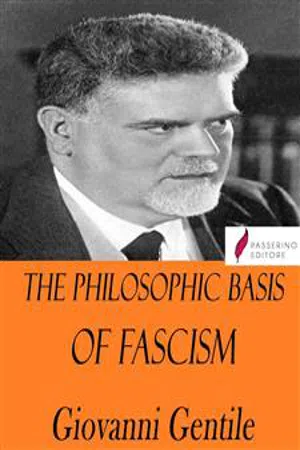
- English
- ePUB (mobile friendly)
- Available on iOS & Android
eBook - ePub
The Philosophic Basis of Fascism
About this book
Information
Topic
PhilosophySubtopic
Philosophy History & TheoryThe Philosophic Basis of Fascism
For the Italian nation the World War was the solution of a deep spiritual crisis. They willed and fought it long before they felt and evaluated it. But they willed, fought, felt and evaluated it in a certain spirit which Italy's generals and statesmen exploited, but which also worked on them, conditioning their policies and their action. The spirit in question was not altogether clear and self-consistent. That it lacked unanimity was particularly apparent just before and again just after the war when feelings were not subject to war discipline. It was as though the Italian character were crossed by two different currents which divided it into two irreconcilable sections. One need think only of the days of Italian neutrality and of the debates that raged between Interventionists and Neutralists. The ease with which the most inconsistent ideas were pressed into service by both parties showed that the issue was not between two opposing political opinions, two conflicting concepts of history, but actually between two different temperaments, two different souls.
For one kind of person the important point was to fight the war, either on the side of Germany or against Germany: but in either event to fight the war, without regard to specific advantages—to fight the war in order that at last the Italian nation, created rather by favoring conditions than by the will of its people to be a nation, might receive its test in blood, such a test as only war can bring by uniting all citizens in a single thought, a single passion, a single hope, emphasizing to each individual that all have something in common, something transcending private interests.
This was the very thing that frightened the other kind of person, the prudent man, the realist, who had a clear view of the mortal risks a young, inexperienced, badly prepared nation would be running in such a war, and who also saw—a most significant point—that, all things considered, a bargaining neutrality would surely win the country tangible rewards, as great as victorious participation itself.
The point at issue was just that: the Italian Neutralists stood for material advantages, advantages tangible, ponderable, palpable; the Interventionists stood for moral advantages, intangible, impalpable, imponderable—imponderable at least on the scales used by their antagonists. On the eve of the war these two Italian characters stood facing each other, scowling and irreconcilable—the one on the aggressive, asserting itself ever more forcefully through the various organs of public opinion; the other on the defensive, offering resistance through the Parliament which in those days still seemed to be the basic repository of State sovereignty. Civil conflict seemed inevitable in Italy, and civil war was in fact averted only because the King took advantage of one of his prerogatives and declared war against the Central Powers.
This act of the King was the first decisive step toward the solution of the crisis.
II
The crisis had ancient origins. Its roots sank deep into the inner spirit of the Italian people.
What were the creative forces of the Risorgimento? The "Italian people," to which some historians are now tending to attribute an important if not a decisive role in our struggle for national unity and independence, was hardly on the scene at all. The active agency was always an idea become a person—it was one or several determined wills which were fixed on determined goals. There can be no question that the birth of modern Italy was the work of the few. And it could not be otherwise. It is always the few who represent t...
Table of contents
- Cover
- The Philosophic Basis of Fascism
- Table of contents
- The Philosophic Basis of Fascism
Trusted by 375,005 students
Access to over 1.5 million titles for a fair monthly price.
Study more efficiently using our study tools.
Frequently asked questions
Yes, you can cancel anytime from the Subscription tab in your account settings on the Perlego website. Your subscription will stay active until the end of your current billing period. Learn how to cancel your subscription
No, books cannot be downloaded as external files, such as PDFs, for use outside of Perlego. However, you can download books within the Perlego app for offline reading on mobile or tablet. Learn how to download books offline
Perlego offers two plans: Essential and Complete
- Essential is ideal for learners and professionals who enjoy exploring a wide range of subjects. Access the Essential Library with 800,000+ trusted titles and best-sellers across business, personal growth, and the humanities. Includes unlimited reading time and Standard Read Aloud voice.
- Complete: Perfect for advanced learners and researchers needing full, unrestricted access. Unlock 1.5M+ books across hundreds of subjects, including academic and specialized titles. The Complete Plan also includes advanced features like Premium Read Aloud and Research Assistant.
We are an online textbook subscription service, where you can get access to an entire online library for less than the price of a single book per month. With over 1.5 million books across 990+ topics, we’ve got you covered! Learn about our mission
Look out for the read-aloud symbol on your next book to see if you can listen to it. The read-aloud tool reads text aloud for you, highlighting the text as it is being read. You can pause it, speed it up and slow it down. Learn more about Read Aloud
Yes! You can use the Perlego app on both iOS and Android devices to read anytime, anywhere — even offline. Perfect for commutes or when you’re on the go.
Please note we cannot support devices running on iOS 13 and Android 7 or earlier. Learn more about using the app
Please note we cannot support devices running on iOS 13 and Android 7 or earlier. Learn more about using the app
Yes, you can access The Philosophic Basis of Fascism by Giovanni Gentile in PDF and/or ePUB format, as well as other popular books in Philosophy & Philosophy History & Theory. We have over 1.5 million books available in our catalogue for you to explore.