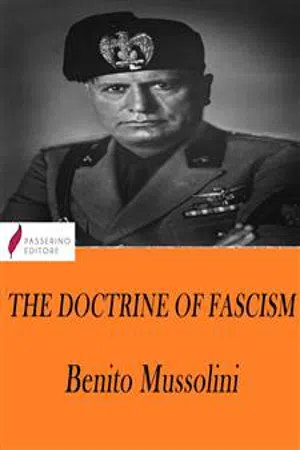
The Doctrine of Fascism (Italian: "La dottrina del fascismo") is an essay attributed to Benito Mussolini. In truth, the first part of the essay, entitled "Idee Fondamentali" (Italian for "Fundamental Ideas") was written by philosopher Giovanni Gentile, while only the second part ("Dottrina politica e sociale") is the work of Mussolini himself. Benito Amilcare Andrea Mussolini (29 July 1883 – 28 April 1945) was an Italian politician and journalist who was the leader of the National Fascist Party. He ruled Italy as the prime minister from 1922 to 1943; he constitutionally led the country until 1925, when he dropped the pretense of democracy and established a dictatorship. Mussolini inspired several totalitarian rulers, such as Adolf Hitler.
- English
- ePUB (mobile friendly)
- Available on iOS & Android
eBook - ePub
The Doctrine of Fascism
About this book
Information
THE DOCTRINE OF FASCISM
FUNDAMENTAL IDEAS.
1. Philosophic Conception.
Like every concrete political conception, Fascism is thought and action. It is action with an inherent doctrine which, arising out of a given system of historic forces, is inserted in it and works on it from within. It has therefore a form co-related to the contingencies of time and place; but it has at the same time an ideal content which elevates it into a formula of truth in the higher region of the history of thought.
There is no way of exercising a spiritual influence on the things of the world by means of a human will-power commanding the wills of others, without first having a clear conception of the particular and transient reality on which the will-power must act, and without also having a clear conception of the universal and permanent reality in which the particular and transient reality has its life and being. To know men we must have a knowledge of man; and to have a knowledge of man we must know the reality of things and their laws.
There can be no conception of a State which is not fundamentally a conception of Life. It is a philosophy or intuition, a system of ideas which evolves itself into a system of logical contraction, or which concentrates itself in a vision or in a faith, but which is always, at least virtually, an organic conception of the world.
2. Spiritualised Conception.
Fascism would therefore not be understood in many of its manifestations (as, for example, in its organisations of the Party, its system of education, its discipline) were it not considered in the light of its general view of life. A spiritualised view.
To Fascism the world is not this material world which appears on the surface, in which man is an individual separated from all other men, standing by himself and subject to a natural law which instinctively impels him to lead a life of momentary and egoistic pleasure. In Fascism man is an individual who is the nation and the country. He is this by a moral law which embraces and binds together individuals and generations in an established tradition and mission, a moral law which suppresses the instinct to lead a life confined to a brief cycle of pleasure in order, instead, to replace it within the orbit of duty in a superior conception of life, free from the limits of time and space a life in which the individual by self-abnegation and by the sacrifice of his particular interests, even by death, realises the entirely spiritual existence in which his value as a man consists.
3. Positive Conception of Life as a Struggle.
It is therefore a spiritual conception, itself also a result of the general reaction of the Century against the languid and materialistic positivism of the Eighteenth Century. Anti-positivist, but positive: neither sceptical nor agnostic, neither pessimistic nor passively optimistic, as are in general the doctrines (all of them negative) which place the centre of life outside of man, who by his free will can and should create his own world for himself.
Fascism wants a man to be active and to be absorbed in action with all his energies; it wants him to have a manly consciousness of the difficulties that exist and to be ready to face them. It conceives life as a struggle, thinking that it is the duty of man to conquer that life which is really worthy of him: creating in the first place within himself the (physical, moral, intellectual) instrument with which to build it.
As for the individual, so for the nation, so for mankind. Hence the high value of culture in all its forms (art, religion, science) and the supreme importance of education. Hence also the essential value of labour, with which man conquers nature and creates the human world (economic, political, moral, intellectual).
4. Ethical Conception.
This positive conception of life is evidently an ethical conception. And it comprises the whole reality as well as the human activity which domineers it. No action is to be removed from the moral sense; nothing is to be in the world that is divested of the importance which belongs to it in respect of moral aims. Life, therefore, as the Fascist conceives it, is serious, austere, religious; entirely balanced in...
Table of contents
- Cover
- The Doctrine of Fascism
- Table of contents
- THE DOCTRINE OF FASCISM
Trusted by 375,005 students
Access to over 1.5 million titles for a fair monthly price.
Study more efficiently using our study tools.
Frequently asked questions
Yes, you can cancel anytime from the Subscription tab in your account settings on the Perlego website. Your subscription will stay active until the end of your current billing period. Learn how to cancel your subscription
No, books cannot be downloaded as external files, such as PDFs, for use outside of Perlego. However, you can download books within the Perlego app for offline reading on mobile or tablet. Learn how to download books offline
Perlego offers two plans: Essential and Complete
- Essential is ideal for learners and professionals who enjoy exploring a wide range of subjects. Access the Essential Library with 800,000+ trusted titles and best-sellers across business, personal growth, and the humanities. Includes unlimited reading time and Standard Read Aloud voice.
- Complete: Perfect for advanced learners and researchers needing full, unrestricted access. Unlock 1.5M+ books across hundreds of subjects, including academic and specialized titles. The Complete Plan also includes advanced features like Premium Read Aloud and Research Assistant.
We are an online textbook subscription service, where you can get access to an entire online library for less than the price of a single book per month. With over 1.5 million books across 990+ topics, we’ve got you covered! Learn about our mission
Look out for the read-aloud symbol on your next book to see if you can listen to it. The read-aloud tool reads text aloud for you, highlighting the text as it is being read. You can pause it, speed it up and slow it down. Learn more about Read Aloud
Yes! You can use the Perlego app on both iOS and Android devices to read anytime, anywhere — even offline. Perfect for commutes or when you’re on the go.
Please note we cannot support devices running on iOS 13 and Android 7 or earlier. Learn more about using the app
Please note we cannot support devices running on iOS 13 and Android 7 or earlier. Learn more about using the app
Yes, you can access The Doctrine of Fascism by Benito Mussolini in PDF and/or ePUB format, as well as other popular books in Politics & International Relations & Fascism & Totalitarianism. We have over 1.5 million books available in our catalogue for you to explore.