Alphonsus Liguori (1696–1787), sometimes called Alphonsus Maria Liguori or Saint Alphonsus Liguori, was an Italian Catholic bishop, spiritual writer, composer, musician, artist, poet, lawyer, scholastic philosopher, and theologian.
He founded the Congregation of the Most Holy Redeemer, known as the Redemptorists, in November 1732. In 1762 he was appointed Bishop of Sant'Agata dei Goti. A prolific writer, he published nine editions of his Moral Theology in his lifetime, in addition to other devotional and ascetic works and letters. Among his best known works are The Glories of Mary and The Way of the Cross, the latter still used in parishes during Lenten devotions.
He was canonized in 1839 by Pope Gregory XVI and proclaimed a Doctor of the Church by Pope Pius IX in 1871. One of the most widely read Catholic authors, he is the patron saint of confessors.
Harold Castle (1868–1908), english Redemptorist.
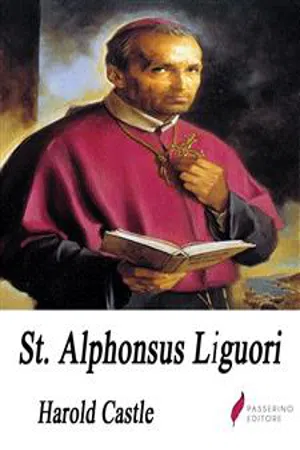
- English
- ePUB (mobile friendly)
- Available on iOS & Android
eBook - ePub
St. Alphonsus Liguori
About this book
St. Alphonsus Liguori
Born at Marianella, near Naples, 27 September, 1696; died at Nocera de' Pagani, 1 August, 1787. The eighteenth century was not an age remarkable for depth of spiritual life, yet it produced three of the greatest missionaries of the Church, St. Leonard of Port Maurice, St. Paul of the Cross, and St. Alphonsus Liguori. Alphonsus Mary Antony John Cosmas Damian Michael Gaspard de' Liguori was born in his father's country house at Marianella near Naples, on Tuesday, 27 September, 1696. He was baptized two days later in the church of Our Lady of the Virgins, in Naples. The family was an old and noble one, though the branch to which the Saint belonged had become somewhat impoverished. Alphonsus's father, Don Joseph de' Liguori was a naval officer and Captain of the Royal Galleys. The Saint's mother was of Spanish descent, and if, as there can be little doubt, race is an element in individual character, we may see in Alphonsus's Spanish blood some explanation of the enormous tenacity of purpose which distinguished him from his earliest years. "I know his obstinacy", his father said of him as a young man; "when he once makes up his mind he is inflexible". Not many details have come down to us of Alphonsus's childhood. He was the eldest of seven children and the hope of his house. The boy was bright and quick beyond his years, and made great progress in all kinds of learning. In addition his father made him practice the harpsichord for three hours a day, and at the age of thirteen he played with the perfection of a master. Riding and fencing were his recreations, and an evening game of cards; he tells us that he was debarred from being a good shot by his bad sight. In early manhood he became very fond of the opera, but only that he might listen to the music, for when the curtain went up he took his glasses off, so as not to see the players distinctly. The Neapolitan stage at this time was in a good state, but the Saint had from his earliest years an ascetic repugnance to theatres, a repugnance which he never lost. The childish fault for which he most reproached himself in after-life was resisting his father too strongly when he was told to take part in a drawing-room play. Alphonsus was not sent to school but was educated by tutors under his father's eye. At the age of sixteen, on 21 January, 1713, he took his degree as Doctor of Laws, although twenty was the age fixed by the statutes. He said himself that he was so small at the time as to be almost buried in his doctor's gown and that all the spectators laughed. Soon after this the boy began his studies for the Bar, and about the age of nineteen practised his profession in the courts. In the eight years of his career as advocate, years crowded with work, he is said never to have lost a case. Even if there be some exaggeration in this, for it is not in an advocate's power always to be on the winning side, the tradition shows that he was extraordinarily able and successful. In fact, despite his youth, he seems at the age of twenty-seven to have been one of the leaders of the Neapolitan Bar.
Alphonsus, like so many saints, had an excellent father and a saintly mother. Don Joseph de' Liguori had his faults. He was somewhat worldly and ambitious, at any rate for his son, and was rough tempered when opposed. But he was a man of genuine faith and piety and stainless life, and he meant his son to be the same. Even when taking him into society in order to arrange a good marriage for him, he wished Alphonsus to put God first, and every year father and son would make a retreat together in some religious house. Alphonsus, assisted by divine grace, did not disappoint his father's care. A pure and modest boyhood passed into a manhood without reproach. A companion, Balthasar Cito, who afterwards became a distinguished judge, was asked in later years if Alphonsus had ever shown signs of levity in his youth. He answered emphatically: "Never! It would be a sacrilege to say otherwise." The Saint's confessor declared that he preserved his baptismal innocence till death. Still there was a time of danger.
There can be little doubt but that the young Alphonsus with his high spirits and strong character was ardently attached to his profession, and on the way to be spoilt by the success and popularity which it brought. About the year 1722, when he was twenty-six years old, he began to go constantly into society, to neglect prayer and the practices of piety which had been an integral part of his life, and to take pleasure in the attention with which he was everywhere received.
"Banquets, entertainments, theatres," he wrote later on—"these are the pleasures of the world, but pleasures which are filled with the bitterness of gall and sharp thorn...
Table of contents
- Cover
- St. Alphonsus Liguori
- Table of contents
- St. Alphonsus Liguori
Trusted by 375,005 students
Access to over 1.5 million titles for a fair monthly price.
Study more efficiently using our study tools.