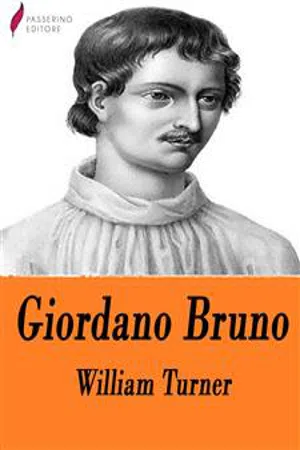
Giordano Bruno (born Filippo Bruno, 1548 – 17 February 1600) was an Italian Dominican friar, philosopher, mathematician, poet, cosmological theorist, and Hermetic occultist. He is known for his cosmological theories, which conceptually extended the then-novel Copernican model. He proposed that the stars were distant suns surrounded by their own planets, and he raised the possibility that these planets might foster life of their own, a philosophical position known as cosmic pluralism. He also insisted that the universe is infinite and could have no "centre". Starting in 1593, Bruno was tried for heresy by the Roman Inquisition on charges of denial of several core Catholic doctrines, including eternal damnation, the Trinity, the divinity of Christ, the virginity of Mary, and transubstantiation. Bruno's pantheism was also a matter of grave concern, as was his teaching of the transmigration of the soul/reincarnation. The Inquisition found him guilty, and he was burned at the stake in Rome's Campo de' Fiori in 1600. After his death, he gained considerable fame, being particularly celebrated by 19th- and early 20th-century commentators who regarded him as a martyr for science, although historians agree that his heresy trial was not a response to his astronomical views but rather a response to his philosophical and religious views.
Bruno's case is still considered a landmark in the history of free thought and the emerging sciences. William Turner, American Catholic bishop
eBook - ePub
Giordano Bruno
About this book
Giordano Bruno
Italian philosopher, b. at Nola in Campania, in the Kingdom of Naples, in 1548; d. at Rome, 1600. At the age of eleven he went to Naples, to study "humanity, logic, and dialectic", and, four years later, he entered the Order of St. Dominic, giving up his worldly name of Filippo and taking that of Giordano. He made his novitiate at Naples and continued to study there. In 1572 he was ordained a priest.
It seems, however, that, even as a novice, he attracted attention by the originality of his views and by his outspoken criticism of accepted theological doctrines. After his ordination things reached such a pass that, in 1576, formal accusation of heresy was brought against him. Thereupon he went to Rome, but, apparently, did not mend his manner of speaking of the mysteries of faith; for the accusations were renewed against him at the convent of the Minerva. Within a few months of his arrival he fled the city and cast off all ...
Table of contents
- Cover
- Giordano Bruno
- Table of contents
- Giordano Bruno
Trusted by 375,005 students
Access to over 1.5 million titles for a fair monthly price.
Study more efficiently using our study tools.