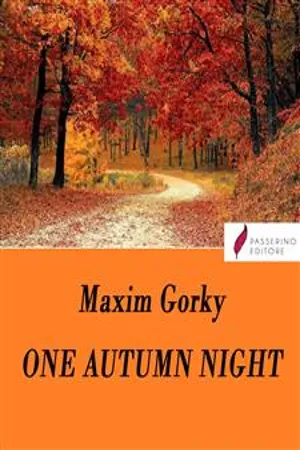
Alexei Maximovich Peshkov (1868 – 1936), primarily known as Maxim Gorky was a Russian and Soviet writer, a founder of the socialist realism literary method, and a political activist. He was also a five-time nominee for the Nobel Prize in Literature. Prior to his renown as an author, he frequently changed jobs and roamed across the Russian Empire; these experiences would later influence his writing. Gorky's most famous works were The Lower Depths (1902), Twenty-six Men and a Girl (1899), The Song of the Stormy Petrel (1901), My Childhood (1913–1914), Mother (1906), Summerfolk (1904) and Children of the Sun (1905). He had associations with fellow Russian writers Leo Tolstoy and Anton Chekhov; Gorky would later mention them in his memoirs.
Gorky was active in the emerging Marxist communist movement. He publicly opposed the Tsarist regime, and for a time closely associated himself with Vladimir Lenin and Alexander Bogdanov's Bolshevik wing of the party. For a significant part of his life, he was exiled from Russia and later the Soviet Union. In 1932, he returned to the USSR on Joseph Stalin's personal invitation and lived there until his death in June 1936. Translated by Thomas Seltzer.
eBook - ePub
One autumn night
About this book
Information
Subtopic
Literature GeneralIndex
LiteratureTable of contents
- Cover
- One Autumn Night
- Table of contents
Trusted by 375,005 students
Access to over 1.5 million titles for a fair monthly price.
Study more efficiently using our study tools.
Frequently asked questions
Yes, you can cancel anytime from the Subscription tab in your account settings on the Perlego website. Your subscription will stay active until the end of your current billing period. Learn how to cancel your subscription
No, books cannot be downloaded as external files, such as PDFs, for use outside of Perlego. However, you can download books within the Perlego app for offline reading on mobile or tablet. Learn how to download books offline
Perlego offers two plans: Essential and Complete
- Essential is ideal for learners and professionals who enjoy exploring a wide range of subjects. Access the Essential Library with 800,000+ trusted titles and best-sellers across business, personal growth, and the humanities. Includes unlimited reading time and Standard Read Aloud voice.
- Complete: Perfect for advanced learners and researchers needing full, unrestricted access. Unlock 1.5M+ books across hundreds of subjects, including academic and specialized titles. The Complete Plan also includes advanced features like Premium Read Aloud and Research Assistant.
We are an online textbook subscription service, where you can get access to an entire online library for less than the price of a single book per month. With over 1.5 million books across 990+ topics, we’ve got you covered! Learn about our mission
Look out for the read-aloud symbol on your next book to see if you can listen to it. The read-aloud tool reads text aloud for you, highlighting the text as it is being read. You can pause it, speed it up and slow it down. Learn more about Read Aloud
Yes! You can use the Perlego app on both iOS and Android devices to read anytime, anywhere — even offline. Perfect for commutes or when you’re on the go.
Please note we cannot support devices running on iOS 13 and Android 7 or earlier. Learn more about using the app
Please note we cannot support devices running on iOS 13 and Android 7 or earlier. Learn more about using the app
Yes, you can access One autumn night by Maxim Gorky in PDF and/or ePUB format, as well as other popular books in Literature & Literature General. We have over 1.5 million books available in our catalogue for you to explore.