Green buildings have become common in India and other countries in Asia. However, there is a concern regarding the performance of green buildings failing to meet the expectations of clients during the operation. One of the key reasons for this is poorly commissioned HVAC systems. In this publication we provide tools and knowhow for more efficient HVAC commissioning. It gives answers for four major questions: why commissioning is needed, how to perform proper commissioning, which key performance issues of common HVAC equipment need to be considered, and what kind of checklists are used during commissioning? It covers the entire commissioning process beginning with the owner's project requirements and commissioning design reviews. Then, it explains procedures during installation and start-up of equipment followed by the functional performance testing, seasonal commissioning and 10 months' operation review. This publication is developed by Indian Society of Heating, Refrigeration and Air Conditioning Engineers ISHRAE for Indian and Asian requirements in conjunction with the Federation of European HVAC Associations REHVA. The process steps described in this publication are in line with all major international building standards and green building certification schemes.
Note: T&F does not sell or distribute the Hardback in India, Pakistan, Nepal, Bhutan, Bangladesh and Sri Lanka.
Commissioning is the process of assuring that all systems and components of a building are designed, installed, tested, operated, and maintained according to the operational requirements of the developer, owner or end user.
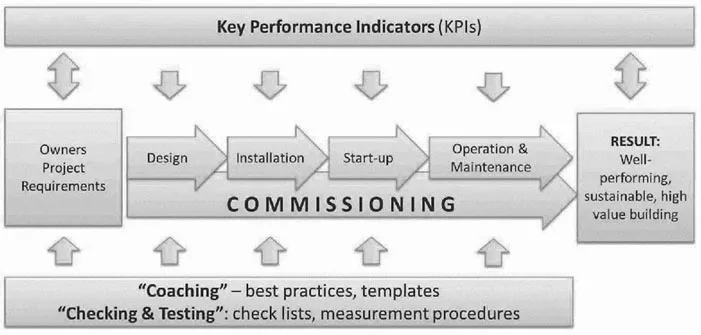
In practice, the commissioning process consists of procedures to check, inspect and test every operational component of the project, both their individual functions and their integration as subsystems and performance as complete system. Commissioning is one of the core activities (Fig.1.2.) to ensure good indoor environment for users, sustainable building operation, increased value of investment and reduced environmental load.
It guarantees proper system performance and renders the desired benefits of an efficient system design. Commissioning is a systematic process of ensuring that all building systems perform interactively according to the design intent and the owner’s operational needs. Initial commissioning is a systematic quality assurance process which through planning, testing and verification, ensures that building meets the Owner’s Project Requirements (OPR) and the owner achieves a successful construction project.
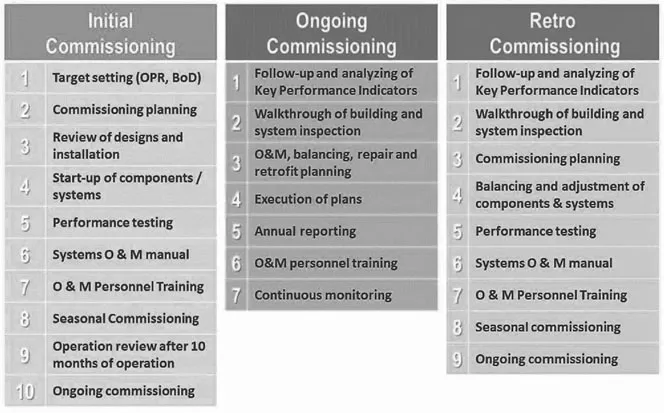
Seasonal commissioning is needed to fine-tune system operation in different seasons and ensure that all operational failures are found and corrected during the first year of operation. Ongoing commissioning helps to continuously monitor operation over a life time and plan corrective actions both for short and long term. (Fig. 1.1.) The economy of operation and user comfort are improved as the building operates in different seasons with optimum operational parameters.
Figure 1.1.
Commissioning starts as initial commissioning during the construction project or as retro-commissioning in an existing building that has not been commissioned before; seasonal commissioning is carried out during the first year of operation and continuous commissioning is carried out annually over a building’s lifetime.
Proper commissioning also contributes to the user’s health. In areas where ambient air quality is poor, properly performing systems keep the unwanted pollution outside the building. As the commissioning process also focuses on training of operation and maintenance (O&M) personnel, it is more likely that systems are operated in such a way that a safe and healthy environment for users is achieved by, e.g. avoiding legionella or mould problems.
The commissioning process ensures that knowledge and resources are available to maintain systems as they were originally intended and reduce the number of problems upon initial occupancy.
Figure 1.2.
Commissioning Process is a support process to assist the main processes to design, construct and operate a building.
The Commissioning Provider conducts quality checks of design, installation and start up procedures and ascertains that proper operation is achieved. It is essential to run the functional performance tests, where the entire building and system operation is evaluated under different conditions, besides ensuring that operation and maintenance personnel are ready to operate the building.
A commissioning process focuses first on system operation and second on the kind of equipment required to achieve the operation. It documents all problems and errors that contradict the OPR and devises their solutions in a structured way. Ideally, commissioning provider should be an independent company that has no affiliation with designers, contractors, manufacturers of equipment or system components or any other person or company which could affect the ability of the Commissioning Provider to generate an independent commissioning report.
Commissioning is not a replacement for the existing quality inspection process during design and construction but it is an addition to these processes. It is also not an additional phase to the existing pre-design, design, construct, occupancy and operation phases; it runs parallel with the core processes. Commissioning is not an isolated testing event of a single equipment, neither is it an adjusting and balancing tool.
Rather, it is the total process focusing on the entire system operation such that all subsystems perform well together and optimum building operation is achieved.
1.2.Who needs commissioning?
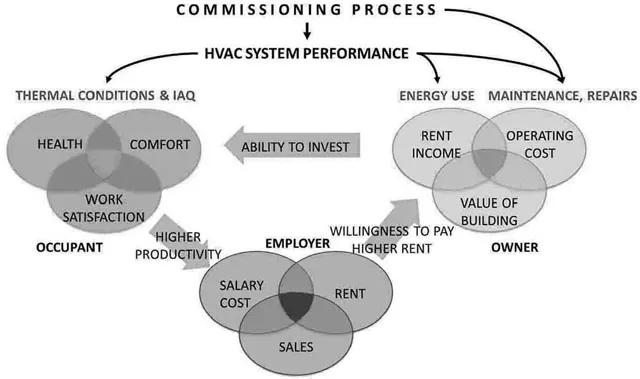
Proper commissioning brings benefits to all stakeholders: users, owners, developers, investors, designers, contractors and manufacturers. It is important to understand and communicate the value addition to all stakeholders. (Fig. 1.3.)
Figure 1.3.
Well performing (commissioned) building is Value for Money to all stakeholders.
The occupants become more productive as thermal comfort and indoor air quality get better. Therefore, a tenant is willing to pay higher rent to the owner. As owners have a positive cash flow via reduced operating costs, increased rent and an increased building value, their ability to invest in proper commissioning and well-performing systems increases and they will be inclined to employ on independent commissioning authority.
Occupants will be more efficient, productive and healthier in buildings that perform properly and where O&M teams are aware of the connection between system operation and occupants’ comfort. Owners and developers get what they have specified in the OPR, whether it is high energy efficiency, good indoor conditions or low operational costs.
Investors also benefit as a well performing building is value for money, either through lower operational costs, higher rent or increased value of the building. Design team (e.g. architect and MEP designers) can satisfy the owner with a well performing building. Efficient commissioning process also ensures less changes and delays during the taking over of systems. A satisfied building owner is more likely to give work in the future. A contractor can deliver and demonstrate that what was promised has been delivered. There is also less hassle and delays during handover and the Defects Liability Period (DLP).
Component manufacturers are constantly developing new and sophisticated products to achieve increasingly demanding system performance targets set by clients. With proper commissioning they can demonstrate the benefits of their products when the project becomes operational.
1.3.‘Mandatory’ commissioning in green buildings and beyond
Commissioning (Cx) activities are not mandatory by building regulation in most of the countries. However applicants of Green Building Certifications like LEED or IGBC Green have to demonstrate certain minimum commissioning activities.
Some Green Building Certification (e.g. LEED and IGB Green) requires fundamental commissioning as a prerequisite to support the design, construction, and eventual operation of the project to meet the Owner’s Project Requirements (OPR) for energy, water, indoor environmental quality and durability.
The owner has to document the requirements as an Owner’s Project Requirements (OPR) document and designers have to develop the Basis of Design (BoD) document. The owner may also nominate the independent Commissioning Provider.
The Commissioning Provider must complete the following commissioning activities for mechanical electrical, plumbing and renewable energy systems and assemblies as follows:
Review OPR and BoDs;
Develop and implement Cx plans, checklists & functional performance test procedures;
Confirm incorporation of Cx requirements into the construction documents;
Verify the system performance.
Document all findings and recommendations and report them directly to the owner & maintain logbook throughout the process. There are numerous commissioning activities that are beneficial in terms of building operation and meeting the owner’s project requirements. Many of these are also required to get additional green building points in certification systems.
For example, LEED Enhanced Commissioning credit requires review of contractor submittals, creation and verification of System O&M manual, inclusion of operator and occupant training, seasonal commissioning and review of system operation after 10 months of operation. Commissioning is required throughout the lifetime of the building. Therefore planning of on-going commissioning process during the initial commissioning process is important.
A building’s thermal envelope also requires commissioning as its enclosure consists of various materials and involves several stakeholders. The Building Enclosure Commissioning (BECx) is utilized to validate that the performance of materials, assemblies, components, systems and design fulfils the owner’s requirements.
2 WHY COMMISSIONING?
2.1.Proper performance ensures healthier and more productive occupants
HVAC and other mechanical systems play a key role in creating a healthy and comfortable work environment. Building commissioning focuses on proper system validation and operation. Therefore, it ensures that thermal conditions, indoor air quality, lighting and acoustic conditions are met as specified in Owner’s Project Requirements. Discomfort increases the stress hormone level and leads to various illnesses. In a comfortable environment, not only are people healthier but also function more effectively.
The World Health Organization (WHO) report titled ‘The Right to Healthy Indoor Air’ (2000) states the following: ‘Indoor air quality is an important determinant of population health and wellbeing. Exposure to the hazardous airborne agents present in many indoor spaces causes adverse health effects such as respiratory diseases, allergy and irritation of the respiratory tract. That is why our responsibility is to provide healthy indoor environment for occupants. [75]
In an office building, the salary paid to the staff is the biggest cost over the building’s lifetime. There is scientific proof that good indoor environmental conditions improve a worker’s health and productivity.
Figure 2.1. Relative performance of workers is depending e.g. the air temperature of the space. [66]
As an example, a reduction of indoor air temperatures by 1 oC can roughly increase the performance of office work by 1% (valid in temperatures ab...
Table of contents
Cover
Half Title
Title Page
Copyright Page
Foreword
Preface
List of Contents
Abbreviations
Terminology
1. Commissioning in Nutshell
2. Why Commissioning?
3. Initial Commissioning
4. Retro-Commissioning
5. Ongoing Commissioning
6. Commissioning Management
7. Typical Pre-Commissioning and Startup Procedures
Appendix A: Commissioning Checklists
References
About Ishrae
About Revha
Trusted by 375,005 students
Access to over 1.5 million titles for a fair monthly price.
Study more efficiently using our study tools.
Frequently asked questions
Yes, you can cancel anytime from the Subscription tab in your account settings on the Perlego website. Your subscription will stay active until the end of your current billing period. Learn how to cancel your subscription
No, books cannot be downloaded as external files, such as PDFs, for use outside of Perlego. However, you can download books within the Perlego app for offline reading on mobile or tablet. Learn how to download books offline
Perlego offers two plans: Essential and Complete
Essential is ideal for learners and professionals who enjoy exploring a wide range of subjects. Access the Essential Library with 800,000+ trusted titles and best-sellers across business, personal growth, and the humanities. Includes unlimited reading time and Standard Read Aloud voice.
Complete: Perfect for advanced learners and researchers needing full, unrestricted access. Unlock 1.5M+ books across hundreds of subjects, including academic and specialized titles. The Complete Plan also includes advanced features like Premium Read Aloud and Research Assistant.
Both plans are available with monthly, semester, or annual billing cycles.
We are an online textbook subscription service, where you can get access to an entire online library for less than the price of a single book per month. With over 1.5 million books across 990+ topics, we’ve got you covered! Learn about our mission
Look out for the read-aloud symbol on your next book to see if you can listen to it. The read-aloud tool reads text aloud for you, highlighting the text as it is being read. You can pause it, speed it up and slow it down. Learn more about Read Aloud
Yes! You can use the Perlego app on both iOS and Android devices to read anytime, anywhere — even offline. Perfect for commutes or when you’re on the go. Please note we cannot support devices running on iOS 13 and Android 7 or earlier. Learn more about using the app
Yes, you can access HVAC Commissioning Guidebook by Maija Virta in PDF and/or ePUB format, as well as other popular books in Technology & Engineering & Construction & Architectural Engineering. We have over 1.5 million books available in our catalogue for you to explore.
![Figure 2.1. Relative performance of workers is depending e.g. the air temperature of the space. [66]](https://book-extracts.perlego.com/2094413/images/fig2_1-plgo-compressed.webp)