The Iban or the Sea Dayaks of Sarawak have probably been the best known of the indigenous peoples of Borneo for well over a century. Much has been written about them, but until the results of Dr Freeman's field research were published by the Government of Sarawak and by Her Majesty's Stationery Office in 1955 there was little information on their methods of agriculture and their social system. The book has become a landmark in the studies of shifting cultivation and of cognatic kinship organization; and the ideas around which it is written have proved over the years to be a continuing and powerful stimulus in the development of kinship theory. The field work on which the account is based was undertaken from 1949 to 1951. Although fundamental changes have taken place in the life of the Iban since the book was first published, it has been decided to republish it substantially unaltered.
- 292 pages
- English
- ePUB (mobile friendly)
- Available on iOS & Android
eBook - ePub
About this book
Information
1
Iban Social Organization: the Bilek-Family
INTRODUCTION: THE IBAN LONG-HOUSE
The most salient characteristic of Iban social organization is the practice of long-house domicile. Anyone who has travelled in the interior of Borneo is familiar with the conspicuous shape of a long-house: an attenuated structure supported on innumerable hard-wood posts, it stretches for a hundred yards or more along the terraced bank of a river, its roof—of thatch, or wooden shingles—forming an unbroken expanse. Superficially viewed the Iban long-house has the appearance of being a single structural unit, and many casual observers have made the facile inference that the long-house is therefore the outcome of some sort of communal or group organization and ownership.1 For the Iban, at least, this inference is the reverse of true. Among the various families which make up a long-house community there does exist a network of kinship ties, but the Iban long-house is primarily an aggregation of independently owned family apartments. The fact that these apartments are joined one to the other so as to produce a long-house detracts little from their essential autonomy. Indeed the unbroken expanse of roof tends to conceal the fact that the Iban long-house is fundamentally a series of discrete entities—the independent family units of a competitive and egalitarian society.
1 S. Baring-Gould and C. A. Bampfylde, A History of Sarawak, 1909, p. 27.
A long-house, then, is made up of a series of independently owned family apartments which are joined longitudinally one to the other so as to produce a single attenuated structure. Long-houses do, however, vary very considerably in size: from houses of three or four family apartments and scarcely over a chain in length, to houses that sprawl for more than three hundred yards along the bank of a river and contain upwards of forty different family sections. But before discussing in detail the overall composition of the long-house, let us first turn to a brief examination of the distinct sections or apartments from which every long-house is constructed. Each of these apartments is owned and occupied by a particular family group, and these family groups are the basic corporate units of Iban society. The principal divisions of a family apartment are:
- a. the bilek, or living room,
- b. the sadau, or loft,
- c. the ruai, or roofed gallery,
- d. tanju, or open platform.
All of these are shown in Fig. 1, which is based on Rumah Tungku, Sungai Tiau, Kapit District.
THE BILEK
Of these four parts the most important is the bilek, which is the family living room, and the place where the valued property of the family is stored. Each bilek is divided off from the ruai by a substantial wall of wooden planks, and side walls separate each bilek from the rooms on either side of it. Each bilek has one main entrance on to the ruai, with a hinged door of wooden slabs that is normally kept closed. At night it is usual for these doors to be barred from the inside. It is also fairly common for the side walls of a bilek to be broken by smaller doors or openings, so providing inter-communication between the family apartments of the longhouse. But this practice is far from universal; internal doors or openings are only found if the neighbouring families are closely related (e.g. siblings or close cousins), or if they are on particularly friendly terms with, one another. On several occasions I witnessed the blocking up of these internal openings following a dispute and quarrelling between neighbouring families. The bilek of a longhouse always vary slightly in size, and the width of the wall facing on to the ruai is some indication of the economic status of the family that owns it. In Rumah Nyala, of the Sungai Sut, the smallest bilek was 12 ft. 6 in. wide by 16 ft. deep, while the largest was 23 ft. wide by 17 ft. 6 in. deep. The largest bilek of Rumah Tungku—a fifty-door long-house of the Sungai Tiau—measured 25 ft. wide by 24 ft. deep.
The bilek is the normal location tor cooking, eating, sleeping and a multitude of domestic tasks. Each bilek is equipped with its own cooking place, or dapur, which traditionally is situated at the front of the bilek against the dividing wall with the ruai. It consists of a rough scaffolding of wood which supports a raised hearth of packed clay, and some feet above, a wide rack on which firewood is stacked ready for use. At this hearth the women boil rice—the staple food of the Iban—and prepare the relishes which accompany
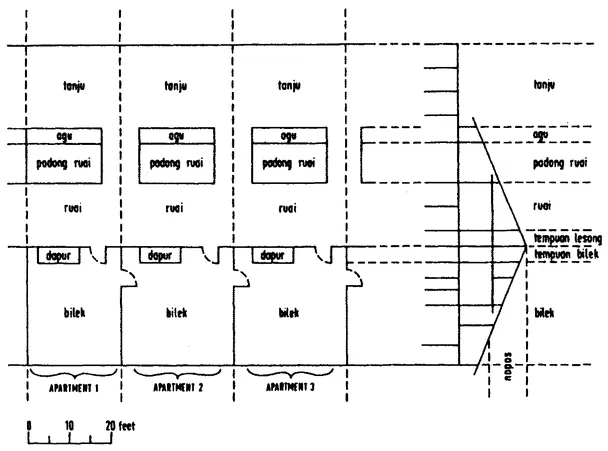
FIG. 1. Plan of an Iban Long-house (Rumah Tungku, Sungai Tiau).
it. In the ordinary course of events, all the members of family—men, women, and children—eat together in their bilek, squatting in a circle around the meal which has been laid out in the centre of the room. At nights, finely plaited mats are spread, mosquito curtains suspended, and the bilek becomes the sleeping place of all but the young unmarried men, who more often favour the open gallery, or ruai of the long-house. At the back of the bilek, and frequently along both its sides, are stacked the huge jars (tajau) and bronze gongs (tawak) which constitute the main capital resources of a family, and its chief form of inheritable property. Kept carefully packed away in wooden trunks, or securely wrapped in bark-cloth are the hand-woven fabrics (pua kumbo and kain kebat), used only on ritual and gala occasions, which are another of the important indications of the wealth and status of an Iban family. Ranged in racks around the walls are plates and bowls, and an extraordinary medley of minor possessions.
THE SADAU
Above each bilek, and jutting out over the ruai, is the sadau, which is a kind of garret or loft. Here, in immense bark-bins, is stored the padi grown by the members of the bilek. A series of smaller containers hold the carefully selected seed (each family possesses many different types of padi), to be used at the next sowing. Most important of all these is the seed of the padi pun—a singular variety of inherited rice—which is the centre of the elaborate fertility cult upon which Iban agriculture is based. Also in the sadau are kept the various implements used in farming, and the mats, baskets and trays used when padi is being husked and winnowed.
THE RUAI
The door of each family bilek opens on to another section known as the ruai, which is always of about the same area as the bilek, and which—like the bilek—is the private property of the family to which it belongs. In an Iban house of traditional design, the division between the bilek and the ruai is marked by the main supporting post (tiang bumbong) of the ridge-pole; thus the rear half of the ridged roof covers the bilek while the front half covers the ruai. Unlike the bilek, a family's ruai has no side walls, so that all these independently owned sections are joined to produce a continuous, roofed gallery, which runs the entire length of the long-house. Throughout its length the ruai maintains a fairly constant width. In Rumah Nyala, for example, the average width of the ruai was about 23 ft., while in Rumah Tunkgu it was 25 ft. The ruai serves many purposes. Three principal parts may be distinguished. Immediately adjacent to the wall dividing the bilek from the ruai, is a section about 3 to 4 feet in width, known as the tempuan lesong. Here stands the lesong, a large wooden mortar, in which the women of the family pound their padi with long hard-wood poles, to husk it. Most o...
Table of contents
- Cover
- Half Title
- Series Page
- Title Page
- Copyright Page
- Contents
- Plates
- Figures
- Maps
- 1. IBAN SOCIAL ORGANIZATION: THB BILBK-FAMIIY
- 2. IBAN SOCIAL ORGANIZATION: THE LONG-HOUSE COMMUNITY
- 3. LAND TENURE
- 4. AGRICULTURE
- 5. THE ECONOMICS OF AGRICULTURE
- 6. IBAN METHODS OF LAND USAGB
- GLOSSARY
- NOTES ON PHOTOGRAPHIC PLATES
- APPENDIX: IBAN KINSHIP TERMS
- INDEX
Trusted by 375,005 students
Access to over 1.5 million titles for a fair monthly price.
Study more efficiently using our study tools.
Frequently asked questions
Yes, you can cancel anytime from the Subscription tab in your account settings on the Perlego website. Your subscription will stay active until the end of your current billing period. Learn how to cancel your subscription
No, books cannot be downloaded as external files, such as PDFs, for use outside of Perlego. However, you can download books within the Perlego app for offline reading on mobile or tablet. Learn how to download books offline
Perlego offers two plans: Essential and Complete
- Essential is ideal for learners and professionals who enjoy exploring a wide range of subjects. Access the Essential Library with 800,000+ trusted titles and best-sellers across business, personal growth, and the humanities. Includes unlimited reading time and Standard Read Aloud voice.
- Complete: Perfect for advanced learners and researchers needing full, unrestricted access. Unlock 1.5M+ books across hundreds of subjects, including academic and specialized titles. The Complete Plan also includes advanced features like Premium Read Aloud and Research Assistant.
We are an online textbook subscription service, where you can get access to an entire online library for less than the price of a single book per month. With over 1.5 million books across 990+ topics, we’ve got you covered! Learn about our mission
Look out for the read-aloud symbol on your next book to see if you can listen to it. The read-aloud tool reads text aloud for you, highlighting the text as it is being read. You can pause it, speed it up and slow it down. Learn more about Read Aloud
Yes! You can use the Perlego app on both iOS and Android devices to read anytime, anywhere — even offline. Perfect for commutes or when you’re on the go.
Please note we cannot support devices running on iOS 13 and Android 7 or earlier. Learn more about using the app
Please note we cannot support devices running on iOS 13 and Android 7 or earlier. Learn more about using the app
Yes, you can access Report on the Iban by Derek Freedman in PDF and/or ePUB format, as well as other popular books in Social Sciences & Sociology. We have over 1.5 million books available in our catalogue for you to explore.