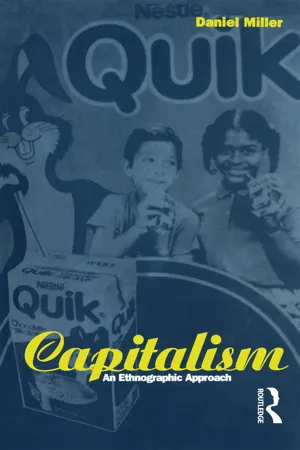
- 384 pages
- English
- ePUB (mobile friendly)
- Available on iOS & Android
eBook - ePub
About this book
This provocative book challenges many of our ingrained assumptions about the direction of contemporary capitalism and offers fresh perspectives that will inform the development of a new and relevant political economy for our times. The complex and often contradictory world within which modern commodities are produced, sold and consumed is set within the larger context of transnational business and economic developments. The importance of factors such as profitability and globalization is highlighted, and a sophisticated analysis of the contradictions and ironies of the world of modern commodities emerges. Trinidad provides an ideal setting for this study, given its recent oil boom and recession and the subsequent experience of both wealth and poverty.
Information
1
Capitalism, Ethnography and Trinidad
Shiny Peanuts
Just after returning to London from the main period of fieldwork in Trinidad in 1989, I decided to interview the director of the firm that supplies the majority of the peanuts to Trinidad. I was interested to know why his particular firm seemed so well established as the dominant supplier, especially when, in the context of a deep recession, packets of salted peanuts seemed a relatively expensive product. He explained to me something of the global trade in peanuts and the main sources of competition. What stuck in my memory was the suggestion that the key advantage he had over his rivals was that he was mainly exporting Chinese peanuts rather than American peanuts. Chinese peanuts are a little shinier than American peanuts, and Trinidadians, he explained, preferred shiny peanuts.
In countries such as Britain or the United States the relationship between our supermarkets and the global economy is not only transparent but widely accepted. That a few products are actually locally grown is almost something of a novelty, to be promoted in specialist gift shops to holiday-makers. In other respects the supermarkets in London or New York take credit for providing goods from throughout the world. The shoppers may well include some whose ancestry lies in exotic regions, and for whom specialist sections are developed; but the majority also now take for granted access to the products of most areas at most times. The major characteristic of this supply is that it is constant, predictable and of uniformly high quality. These goods are expected to compete in terms of attributes such as their glossiness and hue, and to appear, in effect, perfect.
When people in Berlin or Chicago think of Trinidad, by contrast, they assume that none of these things will be true. They imagine foodstuffs that are largely locally grown, and are a much closer reflection of the variety of quality that actually comes up from the ground or down from the tree. In fact, during the time of my first fieldwork (1988-9) agriculture provided only 2.5 per cent of Trinidad's gross national product. The proportion of imported foodstuffs was therefore even greater than in most metropolitan countries, and most foodstuffs are also purchased in supermarkets. Goods are also expected to come to the shopper in branded products of uniformly high quality and without blemish. Attributes such as being shiny or of a particular hue will help determine what sells. In Western Europe this presumption of quality is taken for granted more or less as a right. The same applies in Trinidad.
In Britain the major supermarket chains are increasingly subject to a system of backwards vertical integration in which the retailer controls distribution and, increasingly, production, in the sense of at least the packaging of these goods. These are displayed alongside the well-established brands of the major global transnational, such as Nestlé and Procter and Gamble. The situation in Trinidad is very similar. The dominant supermarket chain is part of the largest conglomerate in the region, with considerable power of distribution and packaging. The branded products are mainly the ones familiar from most other countries in the world.
Throughout the contemporary world there is a general recognition that we live within a world dominated by capitalism. The degree to which this was diluted by alternative ideas such as socialism has diminished significantly in the last decade. In Trinidad capitalism is if anything rather more taken for granted than in Europe. As in the United States, there has never been a period in which it has been under serious challenge, nor has there ever been a government much interested in experimenting with alternative forms of economic control. The only rival to the free market was the growth of state control during the oil boom of the late 1970s; but this was far more influenced by a strident nationalism than by any antagonism to capitalism itself.
To use the shiny peanut as a symbol to justify Trinidad as an exemplar of contemporary capitalism is to acknowledge one of the most significant changes within capitalism itself. This is the increasing centrality of consumption rather than production. We are moving from a time when manufacturers made goods and then sought markets, to a time when retailers tell manufacturers what to produce (see Miller 1995). What has become critical is the development of a huge range of imperatives behind demand and the desire by people throughout the world to possess a wide range of modern commodities. It is this that makes the shiny peanut crucial to modern analysis: that even a country as peripheral to the major metropolitan states as Trinidad has its economy determined by consumers' focus upon the highly specific attributes of the commodities found on supermarket shelves.
The present volume is a continuation of work by myself and others to redirect attention to the importance of consumption. But more specifically it is a description of the results of fieldwork that was undertaken in response to a criticism of this study of consumption. The criticism (for a recent example of which see Fine and Leopold 1993) was that current studies of consumption had neglected the wider context of consumption in production and distribution, and in the same way that earlier studies of production had ignored consumption. We were swinging the pendulum of academic study so far that we might produce an equally disarticulated study of consumption that ignored its relationship to business. As Fine and Leopold have argued, a proper study of capitalism requires consideration of the articulation between all these processes, and my intention was to see to what extent an ethnography might be able to address these issues.
The Aims of this Volume
The aims of this volume follow from the intentions behind the fieldwork it describes. I will outline these, and then consider how they differ from some of the expectations that may have been raised by choosing the title Capitalism: An Ethnographic Approach. This implies, of course, an attempt to justify this discrepancy, as one of my intentions is to expose the narrowness of these expectations.
The first aim of this volume is to give a sense of how commodities come to the consumer with particular attributes. The commodities selected to exemplify this process are those that appear on the shelves of supermarkets in Trinidad, with a particular emphasis upon non-alcoholic beverages. These commodities do not appear to the consumer merely as utilitarian products matched with utilitarian demand functions such as hunger or thirst. Rather, as with the shiny peanut, the key to their relationship to the consumer is a complex amalgam of attributes that they obtain through processes such as branding, marketing, advertising and retailing. These attributes are intended both to create consumer demand and to appeal to existing consumer demand for highly nuanced and complex symbolic attributes of commodities.
This book examines several of these contexts for the production of commodities as complex symbolic formations, and seeks to show how ethnography as a method can reveal something of the context within which each process occurs within one particular region. Thus Chapter 3 focuses on the firm,Chapter 4 on branding, Chapters 5 and 6 on advertising andChapter 7 on retail. In moving through these various institutional contexts the commodity comes to exist as a potential object of consumption.
The second aim of this volume derives from my own particular interest in consumption. I do not believe consumers are merely the end-point of these processes, who then 'choose' to accept or reject what commerce has produced. I certainly do not recognize in them the optimizers of economic theory. Consumers turn out to be among the most active players in the construction of the commodity from its inception. They are constantly involved through their reaction to branding, to advertising and to strategies of selling. For this reason consideration of consumers is not relegated to a final chapter, which as it were ends the sequence of commodity trajectory, but is a clear presence within the process of commodity formation. This varies from market-testing in the early stages of creating new brands to the dual personalities executives acquire through their being themselves consumers. Fieldwork also revealed, however, times when consumers were in a sense absent at key moments when one might have expected them to occupy centre stage. For example, in advertising and marketing the atmosphere of intense competition sometimes creates a fixation on rival firms that pushes out any interest in or concern with consumers.
To say, therefore, that my aim is to integrate consumers does not mean that I give them unwarranted agency. Any attempt to determine the relative power of consumption and production must also face up to what turns out to be a core issue of relative autonomy. In both cases each may be legitimated with respect to the other. Business constantly justifies what it does in the name of the consumer, and in a belief that it understands the behaviour of consumers. Similarly, consumers constantly credit business with the power of determining what they do as consumers. In general, however, each of the central chapters reveals considerable autonomy. The viewers of television reconstruct the meaning of adverts in a manner that has only a limited effect upon the adverts themselves. In the drinks industry, consumers and producers blithely ignore major trends and changes in the other. There are, of course, many instances where this is not the case. Campaigns are described that appear to have of themselves transformed consumer demand, alongside others that vanish without trace. This book therefore aims to integrate the perspective of the consumer as part of the process of commodity production, but only where appropriate.
If the second aim is to turn the consumer from passive endpoint to active agent within the process of the production of commodities, the third aim is to effect a parallel transformation in the concept of regional context. Trinidad is therefore presented throughout this volume as much more than merely the place where these processes happen. The emphasis is rather on Trinidad as itself constructed out of the very activities that are studied here. The book to which the present volume is a sequel (Miller 1994) demonstrated that Trinidad is a product of tensions in modernity, that it is a highly dynamic context that is constantly changing. It would be quite naive, therefore, to tackle Trinidad in the way that anthropologists approach Hawaii or Benin, that is to look for the way some long-standing structural relations that make up 'cultural' predispositions continue to constrain or influence some new institutional activity (e.g. Sahlins 1988). Trinidad, by contrast to these regions, was born out of the particular concerns of capitalism to create a periphery – in this case sugar production, followed by oil production (Brereton 1981; Mintz 1985a). As the material in this volume will indicate, Trinidad continues to evolve in tandem with capitalism, and is not separable as a 'context' to capitalism.
The fourth aim of this volume is to attempt to exploit the advantages of ethnography both as a methodology and a perspective on capitalism. As a methodology, ethnography represented a commitment to the long-term study of these processes in their contexts. As far as possible they were observed as they occurred in their typical setting. The emphasis was on qualitative observation of events as they unfolded. My contention is not that ethnography is a better or worse method for studying these phenomena; it is clear to me that it should be complementary to other methods. Rather, my concern is that in writing up the results I should emphasize that which ethnography – as against other methods – contributes, without falling into the positivistic trap of assuming that the entirety of what constitutes these activities is merely what such a method is able to capture as observation.
My fifth arid final aim arose subsequent to the fieldwork, and was fortuitous in that it emerged out of events that happened to coincide with my study. This was a growing realization that there was another form of capitalism that was certainly not contained in the kind of business practices that were studied, but was grounded instead in the application of certain abstract economic models. This was embodied in what has been termed structural adjustmen – a phenomenon that was just about to impinge upon Trinidad when the fieldwork was being completed.
From these five aims emerges the structure of the volume as a whole. This introductory chapter contains an attempt to contextualize this rather particular perspective on capitalism within the wider comparative literature. It also briefly addresses Trinidad as a context. It is followed by an exploration of the fifth aim, which is the current exposure of Trinidad to structural adjustment, and, in that guise, to a particular model of 'pure' capitalism.
The following five chapters form the substantive core of the study, and trace four major contexts through which the commodity comes into being as a consumer object. The first explores business through the selection of one particular form the transnational companies concerned with the production and distribution of supermarket goods. The next chapter is concerned with the single most important symbolic frame through which the commodity is constituted, both for commerce and for the consumer, which is the brand. It also provides one of the clearest examples of a direct encounter between consumer and producer, through exploring the meaning of brands within the soft drink industry.
The next two chapters take different perspectives on advertising. The first situates advertising entirely within the institutional framework of the advertising industry as a highly competitive set of firms whose primary orientation turns out to be – not the consumer, but – their rivals. The following chapter shifts to the analysis of the actual advertising produced and includes an element of the consumer reading of these adverts. The final chapter of this section then follows through to the next stage, retail. Once again it divides between taking retail from the perspective of retailers, and the analysis of retail from the perspective of the consumer as shopper.
The final chapter starts by examining the ways the consumer is objectified as such through consumer organizations, but then moves to more general questions about the contextualization of capitalism in Trinidad. The conclusion to the volume then attempts to integrate the implications of Chapters 3 to 8 with the larger macro-perspective provided in Chapter 2. From this it derives a model of capitalism as the practice of commerce that then gives rise to a more general model of the contradictions of the consumer economy in the contemporary world.
It is important that the order in which the book unfolds should not be seen as of itself an argument for directionality. As was noted in describing the second aim, the idea is not to see the consumer merely as the end-point in the process, which is why the consumer has an equally clear presence in Chapters 4, 6 and 7 as they do in Chapter 8. Furthermore, one of the conclusions ofChapter 8 is that the whole process can also be seen in reverse, so that the consumer appears as the starting-point for macro-economic shifts such as structural adjustment.
A final aim of this volume is more modest arid descriptive than those already discussed. For whatever institutions and aspects of capitalism the ethnographer sets out to describe, the information must be scholarly enough and full enough that the material can be used in the future as part of a larger project of comparative studies. I do not then apologize for what might be seen as the 'boring' substantive sections of this work. There are certainly parts of my description of the soft drinks industry, advertising agencies and retail that are not intended to make any immediate point, but simply to provide sufficient detail and coverage that any individual points are properly contextualized and that any comparative work has a foundation for assessing similarities and difference.
This volume is committed to a description of capitalism as I encountered it. It differs from most parallel books on the Caribbean economy, which describe and deplore current conditions and then concentrate on the alternatives. Books such as McAfee's admirable (1991) critique include detailed descriptions of community groups and the variety of NGOs (non-governmental organisations) and others working for the benefit of Caribbean peoples. While such bodies should certainly be supported, they remain of limited importance within a country such as Trinidad. The larger problem posed in this book is that Trinidad is vulnerable to a movement towards forms of capitalist control that make its present situation relatively benign by comparison. The key struggle at the moment is between a not particularly good form of capitalism and the threat of a far worse version. I call this the move from organic to pure capitalism. There seems, then, good reason for being closely tied to the grim realities of the historical moment.
These, then, are the basic aims that account for what follows in the rest of this volume. I fully recognize that someone coming from a different academic trajectory and working mainly from the book's title would have other expectations. In the following section I would wish to persuade you, through reference to the comparative literature, that the aims outlined here are just as valid an exploration of capitalism as those aims that you might have expected to have taken their place.
A Particular Perspective on Capitalism
I will not attempt to define capitalism. I assume that, as a kind of Wittgensteinian language game, the word 'capitalism' has many definitions, depending upon its context. Capitalism may achieve its most precise definition within neo-classical economics. Neo-classical economists attempt to construct algorithms that model particular relationships within capitalism, which is thereby rendered a general and ideal system. But this activity bears very little relation to the arena where the term has traditionally been most fully employed, which is in Marxist discourse. Here capitalism has moved from the analysis of a particular system by Marx to become, after a century and more, largely a figure within rhetorical politics. Each of these academic and non-academic fields generates its own language-game, within each of which the term capitalism finds another particular scope and meaning.
In practice, an ethnography reduces capitalism to those aspects manifested within the ethnographic encounter. This will be mainly the workings of commerce involved in creating commodities for supermarkets. In addition, however, the first and last chapters deal with capitalism as derived from a particular economic model manifested through structural adjustment. Indeed, one of the main points made by ...
Table of contents
- Cover
- Half Title
- Series Page
- Title Page
- Copyright Page
- Dedication Page
- Contents
- Acknowledgements
- 1 Capitalism, Ethnography and Trinidad
- 2 Pure Capitalism
- 3 The Local-'Global' and the Global-'Local' Companies
- 4 An Ethnography of Brands: The Trinidadian Sweet Drink Industry
- 5 The Production of Advertising
- 6 The Content and Consumption of Advertisements
- 7 Retail and Shopping
- 8 Consumption and Capitalism
- Bibliography
- Index
Trusted by 375,005 students
Access to over 1.5 million titles for a fair monthly price.
Study more efficiently using our study tools.
Frequently asked questions
Yes, you can cancel anytime from the Subscription tab in your account settings on the Perlego website. Your subscription will stay active until the end of your current billing period. Learn how to cancel your subscription
No, books cannot be downloaded as external files, such as PDFs, for use outside of Perlego. However, you can download books within the Perlego app for offline reading on mobile or tablet. Learn how to download books offline
Perlego offers two plans: Essential and Complete
- Essential is ideal for learners and professionals who enjoy exploring a wide range of subjects. Access the Essential Library with 800,000+ trusted titles and best-sellers across business, personal growth, and the humanities. Includes unlimited reading time and Standard Read Aloud voice.
- Complete: Perfect for advanced learners and researchers needing full, unrestricted access. Unlock 1.5M+ books across hundreds of subjects, including academic and specialized titles. The Complete Plan also includes advanced features like Premium Read Aloud and Research Assistant.
We are an online textbook subscription service, where you can get access to an entire online library for less than the price of a single book per month. With over 1.5 million books across 990+ topics, we’ve got you covered! Learn about our mission
Look out for the read-aloud symbol on your next book to see if you can listen to it. The read-aloud tool reads text aloud for you, highlighting the text as it is being read. You can pause it, speed it up and slow it down. Learn more about Read Aloud
Yes! You can use the Perlego app on both iOS and Android devices to read anytime, anywhere — even offline. Perfect for commutes or when you’re on the go.
Please note we cannot support devices running on iOS 13 and Android 7 or earlier. Learn more about using the app
Please note we cannot support devices running on iOS 13 and Android 7 or earlier. Learn more about using the app
Yes, you can access Capitalism by Daniel Miller in PDF and/or ePUB format, as well as other popular books in Social Sciences & Business General. We have over 1.5 million books available in our catalogue for you to explore.