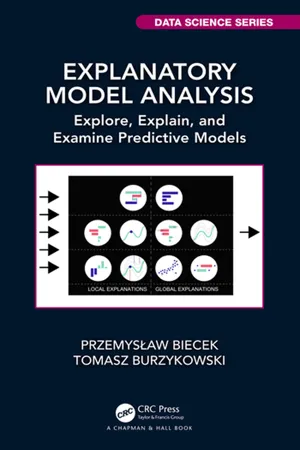
Explanatory Model Analysis Explore, Explain and Examine Predictive Models is a set of methods and tools designed to build better predictive models and to monitor their behaviour in a changing environment. Today, the true bottleneck in predictive modelling is neither the lack of data, nor the lack of computational power, nor inadequate algorithms, nor the lack of flexible models. It is the lack of tools for model exploration (extraction of relationships learned by the model), model explanation (understanding the key factors influencing model decisions) and model examination (identification of model weaknesses and evaluation of model's performance). This book presents a collection of model agnostic methods that may be used for any black-box model together with real-world applications to classification and regression problems.
eBook - ePub
Explanatory Model Analysis
Explore, Explain, and Examine Predictive Models
- 310 pages
- English
- ePUB (mobile friendly)
- Available on iOS & Android
eBook - ePub
Explanatory Model Analysis
Explore, Explain, and Examine Predictive Models
About this book
Information
Publisher
Chapman and Hall/CRCYear
2021Print ISBN
9780367693923
9780367135591
Edition
1eBook ISBN
9780429648731
Part II
Instance Level
Instance-level exploration methods help us understand how a model yields a prediction for a particular single observation. We may consider the following situations as examples:
• We may want to evaluate effects of explanatory variables on the model’s predictions. For instance, we may be interested in predicting the risk of heart attack based on a person’s age, sex, and smoking habits. A model may be used to construct a score (for instance, a linear combination of the explanatory variables representing age, sex, and smoking habits) that could be used for the purposes of prediction. For a particular patient, we may want to learn how much do the different variables contribute to the score?
• We may want to understand how would the model’s predictions change if values of some of the explanatory variables changed? For instance, what would be the predicted risk of heart attack if the patient cut the number of cigarettes smoked per day by half?
• We may discover that the model is providing incorrect predictions, and we may want to find the reason. For instance, a patient with a very low risk-score experienced a heart attack. What has driven the wrong prediction?
In this part of the book, we describe the most popular approaches to instance-level exploration. They can be divided into three classes:
• One approach is to analyze how does the model’s prediction for a particular instance differ from the average prediction and how can the difference be distributed among explanatory variables? This method is often called the “variable attributions” approach. An example is provided in panel A of Figure 5.1. Chapters 6-8 present various methods for implementing this approach.
• Another approach uses the interpretation of the model as a function and investigates the local behaviour of this function around the point (observa-tion) of interest x,. In particular, we analyze the curvature of the model response (prediction) surface around x,. In case of a black-box model, we may approximate it with a simpler glass-box model around x,. An example is provided in panel B of Figure 5.1. Chapter 9 presents the Local Interpretable Model-agnostic Explanations (LIME) method that exploits the concept of a “local model”.
• Yet another approach is to investigate how does the model’s prediction change if the value of a single explanatory variable changes? The approach is useful in the so-called “What-if” analyses. In particular, we can construct plots presenting the change in model-based predictions induced by a change of a single explanatory variable. Such plots are usually called ceteris-paribus (CP) profiles. An example is provided in panel C in Figure 5.1. Chapters 10-12 introduce the CP profiles and methods based on them.

FIGURE 5.1 Illustration of different approaches to instance-level exploration. The plots present response (prediction) surface for a (black-box) model that is a function of two explanatory variables. We are interested in understanding the model response (prediction) at a single point (observation). Panel A illustrates the concept of variable attributions. The additive effect of each variable shows how does the prediction for the particular observation differ from the average. Panel B illustrates the concept of explanations through local models. A simpler glass-b...
Table of contents
- Cover
- Half Title
- Title Page
- Copyright Page
- Dedication
- Table of Contents
- I Introduction
- II Instance Level
- III Dataset Level
- IV Use-cases
- Bibliography
- Index
Trusted by 375,005 students
Access to over 1.5 million titles for a fair monthly price.
Study more efficiently using our study tools.
Frequently asked questions
Yes, you can cancel anytime from the Subscription tab in your account settings on the Perlego website. Your subscription will stay active until the end of your current billing period. Learn how to cancel your subscription
No, books cannot be downloaded as external files, such as PDFs, for use outside of Perlego. However, you can download books within the Perlego app for offline reading on mobile or tablet. Learn how to download books offline
Perlego offers two plans: Essential and Complete
- Essential is ideal for learners and professionals who enjoy exploring a wide range of subjects. Access the Essential Library with 800,000+ trusted titles and best-sellers across business, personal growth, and the humanities. Includes unlimited reading time and Standard Read Aloud voice.
- Complete: Perfect for advanced learners and researchers needing full, unrestricted access. Unlock 1.5M+ books across hundreds of subjects, including academic and specialized titles. The Complete Plan also includes advanced features like Premium Read Aloud and Research Assistant.
We are an online textbook subscription service, where you can get access to an entire online library for less than the price of a single book per month. With over 1.5 million books across 990+ topics, we’ve got you covered! Learn about our mission
Look out for the read-aloud symbol on your next book to see if you can listen to it. The read-aloud tool reads text aloud for you, highlighting the text as it is being read. You can pause it, speed it up and slow it down. Learn more about Read Aloud
Yes! You can use the Perlego app on both iOS and Android devices to read anytime, anywhere — even offline. Perfect for commutes or when you’re on the go.
Please note we cannot support devices running on iOS 13 and Android 7 or earlier. Learn more about using the app
Please note we cannot support devices running on iOS 13 and Android 7 or earlier. Learn more about using the app
Yes, you can access Explanatory Model Analysis by Przemyslaw Biecek,Tomasz Burzykowski in PDF and/or ePUB format, as well as other popular books in Mathematics & Statistics for Business & Economics. We have over 1.5 million books available in our catalogue for you to explore.