
AI for Immunology
eBook - ePub

AI for Immunology

  1. 144 pages
  2. English
  3. ePUB (mobile friendly)
  4. Available on iOS & Android
eBook - ePub

AI for Immunology

About this book

The bioscience of immunology has given us a better understanding of human health and disease. Artificial intelligence (AI) has elevated that understanding and its applications in immunology to new levels. Together, AI for immunology is an advancing horizon in health care, disease diagnosis, and prevention. From the simple cold to the most advanced autoimmune disorders and now pandemics, AI for immunology is unlocking the causes and cures.

Key features:

  • A highly accessible and wide-ranging short introduction to AI for immunology
  • Includes a chapter on COVID-19 and pandemics
  • Includes scientific and clinical considerations, as well as immune and autoimmune diseases
Frequently asked questions

Yes, you can cancel anytime from the Subscription tab in your account settings on the Perlego website. Your subscription will stay active until the end of your current billing period. Learn how to cancel your subscription.
No, books cannot be downloaded as external files, such as PDFs, for use outside of Perlego. However, you can download books within the Perlego app for offline reading on mobile or tablet. Learn more here.
Perlego offers two plans: Essential and Complete
  • Essential is ideal for learners and professionals who enjoy exploring a wide range of subjects. Access the Essential Library with 800,000+ trusted titles and best-sellers across business, personal growth, and the humanities. Includes unlimited reading time and Standard Read Aloud voice.
  • Complete: Perfect for advanced learners and researchers needing full, unrestricted access. Unlock 1.4M+ books across hundreds of subjects, including academic and specialized titles. The Complete Plan also includes advanced features like Premium Read Aloud and Research Assistant.
Both plans are available with monthly, semester, or annual billing cycles.
We are an online textbook subscription service, where you can get access to an entire online library for less than the price of a single book per month. With over 1 million books across 1000+ topics, we’ve got you covered! Learn more here.
Look out for the read-aloud symbol on your next book to see if you can listen to it. The read-aloud tool reads text aloud for you, highlighting the text as it is being read. You can pause it, speed it up and slow it down. Learn more here.
Yes! You can use the Perlego app on both iOS or Android devices to read anytime, anywhere — even offline. Perfect for commutes or when you’re on the go.
Please note we cannot support devices running on iOS 13 and Android 7 or earlier. Learn more about using the app.
Yes, you can access AI for Immunology by Louis J. Catania in PDF and/or ePUB format, as well as other popular books in Ciencia de la computación & Redes neuronales. We have over one million books available in our catalogue for you to explore.

Information

1

Understanding Artificial Intelligence (AI)

Introduction

The Merriam-Webster dictionary defines AI as “…a branch of computer science dealing with the simulation of intelligent behavior in computers; the capability of a machine to imitate intelligent human behavior.”1 Those simple words bespeak the magnitude of the science of AI. For “…a machine to imitate intelligent human behavior” is to have it effectively “mimic” the functions of the human brain or restated, in biologic terms, to mimic neuroscience. The neurological functions associated with intelligence are related to the cortical control centers, progressive neural layers, and the complex neural networking between these centers and layers. Thus, AI must simulate the structures of these cortical centers and layers and their neural network functioning.
While there are substantial differences between AI and basic computers, there also are some common denominators in their structure and function. The most relevant among them include three fundamental categories: (1) the input layer, components for entering “user data” (e.g., hardware such as keyboard, printers, audio/visual); (2) the inner (hidden) layer, a functional component for data processing (sequence of automated operations to convert user input data into computer language or “code”) consisting of hardware like microprocessors (central processing unit [CPU], random access memory drive [RAM]) and software (“hidden” operating systems [OS] programming applications); and (3) the output layer consisting of the hardware devices (monitors, printers, audio/visual) to present computed results.

A Model for Understanding Artificial Intelligence

AI utilizes multiple hardware and software tools in its inner layer to effectively mimic the neurological functions associated with intelligence. These inner layer functions are classified into the two main categories of AI: “machine learning” and “deep learning.” These two categories introduce unique aspects to the computing process that electronically reproduce the qualities of human intelligence. To accomplish this task, AI uses “algorithms,” mathematical formulas to simulate the progressive layers of neuronal functions and neural networking in the human brain.
A simple way (kind of) to understand how AI works is to briefly present how the structures and functions of the human brain process information. Then we can compare that process to the structures and functions associated with the three layers of AI computing and its machine and deep learning process.
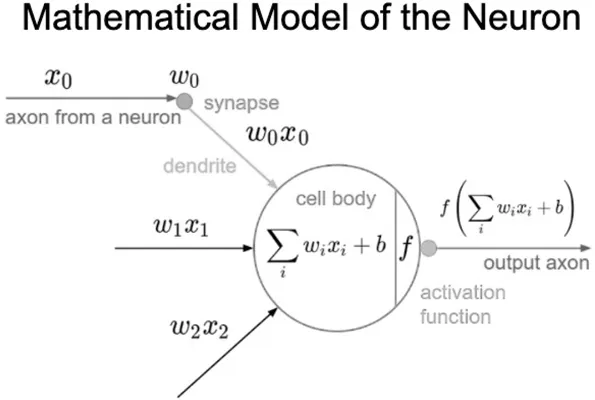
The fundamental neuroanatomical component of the brain that dictates neural functioning is called “the neuron.” It is estimated that there are approximately 100 billion neurons in the human brain.2 Nerve impulses travel down axons reaching junctions called synapses where neurotransmitter chemicals are released across the synaptic cleft activating other neurons. All of this activity can be reduced to a mathematical model using linear algebra and differential calculus3 (Figure 1.1).
Image
Figure 1.1 Mathematical model of neuron. (Diaa, Ahmedien [2018] The Mathematical Model of the Biological Neuron.)
The brain receives its user (input) data which it transmits through inner layer neuronal pathways in nuclei called the limbic system (analogous to a computer operating system [OS]). These nuclei act as relay stations that analyze input data and transmit it to appropriate higher cortical layers for interpretation. This vast network of 100 billion interconnecting neurons creates a complex in the human brain, collectively referred to as the neural network (NN), analogous to AI algorithms. This vast network produces multilayered, convolutional interconnections called the convolutional neural network (CNN).
The CNN has the potential of producing 100 trillion neural connections.4 This level of neural networking is called the “deep neural network” (DNN). The DNN is the analog of the AI electronic computing functions conducted by a central processing unit (CPU) and/or a graphic processing unit (GPU); programming applications; algorithms; databases; and servers. In the human brain, the results are human intelligence (output) while the electronic computer produces AI output. The sum total of this computer process is referred to broadly as “machine learning” with the specific CNN and DNN processes called “deep learning.”
These comparative analogies introduce hardware and software components associated with the science and technologies of AI. To complete an understanding of AI, descriptions of the major software and hardware components are needed. With that understanding, you will be able to appreciate the influences and applications AI has in the science of immunology.

AI Hardware

The guiding principle and goal of AI hardware technology are to support the enormous volume of data processing and the calculations and computations the AI software algorithms must execute simultaneously and in milliseconds. A brief thumbnail of each of the significant forms of current and evolving hardware will provide an understanding of the physical resources that drive the AI computing process and its diverse and complex software algorithms.

RAM (Random Access Memory)

A RAM microchip is a high-speed type of computer memory device that temporarily stores all input information as well as application software instructions the computer needs immediately and in the near future. RAM is read from any layer of the computer at almost the same speed. It loses all of its dynamic memory when the computer shuts down.5
When thinking of RAM relative to AI computing, consider it analogous to the hippocampus nucleus of the limbic system in the neuroscience model. It uses an ANN process called “memory networking” (similar to brain “plasticity”) to differentiate and adjust the connections between machine (unsupervised) and deep (supervised) learned information.6

Central Processing Unit (CPU)

The central processing unit (CPU) is the “brain” of the computer. It transforms the raw data into binary code (computer language) that can be manipulated and stored as memory in RAM. The CPU is the analog to the human brain at large when using our neuroscience analogy. It is the processor for all the operations the computer conducts. How your computer operates is based on mathematical operations (algorithms), and the CPU controls all of them through its arithmetic logic unit (ALU).

Graphic Processing Unit (GPU)

A GPU is a specialized microprocessor optimized for displaying graphics and doing very specific computer tasks. CPUs and GPUs are both made from hundreds of millions of transistors which can process thousands of operations per second. The GPU uses thousands of smaller and more efficient cores than the CPU and can handle multiple functions of lively parallel data at the same time. GPUs are 50–100 times faster in tasks that require multiple parallel processes, such as computer graphics and gaming (for which they were initially developed by Nvidia), but its most significant value is in its iterative computations of massive data load in machine learning, deep learning, and big data analytics.7

Servers

The term “server” simply means a machine (computer) that “serves” other machines, thus the name “server machine.”8 Whereas processors and CPUs are “the brain of the computer,” servers are their “heart.” They are computers themselves (hardware supporting software) designed to process requests and deliver data to another computer, a local network, or over the Internet.

Internet of Things (IoT)

A “hybrid” system known as the “Internet of Things” (IoT) is a system of interrelated computing devices, mechanical and digital machines, objects, and even people and animals that are provided with unique identifi...

Table of contents

  1. Cover
  2. Half Title
  3. Series Page
  4. Title Page
  5. Copyright Page
  6. Dedication
  7. Table of Contents
  8. Preface
  9. Acknowledgments
  10. Author
  11. 1 Understanding artificial intelligence (AI)
  12. 2 AI and the bioscience and clinical considerations for immunology
  13. 3 AI and chronic inflammation
  14. 4 AI and autoimmunity
  15. 5 AI and immunology considerations in pandemics and SARS-CoV-2 COVID-19
  16. 6 Emerging trends and future directions for AI in immunology
  17. Index