- 292 pages
- English
- ePUB (mobile friendly)
- Available on iOS & Android
eBook - ePub
About this book
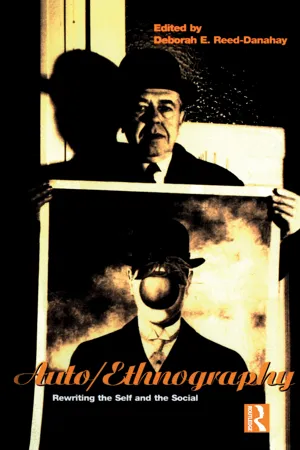
In departing from the traditional stance taken by anthropologists, who study 'others' ethnographically, this timely book explores forms of self-inscription on the part of both the ethnographer and those 'others' who are studied. Informed by developments in postmodernism, postcolonialism, and feminism, this is an original contribution to the growing dialogue across disciplinary boundaries. The chapters build upon recent reconsiderations of the uses and meaning of personal narrative to examine the ways in which selves and social forms are culturally constituted through biographical genres. Ethnic autobiography, self-reflexivity in ethnography, and native ethnography raise provocative questions about a range of issues for the contemporary scholar: authenticity of voice; ethnographic authority; and the degree to which autoethnography constitutes resistance to hegemonic bodies of discourse. Examined here in a variety of cultural and political contexts, writing about the self offers challenging insights into the construction and transformation of identities and cultural meanings.
Information
Part One Power, Documentation, and Resistance
Chapter 1 Narrating Cultural Resurgence: Genre and Self-Representation for Pan-Mayan Writers
Kay B. Warren
... we know that while intellectual debates wear themselves out with sterile rhetoric about how to understand "the other," indigenous people continue to live the most horrendous injustices which have been perpetuated across the centuries.
Victor Montejo (1992: 3)
The public intellectuals involved in Guatemala's Pan-Mayan movement critique the ethics and politics of foreign anthropology and openly reject interview-based research and the ethnographic genre for their own writings.1,2 They also distance themselves from autobiographical portrayals of cultural resurgence by arguing that the movement is at heart a collective effort. For these activists, this resistance represents a rejection of divisive individualism in favor of a transcendent Mayan identity for the 60 percent of the national population with indigenous backgrounds.
As the movement developed an institutional base throughout the highlands in the late 1980s and early 1990s,3 Pan-Mayanists created a variety of genres of self-representation for different audiences: daybooks based on Mayan and Gregorian calendrics, school texts, point-of-view columns for editorial pages, collections of Mayan fables, conference proceedings, essays on Guatemalan racism, novels, testimonies, translations, poetry, linguistic research, reports to development organizations, social commentary, university theses, and statements asserting cultural rights.4 As resurgence has gained momentum, these works have been published and distributed by Mayan presses, national newspapers and periodicals, international development funders, universities, the Ministry of Education, and other organizations inside and outside the country.
Drawing inspiration from Mary Louise Pratt (1992), Marc Zimmerman (1995a, 1995b), Jonathan Boyarin (1993), Joanne Rappaport (1994), and anthropologists working on Mayan resurgence,5 my wider project surveys the writings of Mayan intellectuals with an eye to the ways that marginalized groups represent themselves, interrogate the power structures in which they operate, and imagine alternative futures.6 This research deals with the convergent and conflicting constructions of "the individual" and "the collective" in Pan-Mayan, traditionalist, and foreign portrayals. I am interested in the ways in which Mayan activists produce, circulate, read, and appropriate literature which now reaches hundreds of local communities through schools and nonformal education activities and by means of workshops, audio and video tapes, publications, radio programs, and the press. These materials find another axis of transcultural circulation through international meetings and courses in Latin American Studies in American and European universities and through organizations and journals supporting international human-rights struggles.
This essay discusses the prose of Victor Montejo, one of Pan-Mayanism's most prominent writers in exile. After fleeing Guatemala at the age of thirty in 1982, Montejo worked at Bucknell University, earned a master's degree at the State University of New York at Albany and a doctorate at the University of Connecticut at Storrs, and taught at Bucknell and the University of Montana before becoming assistant professor of anthropology at the University of California at Davis.
To use Mary Louise Pratt's insightful phrasing, Montejo has created "intercultural texts" - giving authority to subaltern voices through the testimonio genre - in order to describe the violence and existential dilemmas of Guatemala.7 Testimonies, which have been widely used in Latin America to personalize the denunciation of state violence and to demonstrate subaltern resistance, gain their narrative power from the metaphor of witnessing. On the one hand, they represent eye-witness experiences, however mediated, of injustice and violence; on the other hand, they involve the act of witnesses presenting evidence for judgment in the court of public opinion. Drawing on Narvaez, Zimmerman (1995b: 12) notes that the literary testimonio involves
... generally linear first person narration of socially and collectively significant experiences, in which the narrative voice is that of a typical or extraordinary witness or protagonist who metonymically represents other individuals or groups that have lived through other, similar situations or the circumstances which induce them. By virtue of its collective representativeness, testimonio is overtly or not, an intertextual dialogue of voices, reproducing but also creatively reordering historical events in a way which impresses as representative and true and which projects a vision of life and society in need of transformation.
The Guatemala of Montejo's testimony is not the tourist paradise of colorful weavings and isolated peasant villages awaiting Western development, but rather a world of "contact zones," social spaces where disparate cultures meet, clash, grapple with each other, often in highly asymmetrical relations of domination and subordination" (Pratt 1992: 4).
Montejo's intercultural texts are both familiar and rebellious. They ignore the ethnographic conventions of anthropology which call on authors, sooner or later, to establish professional authority through abstraction, generalization, depersonalized narrative voices, and the theoretical justification of worthy research.8 His books are also transgressive in light of Pan-Mayanist arguments against the autobiographical and ethnographic genres for the promotion of resurgence. Finally, while testimonios are most often autobiographical narratives edited by outsiders as acts of international solidarity, Montejo is an insider, a Jacaltec Maya who fled the extreme of rural violence in 1982 and met with other refugees, who in Brevísima Relación become peers working on a project of common concern:9
As an insider, my efforts are centered on the issue of how I (a native) can tell my collective story (of expropriation and exile) and, at the same time, elicit a strong commitment from anthropologists to promote issues such as social justice, self-determination, and human rights in the politics of native people. One of the most persistent struggles of modern Mayans is to get rid of their five century old denigrating images and colonial "representations." Thus, indigenous people have always complained that anthropologists do not listen to them, that instead they have represented native people with the anthropologist's preferred images: "primitives," "minorities," "backward," or just "informants." We Mayans find it difficult to deal with the academic world because if we tell the “experts" what is Mayan, they are reluctant to listen; instead they find it more scientific (comfortable) to tell us what it is to be Mayan, or to define Mayan culture. This is not to say that we possess the sole "truth," but as our culture is at stake, we regret that our views are not taken seriously .... My aim has always been to make the sufferings of refugees more visible and to bring attention to their struggles to liberate themselves from continuous oppression and persecution. Mayans are again speaking for themselves and rupturing those barriers that have silenced us and positioned us in such unequal social relations (1993a: 16-17).
As a Mayan, a refugee, and an anthropologist, Montejo is aware of his own multiple accountability to readers with inherently conflicting politics and positionings. As an insider/outsider who studies displaced communities, Montejo must answer AbuLughod's question: "What happens when the 'other' that the anthropologist is studying is simultaneously constructed as, at least partially, a self?" (1991:140).
Montejo has become an important interpreter of indigenous culture and Guatemalan politics during and after the counterinsurgency-guerrilla war of 1978-85, which killed an estimated 50,000 to 70,000 people, internally displaced 500,000 people out of a national population of 8 million, and forced 350,000 refugees to flee to Mexico and the United States, of whom 46,000 found shelter in refugee camps across the border in Chiapas, Mexico (Manz 1988: 30, 209). He argues that, just as the sixteenth-century Spaniards feared an indigenous uprising and used violence preemptively, so the Guatemalan army undertook a scorched earth policy in the early 1980s to undermine any incipient alliance between indigenous communities and the revolutionary movement which was then expanding into the western highlands (1993a). Montejo's writings, which have been published in Spanish, English, Jacaltec, and Italian, circulate in the United States, Latin America, and Europe. His works include El Kanil; Man of Lightning (1982), Testimony: Death of a Guatemala Village (1987), the collection with Q'anil Akab' titled Brevísima Relación Testimonial de la Continua Destrucción del Mayab' (Guatemala) (1992), The Bird Who Cleans the World (1992), and Sculpted Stones (1995). Some of these works are extraordinarily painful accounts of state terrorism in Guatemala. Others are bilingual compilations of Mayan fables from Montejo's home community, Jacaltenango, in the state of Huehuetenango, and poetry which recounts his journey from rural Guatemala to exile.
As it was for past generations, the issue for Pan-Mayan writers involved in projects of revitalization is to find a way to engage the terms of violence and racism and create space for something beyond extreme fragmentation. The challenge in the repressive environment of the late 1980s was to represent the formative experience of cultural difference in a multiethnic society without being labeled subversive. Perhaps it is fortunate that Mayan hermeneutics focuses on highly condensed symbolism, multiple levels of meaning, and veiled language. In the traditionalist past, community intellectuals, such as the k'amöl b'ey ritual guides, kept social criticism alive through religion and liminal ritual; today, national and regional leaders elaborate social criticism through the emerging field of Mayan Studies. The transnational field concentrates on Mayan languages, cultural distinctiveness, and prehispanic and colonial history - topics that, on the face of it, appear quite distant from contemporary politics. Yet, as I have argued elsewhere,10 cultural and linguistic distinctiveness represent for Mayans an ethnogenesis that antedates and transcends the Spanish conquest. Colonial histories in service of the movement are presentist accounts which call on readers to see echoes of past violence in the cultural dynamics of the present.
Until very recently, writers in Guatemala were forced by death squads and state repression to veil their analyses and maintain extreme public caution when discussing politics. Mayan writers such as Demetrio Cojtí, Enrique Sam Colop, and Demetrio Rodriguez Guaján, and organizations such as the Coordinadora Kaqchikel de Desarrollo Integral and the Mayan press Cholsamaj showed great courage when they published on social issues in Guatemala. Those in exile were the first Pan-Mayanists explicitly to chronicle memories of violent displacement during the civil war.
Mayan Writers Outside the Country
Me Llamo Ribogerta Menchú y Así Me Nació la Conciencia (1985) is the most famous and controversial of the Guatemalan testimonial literature. As is clear from Elizabeth Burgos-Debray's preface, this is a highly mediated work, compiled by a Venezuelan anthropologist with European training who had a well-defined political agenda. Burgos-Debray did not know Guatemala well and spent only limited time with Menchú. Critics have argued that Menchu was an active participant in the literary process with her own political goals which shaped the product ethnographically and politically.11 Used widely by solidarity organizers in the US and Europe "to embody and represent revolutionary possibility and hope in her country" (Zimmerman 1995b: 71), the work has unfortunately come to overshadow the writings of Pan-Mayanists living in exile12 who have composed powerful personal testimonies, worked with Mayan refugees in Chiapas, and advocated cultural revitalization rather than revolution (Montejo 1987; Montejo and Akab' 1992). In the post-Cold War era, with the transition to civilian governments and the signing of the peace accords negotiated by representatives of the government, military, and the URNG guerrillas in 1996, it is particularly important to hear other voices and grammars of dissent.
Victor Montejo's writings take readers on a personal journey of violence, displacement, and cultural renewal. From the safety and free speech of exile, he was able to criticize state terrorism directly. In the United States, one of his goals was consciousness raising, to reach North American and international audiences so they would understand the human cost of authoritarian military regimes. To this end, he has lectured widely and participated in many forums on Mayan culture and on human rights.
While the rhetoric of anticommunism was used by Latin American governments to gamer US financial support for counter-insurgency warfare in the 1970s and 1980s, human rights activists worked to convince Americans that the Guatemalan regime had an agenda which targeted armed guerrillas as well as unarmed civilian populations who were deprived of basic internationally recognized human rights.13 The human-rights movement did achieve some success in pressuring the US government to cut foreign spending which directly financed state violence.14 Another goal was to make Americans aware of continuing human-rights abuses and the unfinished business of the land crisis, refugee return, clandestine cemeteries, demilitarization, and peace negotiations after the war's de-escalation in the late 1980s.15 To these ends, Montejo has participated in the Commission on Human Rights of the American Anthropological Association.
Over a period of several months at the end of 1982 and beginning of 1983, Montejo first drafted his own story of state violence and survival, Testimony: Death of a Guatemalan Town (1987), during his stay with relatives living in the Guadalupe Victoria refugee camp on the Mexico-Chiapas frontier. At that time, he visited neighboring camps to search for people he knew from his Kuchumatan homeland. He finished the book in the United States (Montejo 1992: 1-2).
Testimony tells of the September 9, 1982, massacre of San José Tzalalá, the village where Montejo had been in charge of the elementary school for ten years.16 This deadly confrontation is initially presented as the consequence of a terrible mistake, which made the cost of joining the newly instituted "civil patrols" - locally organized to hunt guerrillas and monitor community members - the same as suicidal noncompliance with the policy of citizen involvement in the counterinsurgency war. When the army first came to Tzalala to organize the patrols, wives and mothers protested the extra work and danger for the men, who dared not resist di...
Table of contents
- Cover
- Half Title
- Title Page
- Copyright Page
- Contents
- Acknowledgements
- Notes on Contributors
- List of Illustrations
- Introduction
- Part One: Power, Documentation, and Resistance
- Part Two: Exile, Memory, and Identity
- Part Three: Voice, Representation, and Genre
- Bibliography
- Index
Trusted by 375,005 students
Access to over 1.5 million titles for a fair monthly price.
Study more efficiently using our study tools.
Frequently asked questions
Yes, you can cancel anytime from the Subscription tab in your account settings on the Perlego website. Your subscription will stay active until the end of your current billing period. Learn how to cancel your subscription
No, books cannot be downloaded as external files, such as PDFs, for use outside of Perlego. However, you can download books within the Perlego app for offline reading on mobile or tablet. Learn how to download books offline
Perlego offers two plans: Essential and Complete
- Essential is ideal for learners and professionals who enjoy exploring a wide range of subjects. Access the Essential Library with 800,000+ trusted titles and best-sellers across business, personal growth, and the humanities. Includes unlimited reading time and Standard Read Aloud voice.
- Complete: Perfect for advanced learners and researchers needing full, unrestricted access. Unlock 1.5M+ books across hundreds of subjects, including academic and specialized titles. The Complete Plan also includes advanced features like Premium Read Aloud and Research Assistant.
We are an online textbook subscription service, where you can get access to an entire online library for less than the price of a single book per month. With over 1.5 million books across 990+ topics, we’ve got you covered! Learn about our mission
Look out for the read-aloud symbol on your next book to see if you can listen to it. The read-aloud tool reads text aloud for you, highlighting the text as it is being read. You can pause it, speed it up and slow it down. Learn more about Read Aloud
Yes! You can use the Perlego app on both iOS and Android devices to read anytime, anywhere — even offline. Perfect for commutes or when you’re on the go.
Please note we cannot support devices running on iOS 13 and Android 7 or earlier. Learn more about using the app
Please note we cannot support devices running on iOS 13 and Android 7 or earlier. Learn more about using the app
Yes, you can access Auto/ethnography by Deborah Reed-Danahay in PDF and/or ePUB format, as well as other popular books in Scienze sociali & Antropologia. We have over 1.5 million books available in our catalogue for you to explore.