eBook - ePub
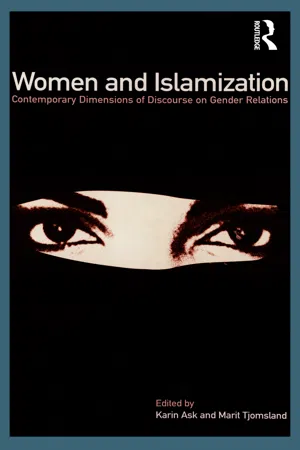
Women and Islamization
Contemporary Dimensions of Discourse on Gender Relations
- 212 pages
- English
- ePUB (mobile friendly)
- Available on iOS & Android
eBook - ePub
Women and Islamization
Contemporary Dimensions of Discourse on Gender Relations
About this book
The current Islamic revival is frequently associated with fundamentalism and radical politics. This reinforces Western perceptions of Islamic women as victims of a sexist and reactionary rule. What many outsiders fail to realize is that quite a number of Muslim women are ardently embracing their religion as a means through which they can express gender identity, power and creativity.In overturning ingrained notions of Muslim women's subjugation, this timely book situates Islam as a religion undergoing reinterpretation and change -- especially in relation to gender identities -- rather than as a monolithic movement reacting against westernization and modernization. Through their political, educational, and recreational activities, more and more Muslim women are setting agendas of their own and are actively redefining the role of women in Muslim society.
Information
Chapter 1
Feminist Reinterpretation of Islamic Sources: Muslim Feminist Theology in the Light of the Christian Tradition of Feminist Thought
Introduction
In the last decade there has been an increasing concern with women’s rights in Islam. Not only have Muslim feminists highlighted the status of women in Muslim societies but Islamists,1 male and female, have also joined the debate, stressing the liberating potential Islam has for women. During my fieldwork in Malaysia in 1991-2, I came across a group called ‘Sisters in Islam’. It consisted mainly of highly educated Malay women, but also included some Western ćonverts to Islam. They had an Islamic profile and they distributed pamphlets with titles such as ‘Are Muslim men allowed to beat their wives?’ In Karachi, Pakistan, in February 1992 I met a group of women at Karachi University with a very similar perspective. During my visit to Jordan in April 1992, 1 found that with regard to women’s issues, female perspectives were mainly a matter for the more secularized forces in society. However, on revisiting Jordan in the summer of 1995 I was thrown directly into the debate on the Muslim woman’s position in society. Interestingly, this debate was conducted in one of the headquarters of the Islamists in Jordan, in the Islamic Studies and Research Association (ISRA), also known as the Jordanian Centre for the International Institute of Islamic Thought (HIT). Over a period of three years, Islamists’ attitudes towards gender and gender relations had changed character. Muslim women’s reinterpretation of Islamic sources is thus a matter of interest as it is not only an intellectual discussion within a feminist sphere but has entered the contemporary Islamist debate, as well.
This study will focus on the feminist intellectual discussion: what has been done in this respect and which subjects have been considered significant. Can a feminist reinterpretation of Islamic sources be set in the context of Islamic theology, i.e. is it possible that this trend might influence established Islamic theology? It is also of importance to examine the Muslim feminist tradition’s relevance to a Christian feminist theology: what similarities exist and where do they divert?
The centennial anniversary of the publication of The Woman’s Bible was observed in 1995. Elizabeth Cady Stanton was the main editor of this work and together with the black feminist Anna Julia Cooper’s book, A Voice from the South (1892), it marked a turning point in Christian feminist theology. Early Arab feminists, such as the Lebanese Nazira Zayn ad-Dln, incorporated feminist ideas into an Islamic frame of reference. In 1928 she published a book called Removing the Veil and Veiling, which aroused the anger of Islamic scholars. It will be interesting to see whether Muslims will simply repeat the development of the Christian tradition or whether Islam is so inherently different from Christianity that a comparison between the two religions is impossible. This question can also be posed regarding matters such as whether Islam will be as secularized as Christianity, in the sense of a separation between church and state (din wa dunya). I suggest that the development of feminist ideas within an Islamic framework necessarily will end up asking such a question, but at the inauguration of a feminist reinterpretation of Islamic sources other matters are emphasized.
Reformation or Reconstruction
An important issue in the Christian and Judaic feminist tradition is whether the aim is reformation or reconstruction. On the one hand, feminists can regard the holy text as limited by its historical context and thus fragment it, classifying the fragments according to what is regarded as either universal and essential or culturally relative. On the other hand, feminists can regard the holy text as androcentric and manmade in the interest of men. The last position was that of Cady Stanton and the implication of this point of view is far-reaching.
Another issue which is closely related to the question of reform or reconstruction is whether interpretation of the holy text should be within a patriarchal framework or outside it. A reform would imply a degree of acceptance of existing ideas, whereas a reconstruction would imply a refutation of the same ideas. Within the tradition of feminist theological hermeneutics, Carolyn Osiek distinguishes between five hermeneutic approaches to the biblical text by contemporary feminists: loyalist, revisionist, sublimationist, rejectionist, and liberationist.
According to Osiek, the loyalists accept the Bible as divine revelation and the word of God but at the same time they claim the divine intention of man and woman living together in happiness and respect (Osiek 1985: 99). Turid Karlsen Seim,2 a Norwegian researcher on the new testament, speaks of fundamentalist woman’s exegesis, thus indicating a literal reading of the text, and this particular approach fits into Osiek’s loyalist category. The revisionists, according to Osiek, believe that the patriarchal framework for the Judaeo-Christian tradition is historically and culturally but not theologically determined. The revisionist approach to reading the Bible involves a search for positive role models for women and an interpretation of the text from a feminist point of view. The sublimationists tend to read the Bible allegorically, presupposing equality of maleness and femaleness or even a preference for femininity (ibid.: 100, 102). She characterizes Cady Stanton among the rejectionists, stating that as regards the Bible as well as Christianity and Judaism, Cady Stanton considered them to be so permeated by patriarchal ideas that they had to be rejected. The fifth category, liberationist feminism, yearns for a transformation of the social order. The focus is on women’s liberation in this world through a female struggle against all oppression (ibid.: 103). These five categories can be incorporated into the model of reformation and reconstruction where loyalists, revisionists and sublimationists can be classified as reformers whereas rejectionists and liberationists are reconstructors.
In the new Muslim feminist tradition several of these categories defined by Osiek are visible. Nawal el-Saadawi can be characterized as rejectionist, whereas from the writings of Amina Wadud-Muhsin and Riffat Hassan we can classify them both as loyalist and revisionist. Fatima Memissi and Leila Ahmed are the closest to the liberationist scholarship. However, these categories are not totally distinguishable. Islam plays such a fundamental role in Muslim societies that for a social reformer to exclude Islam necessarily means failure. Many feminists, who previously struggled against female oppression in Western feminist terms have therefore now adopted a more favourable attitude towards Islam. For example, Fatima Memissi in her study Beyond the Veil (first published in 1975) considered that changes in the conditions of women could be done without the framework of Islam, whereas in her book Women and Islam (first published in 1987) she has shifted attitude and believes that such a change has to be done from within Islam through a reinterpretation of Islamic sources. However, Memissi does not give her point of view on the authority of the Koran in either of these two works. The work of Leila Ahmed points in the same direction, as she is vague in her attitude towards Islam. In her 1992 book Women and Gender in Islam, she expresses the view that Islam’s coming brought with it a deterioration in the status of women in some places, whereas in other places it had a liberating effect. She does not, however, explicitly reject Islam, but rather the common interpretations of the Islamic sources. It seems that by focusing on Islam, the principles of female liberation have acquired a certain validity in Muslim society, as Islamically-minded women would sympathize with some of the arguments.
As for Wadud-Muhsin and Hassan, both tend to analyze the Koran within a framework accepted by many Islamic scholars. Although several of their arguments would be contested by these scholars, their works are part of an internal Islamic debate.
The Question of Authority
The question of authority is a vital one in both the Judaeo-Christian and Islamic debates. There are two levels of authority concerning the holy scriptures, the authority of the text and the authority of the interpretation of the text. Elisabeth Schussler Fiorenza has noted that the feminist biblical discourses have been caught up in an apologetic debate which seeks to show that the Bible, or at least parts of it, is either liberating and therefore has authority for women ... or that it is totally patriarchal and must be rejected (Schtissler Fiorenza 1994). This issue, which she labels ‘the apologetic debate’, is very much part of the new Muslim feminist debate although less explicit than in the Judaeo-Christian one which has gone on for more than a hundred years. As shown above, in most of her work Memissi does not explicitly reject the Koran as the word of God, but neither does she explicitly accept it.
The concept of the holy text as the word of God has today different implications in Christianity and Islam. A common notion among researchers of Islam has been that the Koran is to Islam what Jesus is to Christianity. The development of the historical-critical method in the biblical debate has revealed that the question of whether the Bible contains words coming directly from God or whether it is only human narration about holy persons and happenings is not as fundamental as the question of whether the Koran is the word of God or not. It is possible to regard Jesus as ‘the son of God’ in spite of a degrading of the holy text, whereas Islam’s theology is contingent on the belief that the Koran is the word of God (kalām allāh) which exists in heaven ‘in a preserved tablet’ (JT lawhin mahfuz [K. 85: 22]).
The question of authority related to the interpretation of the Islamic sources is emphasized in the debate. In Christianity, Schiissler Fiorenza has noted that the project of The Woman’s Bible started ‘with the realization that throughout the centuries the Bible has been invoked both as a weapon against and as a defence for subjugated women in their struggles for access to citizenship, public speaking, theological education, or ordained ministry’ (Schiissler Fiorenza 1994: 5). This ambiguity of the holy text rests on differences of interpretation. As every interpreter has his or her own distinctive biography, this will influence the reading of the text. The interpreter’s biography involves a person’s specific character-traits, upbringing and experiences as well as class, status and gender (Hastrup 1992).
There is, however, another issue involved in Schiissler Fiorenza’s expression. As theological deductions from the sacred texts have been a matter for elite males and thus favourable for men at the expense of female interests, religion has been the means for women to endure oppression. Schiissler Fiorenza has asserted that women’s biblical heritage is ‘at one and the same time a source for women’s religious power and for women’s suffering’ (1994: 8).
An important question to pose is, who has the authority to interpret the Islamic sources? The traditional understanding in Islam has been that the interpreters of Islamic theology should be males only. Due partly to the gender-segregation in Muslim society with a traditional division of labour, where men are in charge of the civil life whereas women are supposed to keep to the domestic sphere, and partly to the low educational standard Muslim women used to have, the ideas of female Koranic interpreters have been refuted. There are records of female intellectuals and teachers in Muslim history (Berkey 1991: 143-75), but it is difficult to judge whether these women simply transmitted male knowledge or created knowledge of their own.
Female Perspectives
A probable hypothesis would be that when female perspectives come into focus the interpretations of the Islamic sources change. However, this is not always true. The first known woman to comment on the Koran was A’isha ’Abd ar-Rahmān (Bint ash-Shātī’) bom in 1913 in Egypt. She was a professor of Arabic literature in Cairo and a professor of Koranic studies in Morocco. According to Andrew Rippin, a researcher on Islam, A’isha ’Abd ar-Rahmān saw the Koranic aim to be spiritual and religious guidance, and not to give historical facts (Rippin 1993: 94). Although she emphasizes the importance of regarding the Koran according to time and place of revelation, her approach is not feminist. It is interesting to note that Schüssler Fiorenza (1994: 14) stresses that a woman who reads the Bible does not necessarily read it from a female perspective. She claims that ‘to the contrary, women’s writing and speaking often function to mediate and reinforce kyriarchal behaviour’. Schüssler Fiorenza further argues: ‘One must also consider that women, even more than men, have internalized cultural-religious feminine values and that they consequently tend to reproduce uncritically the patriarchal politics of submission and otherness in their speaking and writing’ (ibid.: 15).
As regards ’A’isha ’Abd ar-Rahmān, this observation seems plausible. Rippin has labelled her as ‘neo-traditionalist’ and states that her approach to the Koran is ‘conservative’ (Rippin 1993: 94). That is, although she is critical, her criticism is directed to the rigidity of earlier interpretations in general, rather than to traditional assumptions of femininity or womanhood.
It took a little more than thirty years from the publication of The Woman’s Bible in 1895, to the first feminist interpretation of the Islamic sources. However, from this first step up to the 1970s and 1980s, Muslim feminists tended to regard the feminist case in purely Western terms and Islam was not brought into the debate. With the advent of the Islamic resurgence from the end of the sixties onwards, the Islamic issue came to the forefront even in the feminist debate. In a short time many Muslim women have published books and articles dealing with a reinterpretation of the Islamic sources. It is also interesting to note that in the 1980s two Islamic scholars, Muhammad al-Ghazzālī and Abd al-Halīm Abu Shaqqa, took up the subject of Muslim women. Their starting point is in the present situation of oppression in the Muslim world, claiming this to be a result of ignorance of ‘the true Islam’. Their method is a reinterpretation of the ahādīth (Prophet Muhammad’s sayings, actions and decisions (sing, hadīth) in two stages. Firstly, they...
Table of contents
- Cover
- Half Title
- Title Page
- Copyright Page
- Contents
- Preface
- Notes on Contributors
- Introduction
- 1 Feminist Reinterpretation of Islamic Sources: Muslim Feminist Theology in the Light of the Christian Tradition of Feminist Thought
- 2 New Veils and New Voices: Islamist Women’s Groups in Egypt
- 3 Contested Identities: Women and Religion in Algeria and Jordan
- 4 Public Baths as Private Places
- 5 Female Dervishes in Contemporary Istanbul: Between Tradition and Modernity
- 6 Women and Muridism in Senegal: The Case of the Mam Diarra Bousso Daira in Mbacké
- 7 Reconstruction of Islamic Knowledge and Knowing: A Case of Islamic Practices among Women in Iran
- Index
Trusted by 375,005 students
Access to over 1.5 million titles for a fair monthly price.
Study more efficiently using our study tools.
Frequently asked questions
Yes, you can cancel anytime from the Subscription tab in your account settings on the Perlego website. Your subscription will stay active until the end of your current billing period. Learn how to cancel your subscription
No, books cannot be downloaded as external files, such as PDFs, for use outside of Perlego. However, you can download books within the Perlego app for offline reading on mobile or tablet. Learn how to download books offline
Perlego offers two plans: Essential and Complete
- Essential is ideal for learners and professionals who enjoy exploring a wide range of subjects. Access the Essential Library with 800,000+ trusted titles and best-sellers across business, personal growth, and the humanities. Includes unlimited reading time and Standard Read Aloud voice.
- Complete: Perfect for advanced learners and researchers needing full, unrestricted access. Unlock 1.5M+ books across hundreds of subjects, including academic and specialized titles. The Complete Plan also includes advanced features like Premium Read Aloud and Research Assistant.
We are an online textbook subscription service, where you can get access to an entire online library for less than the price of a single book per month. With over 1.5 million books across 990+ topics, we’ve got you covered! Learn about our mission
Look out for the read-aloud symbol on your next book to see if you can listen to it. The read-aloud tool reads text aloud for you, highlighting the text as it is being read. You can pause it, speed it up and slow it down. Learn more about Read Aloud
Yes! You can use the Perlego app on both iOS and Android devices to read anytime, anywhere — even offline. Perfect for commutes or when you’re on the go.
Please note we cannot support devices running on iOS 13 and Android 7 or earlier. Learn more about using the app
Please note we cannot support devices running on iOS 13 and Android 7 or earlier. Learn more about using the app
Yes, you can access Women and Islamization by Karin Ask,Marit Tjomsland in PDF and/or ePUB format, as well as other popular books in Theology & Religion & Islamic Theology. We have over 1.5 million books available in our catalogue for you to explore.