- 250 pages
- English
- ePUB (mobile friendly)
- Available on iOS & Android
eBook - ePub
About this book
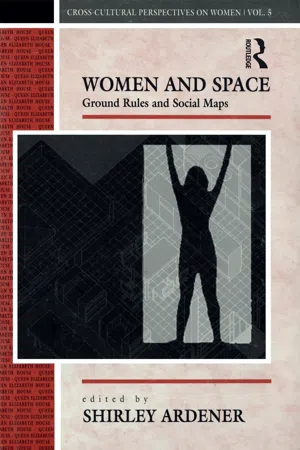
Second, Revised EditionThe relationship between women and space has now been recognized as an important issue for feminist discussion. Developments in psychology and geography have encouraged the use of `social maps' to explore the way in which space is perceived. This book presents fascinating ethnographic evidence collected by the authors from actresses, politicians, farmers and housewives in England, Africa, Iran, Peru, Greece and the former Soviet Union. This evidence illustrates how space must be considered both in its physical dimensions and in its social and symbolic aspects, as experienced by women.
Information
1
Ground Rules and Social Maps for Women: An Introduction
The Partition of Space
A restricted area like a club, a theatre or a nation-state has a set of rules to determine how its boundary shall be crossed and who shall occupy that space. Those who enter it will share certain defining features: they will perhaps have met specific criteria of club membership, bought a ticket or passed a citizenship test. In some way they must be recognised, say by a gate-keeper, such as a hall porter, an usherette or an Immigration Officer, or by the other members of the category. So, too, other systems of classification will be decided by taxonomic rules of some kind, which will define ‘X’ in contrast to ‘non-X’. Thus, in studying the way people pattern their perceptions, attention has been especially drawn to the significance of the perimeters of the categories that we make in order to codify and confront the worlds we create, in which we then live, and how we cope with some of the problems that arise from the existence of these boundaries (see, for example, Douglas 1966; S. Ardener 1978).
These few words have already found us deeply involved with the point on which the chapters in this volume depend: space. For in discussing ways in which humans perceive and pattern their social worlds a notion (the boundary) has been seized and applied to the meaning of concepts, and to classification into groups, whose label is taken from the register of terms which is used primarily for the three-dimensional ‘real’ world. The extended use of such spatial terms is firmly embedded in the language in which this is written. Obvious cases would be ‘high society’, ‘wide application’, ‘spheres of interest’, ‘narrow-mindedness’, ‘political circles’, ‘deep divides of opinion’, and so forth. Such practices merely remind us that much of social life is given shape, and that when dimension or location are introduced we assert a correspondence between the so-called ‘real’ physical world and its ‘social reality’ (cf. Durkheim and Mauss 1903).1 There is, of course, an interaction such that appreciation of the physical world is in turn dependent on social perceptions of it. Measurements, and what is measured, for instance, are neither totally imperative nor just random; choice enters ‘reality’. Societies have generated their own rules, culturally determined, for making boundaries on the ground, and have divided the social into spheres, levels and territories with invisible fences and platforms to be scaled by abstract ladders and crossed by intangible bridges with as much trepidation or exultation as on a plank over a raging torrent.
This brief preamble is by way of indicating why this book on ‘women and space’ links ‘ground rules’ with ‘social maps’ and why such ambiguous pairs of terms were selected for the sub-title. As a preliminary to introducing the chapters and to giving special consideration to women, a few more general points may quickly be raised, in condensed form. It will become apparent that, while divisions of space and social formations are intimately associated, no simple one-way ‘cause and effect’ pertains, and their cumulative interdependence suggests that we should think rather in terms of ‘simultaneities’ (see E. Ardener 1971, 1977, 1978, 1989), and this should be remembered when considering the following section.
Communication systems are primarily associated in our minds with words. Nevertheless, it is by now well recognised, of course, that society has also devised many other symbolic codes. Of one, Edwin Ardener has written: ‘We might visualise a semiotic system that depended, in the absence of the power of speech, upon the apperception by the human participants of contextually defined logical relations among themselves in space. Let us say: the relevant position of each participant to another in a gathering, and to items in a fixed environment’ (1971: xliii-xliv). Thus people may ‘jockey for position’ knowing that their fellows may ‘read’ from this their social importance. Thus, as Hall puts it, space speaks.
Goffmann suggests that ‘the division and hierarchies of social structure are depicted microecologically, that is, through the use of small-scale spatial metaphors’ (1979: 1). This suggests that space reflects social organisation, but of course, once space has been bounded and shaped it is no longer merely a neutral background: it exerts its own influence. A dozen people in a small room ‘is not the same thing’ as a dozen people in a great hall; seating-space shaped by a round, rather than square, table, may influence the nature of social interaction among those seated. The ‘theatre of action’ to some extent determines the action. The environment imposes certain restraints on our mobility, and, in turn, our perceptions of space are shaped by our own capacity to move about, whether by foot or by mechanical or other transport. So: behaviour and space are mutually dependent.
As Judy Matthews in her study of community action has noted, social identity is partly determined by ‘the physical and spatial constituents of the groups’ environment’ (1980: 4); that is to say: space defines the people in it. At the same time, however (again reflexively), the presence of individuals in space in turn determines its nature. For example, the entry of a stranger may change a private area into a public one (see S. Ardener 1978: 32; 1993 ed.: 18 and Rodgers, below); similarly, ‘the Court is where the king is’. Thus: people define space.
Not only people, but, as Goffmann has said, ‘Objects are thought to structure the environment immediately around themselves; they cast a shadow, heat up the surround, strew indications, leave an imprint, they impress a part of themselves, a portrait that is unintended and not dependent on being attended, yet, of course, informing nonetheless to whomsoever is properly placed, trained and inclined’ (1979: 1). Further, as anyone who has played chess will know, objects are affected by the place in space of other objects; not only their presence, and their position, but even their absence, or ‘negative presence’, may be important.2
Structural relationships, such as in hierarchies or other ranking patterns, and systems of relationships like those of kinship, are treated in this volume as ‘social maps’, which are frequently, but not necessarily, realised on ‘the ground’ by the placing of individuals in space. In many situations we find (real or metaphysical) ‘spaces within spaces’, or ‘overlapping universes’. To understand them we may be required to ‘pull them apart’ in order first to identify each simple map (of, say ‘X’ and ‘non-X’), before reconsidering the way these correspond or are interrelated. It is as if we provide one map showing only where the roads are (or are not), and another setting out the water courses, and so on, before we compile a complex map of all the features of the terrain. Correspondingly, ideally we may ‘map’, say, the relationships between a wife and her husband (where they draw the various limits) before ‘mapping’ the same woman’s relationships to her children, in order to compile a complete picture of her family life.
Individuals (and things) belong, then, to many pairs, groups or sets, each of which may be thought of as occupying its own ‘space’, or as sharing a particular ‘universe’. Members of one group may be ‘dominant’ relative to members of another group in one ‘universe’, while in turn being ‘muted’ in relation to members of a third group sharing with them a universe differently defined.3 A woman may be ‘muted’ relative to her husband and ‘dominant’ in relation to her children; gypsy men are ‘dominant’ in their own culture and structurally ‘muted’ vis-à-vis the English (Okely 1978). In a society where, say, (a) men take precedence over women and (b) the religious is dominant in relation to the secular, the following ordering is possible: monks <- lay-men <- nuns <- lay- women (where gender is the predominant critical distinction). Alternatively (as in some Buddhist processions), where the space is primarily religious (but gender counts), we may find a redistribution of space between the poles: monks <- nuns <- lay-men <- lay-women. The second ordering is interesting because the (religious) precedence of nuns over lay-women may tend to obscure the priority of males between the sexes. This might be particularly so if, at any time or place, no monks or lay-women are present (that is, the sequence is incomplete). This may account for the inability of some to distinguish assymetries, that even bear upon them disadvantageous^. In other ‘real’ or ‘social’ spaces femaleness may be the dominant determinant, but in others yet again, gender may be irrelevant, or insignificant. Age, class and many other features, may add further complexities in situations of multiple dimensions (see S. Ardener 1992). If relationships (say between monks, nuns and lay-persons) are expressed by the distribution of people on the ground, then the application of the term ‘map’ is probably unambiguous to most readers of this book. If, however, the relationships cannot be actually ‘seen’ in physical arrangements, but only detected in other ways (such as by who speaks first, or in what manner, or by who bows to whom) then possibly the use of the term ‘map’ may be challenged. Even when an ordering is ‘jumbled up’ to the eye, or intangible, it may, however, still be convenient to our understanding to think of that ordering as a ‘map’ on which the ‘jumble’ has been simplified by a logical rearrangement of the information. No map corresponds to what can be seen: the London underground system is not accurately and completely portrayed on the map provided to the public.
Thus, in this volume the term ‘social map’ has been used broadly, and sometimes in different ways. The concept is applied to ‘historical time’ (in which ‘yesterday’ may seem ‘closer’ than the ‘distant’ past; just as some kin, living or dead, may seem ‘close’ relative to other kin). The notion of ‘private’ as opposed to ‘public’ is seen as a criterion for ‘mapping’ metaphysical space, as ‘inner’ does in opposition to ‘outer’, regardless of the fact that some ‘private places’ can really be walked into. No emphasis has been given to the distinction between ‘place’ and ‘space’, as used by geographers. The term ‘social map’, as used in this book, may be taken, perhaps, as a temporary and handy ‘folk’ term, rather than as having the status of a definitive scientific label.
Space, then, is not a simple concept. In certain societies it is coloured. Thus, among the Zuni of America, north is thought of as blue, south as red, and east as white (Durkheim and Mauss [1903] 1963: 44; Needham 1973: 33). Among the Atoni of Indonesia, south is again red (it is also associated with rulers), east is again white (and is connected with warriors, west is black (and is associated with village headman) and the north is - not blue (Zuni) - but yellow. The Irish have coloured space (Ardener 1975). Here, however, south is black (and the sphere of music, slaves, witches and the dead).
If space is an ordering principle, so, of course, is gender. These principles are often also linked, though not always in the same way. For the Irish, south is associated with women. In contrast, the Chinese see the south as male and the north as female.
In 1909 Robert Hertz wrote a classic text ‘The Pre-eminence of the Right Hand’. It is available in Needham’s 1973 translation from French into English. Thus over 80 years ago Hertz wrote:
Society and the whole universe have a side which is sacred, noble and precious, and another which is profane and common; a male side, strong and active, and another, female, weak and passive; or, in two words, a right side and a left side… . (Needham: 10)
He also equated the right with ‘rectitude’, ‘dexterity’, ‘the juridical norm’ (p.11), ‘life’ (p.12), the ‘inside’ (p.13), the ‘sacred’ (p. 12), ‘good’, and ‘beauty’ (p.12).
He associated the left with the ‘profane’ (p.12), the ‘ugly’ (p.12); with ‘bad’ (p.12), ‘death’ (p.12), the ‘outside, the infinite, hostile and the perpetual menace of evil’ (p. 13).
Hertz (drawing on Wilson’s report of 1891) noted that among North American Indians ‘The right hand stands for me, the left for not-me, others’. Drawing on Mallery (1881) Hertz noted that ‘The raised right hand signifies bravery, power, and virility, while on the contrary the same hand, carried to the left and placed below the left hand, signifies, according to context, the ideas of death, destruction, and burial’.
After discussing Australian beliefs (of the Wulwanga), Hertz concludes it is not chance that God took one of Adam’s left ribs to create Eve, ‘for one and the same essence characterises woman and the left side of the body - two parts of a weak and defenceless being, somewhat ambiguous and disquieting, destined by nature to a passive and receptive role and to a subordinate condition’.
Since Hertz, social anthropologists have travelled the world collecting world-views from different cultures. Many have described systems of dual classification, and a selection of studies can be found in Needham (1973). These schemes of perception which elsewhere Bourdieu (1977: 15) speaks of finding, include those ‘which divide the world up in accordance with the oppositions between male and female, east and west, future and past, top and bottom, right and left… .’ To which we may add public/private and inside/outside (a particular concern of modern Greeks, as shown by Hirschon below). Thus Faron (Needham: 196) provides two lists from Chile demonstrating the ‘Mapuche inferior-superior, left-right hand associations’ adding that ‘There are many indications of male superiority and association with the right as well as with good and the sacred’. There is also ‘an unmistakable and literal connection between left and evil, right and good’. Again, van der Kroef (ibid.: 180) correlates pairs of oppositions among the people of Amboyna in Indonesia. Other sets of dual classification for the Gogo of Tanzania (Peter Rigby: 279), for the Kaguru of Tanzania (Beidelman: 151), for the Meru of Kenya (Bernardi: 116), and for the Fulani of West Africa (Stenning: 122), document this approach. Reference to the association of women and the left arise in the discussions below (see, for example, Sciama) and the disempowered (Rodgers).
Now it would be a diversion to go into further details on dual classification here; it is a field requiring delicate handling - especially of the relationship between concepts placed in vertical lists. There is, indeed, no attempt here at a comprehensive analysis of all the characteristics of space; the literature is in any case already extensive. McDowell, for example, has provided a useful review of material on the gender division of urban space. For some Marxist analyses of place and space see the work of David Harvey. The few simple, but fundamental points raised above are merely reminders of the general context in which the following discussions are to be viewed. The chapters below provide illustrations of them, and give some examples of their special relevance to women. Although there is no pretence to comprehensiveness, one more aspect must, nevertheless, be mentioned: the relationship of time and space. When we speak of ‘the world getting smaller’ through the advent of air travel, or of a distance being ‘five minutes’ walk away’, we clearly acknowledge that time and space are ‘mutually affecting spheres of reality’, where ‘reality’ is understood to depend upon human apperceptions. Paine quotes a resident of Israel who felt that by settling in Israel he had taken a leap back in time which made him closer to David and Uzziah than to the contemporary shtetl in Poland. One could say that by a change of place time had been collapsed, or elided. This reminds us of Harvey’s comment that ‘nearness does not consist of shortness of distance’ (1990) and Edwin Ardener’s study of ‘remoteness’ (1987). ‘Time-systems occupy spaces which are generated by and with the physical and social space’ (E. Ardener 1975b: 11).4
Time and Place
Time, then, is particularly closely associated with space. Indeed, for some, space and time are homologous. Drid Williams, for example, in her description of the daily routine of the Carmelite nuns shows how her situation in space can always be told by her situation in time (and vice versa). Thus ‘a nun who spends sixty years in a Carmelite enclosure… is in the same place at the same time exactly 42,800 times during those years’. But further subtleties emerge which take us into a more abstract realm. Williams writes, ‘It is as if the Carmelite has two “maps”: one which locates her in ordinary space-time, and another consisting of an “interior territory” of a spiritual and psychological nature in which she is located at the same time.’ As Williams writes, ‘this represents a rather dif...
Table of contents
- Cover
- Half Title
- Series Page
- Title Page
- Copyright Page
- Contents
- Preface
- 1. Ground Rules and Social Maps for Women: An Introduction
- 2. Andean Women and the Concept of Space/Time
- 3. Women’s Space in a Men’s House: The British House of Commons
- 4. Essential Objects and the Sacred: Interior and Exterior Space in an Urban Greek Locality
- 5. The Problem of Privacy in Mediterranean Anthropology
- 6. Sexual Prohibitions, Shared Space and ‘Fictive’ Marriages in Shi’ite Iran
- 7. Place and Face: Of Women in Doshman Ziāri, Iran
- 8. The Sexual Division of Domestic Space among Two Soviet Minorities: The Georgians and the Tadjiks
- 9. Spatial Domains and Women’s Mobility in Yorubaland, Nigeria
- 10. Where Women Must Dominate: Response to Oppression in a South African Urban Community
- 11. Private Parts in Public Places: The Case of Actresses
- Bibliography
- Index
Trusted by 375,005 students
Access to over 1.5 million titles for a fair monthly price.
Study more efficiently using our study tools.
Frequently asked questions
Yes, you can cancel anytime from the Subscription tab in your account settings on the Perlego website. Your subscription will stay active until the end of your current billing period. Learn how to cancel your subscription
No, books cannot be downloaded as external files, such as PDFs, for use outside of Perlego. However, you can download books within the Perlego app for offline reading on mobile or tablet. Learn how to download books offline
We are an online textbook subscription service, where you can get access to an entire online library for less than the price of a single book per month. With over 1.5 million books across 990+ topics, we’ve got you covered! Learn about our mission
Look out for the read-aloud symbol on your next book to see if you can listen to it. The read-aloud tool reads text aloud for you, highlighting the text as it is being read. You can pause it, speed it up and slow it down. Learn more about Read Aloud
Yes! You can use the Perlego app on both iOS and Android devices to read anytime, anywhere — even offline. Perfect for commutes or when you’re on the go.
Please note we cannot support devices running on iOS 13 and Android 7 or earlier. Learn more about using the app
Please note we cannot support devices running on iOS 13 and Android 7 or earlier. Learn more about using the app
Yes, you can access Women and Space by Shirley Ardener in PDF and/or ePUB format, as well as other popular books in Social Sciences & Anthropology. We have over 1.5 million books available in our catalogue for you to explore.