In this essay the author presents the principles of one important sector of social organization in Japan, and establish its framework. Japanese kinship structure, with its multiple historical and local factors, and unlike that of the Chinese or of the Hindus, does not belong to the category of unilineal systems, nor to any kind of descent pattern found in the published literature of social anthropology. Social anthropology, developed by micro-synchronic studies of simpler societies, and with its major analysis devoted to descent systems, has to face in Japan a critical methodological test. In this essay, the author, as a social anthropologist, want to overcome these drawbacks of anthropological method, and to demonstrate one of the new approaches by which an anthropologist can cope with the data from a sophisticated society
- 236 pages
- English
- ePUB (mobile friendly)
- Available on iOS & Android
eBook - ePub
Kinship and Economic Organisation in Rural Japan
About this book
1
Basic Structure of Household and Kinship
CONCEPT OF IE (HOUSEHOLD)
The primary unit of social organization in Japan is the household. In an agrarian community a household has particularly important functions as a distinct body for economic management. A household is normally formed by, or around, the nucleus of an elementary family, and may include relatives and non-relatives other than these immediate family members. Its composition varies according to the specific situation, such as the stage in the cycle of the domestic family, and the economic situation of the household. However, its sociological importance is such that a household of any kind of composition is regarded as one distinct unit in society, represented externally by its head, and internally organized under his leadership. Once established a household is expected to remain intact in spite of changes of generations. In a village community it is the household, not family or kin group, that forms the basis of social organization.
This co-residential group forms an independent property group, the members of which alone have exclusive rights of inheritance. The members of the household, sharing the common economy, are considered as the closest social entities to ego, more important than any other, even close kin, who are not members of the household. This strong consciousness of the residential domestic group is symbolically phrased in terms such as 'under the same roof, or 'the relationship in which one shares the meals cooked in the same pot'.
This basic sociological unit of co-residential members of a house is called ie in Japanese.1 The term ie is often used in sociological literature as an equivalent of family, but the English term household is closer to the conception since it includes all co-residents residents and is not necessarily restricted only to the members of a family. Strictly speaking, ie is a unit which is primarily defined by the criterion of local residence, while family involves primarily kinship and affinity. In Japanese etymology ie itself indicates residential criteria, signifying 'hearth' (he). (I is a prefix: the combination of i and he becomes ie.) The house building itself is also called ie. Further, the ie is not simply a contemporary household as its English counterpart suggests, but is conceptualized in the time continuum from past to future, including not only the actual residential members but also dead members, with some projection also towards those yet unborn. The ie is always conceived as persisting through time by the succession of the members. Hence succession to the headship is of great functional importance, and the line of succession is the axis of the structure of ie, while the house gives the material and social frame of ie. The members of a household normally correspond to a family, but the shape and composition of a family are always subject to the structure of ie; at the same time the ie has the capacity to include persons other than immediate members of the family.
1 Ie is pronounced as two syllables: e in the Japanese romanization is always pronounced as é in French. The romanization in this book is according to the Hepburn system.
Once established, the house building itself becomes an indivisible spatial unit, forming a basic social unit in a community. An individual must first be a member of a household; it is a fairly widespread custom that a house has a house-name by which individual members are addressed. The organization of a community in rural Japan is built only on the basis of the household, not on the individual of the family, or on the descent group. Thus the ie is the most important structural element in the analysis of kinship and economic organization in rural Japan.
PRINCIPLES OF HOUSEHOLD SUCCESSION
The head of the household, a position normally occupied by the father of a family, manages its farming, controls its property, and represents the household externally. The property and other various kinds of rights which are of vital importance for agriculturists are attached to the household—theoretically at least not to the individual or to any kind of descent group. These rights, in their operation, are held by the head exclusively, and he should be succeeded by one of his sons, who has the right to share in the
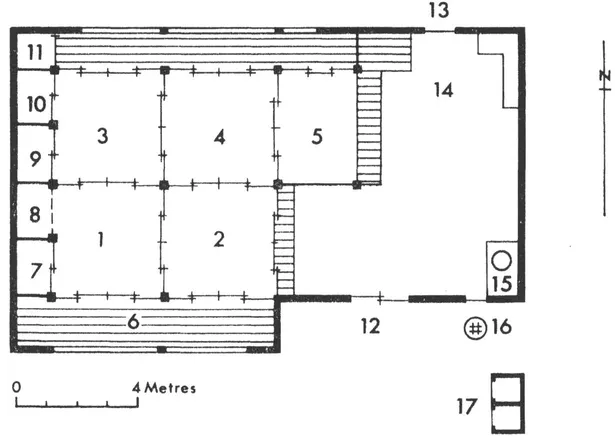
figure I. Plan of a Farmer's House (Ie) I. Guest room: facing the garden; where guests are entertained formally. 2. Living room: also used for greeting guests. 3. Shrine room: this room is used for prayers, but otherwise is hardly used in daily life. 4. Bedroom: other rooms can also be used as bedrooms. 5. Dining room: an open hearth (irori or he) about I metre square is commonly placed near the entrance of this room, except in warmer areas such as Koshiozu. This room opens on to the kitchen (ground level) and together with it serves as a general living room. These five rooms are divided by sliding doors (seen in Plate 8b), so that it is possible to open up a larger space on special occasions; their floors are about 70 cm above ground level, and are covered with thick straw mats. 6. Corridors run along both sides of the house, with wooden sliding doors along their outer edges which can be closed at night. At the entrances of rooms 2 and 5, the floor projects as small platforms into the kitchen. 7, 10 and 11. Closets. 8. Tokonama (alcove): the honourable centre of the house, ornamented by a picture and arranged flowers, as seen in Plate 8b. 9. Shrine; an image of Buddha and ancester tablets etc. are placed for daily Buddhistic service. 12. Main Entrance. 13. Back-door. 14. Kitchen: the rest of this large space at ground level is used as a workroom. 15. Bathroom. 16. Well. 17. Lavatory.
This plan, with four raised rooms and a ground level kitchen at the side, is the basic pattern of the traditional peasant house. (This particular plan is taken from a house in Koshiozu village.) The plan can be enlarged, either by adding rooms to the west or north, or by adding a second floor (as seen in Plate 3a).
management of the property on the ground of his being a co-residential member making a considerable contribution of labour to the economy, and a man on whom the head can depend in his old age. In rural Japan it is common for the transmission of the headship to take place during the father's lifetime.
There are two important rules of succession to the headship common throughout Japan. One is that the head should be succeeded by the 'son, not by any other kind of kinsman. However, the successor is not necessarily the real son; any male (whether he be kin to the head or not) can be 'the son' provided that the necessary legal procedure has taken place for him to become a member of the household (ie) by the relationship commonly expressed as 'adopted son' or 'adopted son-in-law'.
The adopted son is taken when the head has no real child. The adopted son-in-law is taken when the head has no son but a daughter. When the daughter's husband becomes the successor of his father-in-law, as well as the inheritor of the father-in-law's household property, he is called an adopted son-in-law. An adopted son-in-law may also be taken when the head has no child, in the following manner: the head may adopt a daughter first and later by her marriage obtains an adopted son-in-law. Or, without any child, he may adopt a young married couple as son-in-law and daughter-in-law. An adopted son or adopted son-in-law may become the successor even when the head has a real son, though such cases are rare; when the head considers his real son is not fit to be his successor, such action may be taken.
By the adoption of son or son-in-law, the 'father' and 'son' relationship is firmly established, as expressed by the fact that an adopted son or son-in-law takes the surname or the same personal name as the head.1 This he assumes as if he were the real son, being cut off legally from his real father and the members of his natal household.
1 Before the Meiji period, commoners were not allowed to have surnames. There was, however, a widespread usage by which the successor took his predecessor's personal name.
This adopted son may be taken from among the kinsmen of the head, such as his younger brother, cousin, or more remote relatives (including his wife's). But a man who has no kinship relation at all to the head is often taken. In some cases a servant or a collaborator of the head may become an adopted son, or son-in-law. Normally the adoption takes place between households of fairly equal status, as in the case of a marriage arrangement, which I describe later (pp. 152, 158).
Adoption has been very common among Japanese. This is because every household, once established, needs a successor to the head. An adopted son or adopted son-in-law has exactly the same rights in succession and inheritance as the real son. This is closely related to the rule that rights of succession and inheritance in the ie only go along the line of 'father' to 'son', and not through any other consanguineal descent line.1 For the continuation of the ie, one must have a son to whom the headship and property can be transmitted. If a man has not established a relation of 'son' to the head, he has no right of succession, and though he may get a share of the property when he becomes independent from the household, which implies a kind of analogy to the father-son relation, he is clearly differentiated from the 'son'. (The details will be discussed in Chapter 3.)
1 In the absence of a grown-up son (real or adopted), the wife or daughter (or other members of the household) of the deceased head may act as the head, but in such cases their role appears to be only temporary.
Through this 'father-son' relationship (whether by initial kinship or by adoption) inescapable economic and moral ties are established between the two statuses: the son, being given the economic advantage, has an obligation to feed his predecessor in his old age, and the latter's dependants. Among an agricultural population the household is thus a distinctive enterprise with insurance for old members, rather than simply the residence of a family. Thereby it entails the strong desire to ensure its continuance: to get a successor is the great concern of the household head.
Another important rule of succession to headship of the household is that it should be by one son only; never by two or more sons jointly. Whatever the composition of a household may be, its basic structure is always in terms of this principle. Hence in Japan, theoretically there has been no joint family structure like that of the Chinese or the Hindus. If a household is occupied by two brothers with their wives and children, there is a sharp functional and status distinction between the two—between the successor and the non-successor. The family of the non-successor is considered as comprising 'extra members', not 'full members' of the household. In fact it is very rare for two married brothers to reside in the same household for a long time, though sometimes such cases do occur, possibly because of the economic situation. Even in such a case the brother of the head never becomes the successor unless he becomes an adopted 'son' of the latter. The principle of father-son succession is combined with the principle of the one-son-succession, and produces a residential pattern in which married siblings are expected to have separate households. Non-successors are supposed to leave the father's household on marriage, whether or not they may be given a share of the property. Once they have established their own independent households, each forms a distinctive property unit, in which again the same principle operates.
This process entails status differentiation, among the brothers: successor and non-successor. In actual working, inheritance tends to be influenced by the principle of succession; the successor always gets the father's house and tends to have the lion's share of the father's property. This distinction becomes more obvious when the household possesses considerable property, and has high social prestige in the community. Even if the land is divided equally among the brothers, the successor gets the father's household with various rights and advantages, including the prestige of having an older house to which the ancestor cult is attached. Thus a non-successor is at a disadvantage through his inferior social and economic situation. Further it is a frequent phenomenon that an outstandingly wealthy household in a community tends to maintain an especially sharp discrimination between successor and non-successor, because it desires to keep its social and economic status intact.
This situation may appear also among the less wealthy, among households with little land to be divided among sons. In such a case it is a very common arrangement in rural Japan for the successor to take the property intact, while his brothers leave the household without receiving any share, and seek their fortune somewhere else. However, the household would give the departing brothers shelter until they could establish themselves. It is interesting to observe that today, though the 1947 post-war Civil Code ...
Table of contents
- Cover
- Half Title
- Series Page
- Title Page
- Copyright Page
- Preface
- Contents
- Plates
- Map
- Figures
- Tables
- 1. BASIC STRUCTURE OF HOUSEHOLD AND KINSHIP
- 2. BASIC VILLAGE ORGANIZATION IN HISTORICAL PERSPECTIVE
- 3. ANALYSIS OF LOCAL CORPORATE GROUPS WITHIN A VILLAGE
- 4. THE FUNCTION OF MARRIAGE RELATIONS
- CONCLUSION
- BIBLIOGRAPHY
- INDEX
Trusted by 375,005 students
Access to over 1.5 million titles for a fair monthly price.
Study more efficiently using our study tools.
Frequently asked questions
Yes, you can cancel anytime from the Subscription tab in your account settings on the Perlego website. Your subscription will stay active until the end of your current billing period. Learn how to cancel your subscription
No, books cannot be downloaded as external files, such as PDFs, for use outside of Perlego. However, you can download books within the Perlego app for offline reading on mobile or tablet. Learn how to download books offline
Perlego offers two plans: Essential and Complete
- Essential is ideal for learners and professionals who enjoy exploring a wide range of subjects. Access the Essential Library with 800,000+ trusted titles and best-sellers across business, personal growth, and the humanities. Includes unlimited reading time and Standard Read Aloud voice.
- Complete: Perfect for advanced learners and researchers needing full, unrestricted access. Unlock 1.5M+ books across hundreds of subjects, including academic and specialized titles. The Complete Plan also includes advanced features like Premium Read Aloud and Research Assistant.
We are an online textbook subscription service, where you can get access to an entire online library for less than the price of a single book per month. With over 1.5 million books across 990+ topics, we’ve got you covered! Learn about our mission
Look out for the read-aloud symbol on your next book to see if you can listen to it. The read-aloud tool reads text aloud for you, highlighting the text as it is being read. You can pause it, speed it up and slow it down. Learn more about Read Aloud
Yes! You can use the Perlego app on both iOS and Android devices to read anytime, anywhere — even offline. Perfect for commutes or when you’re on the go.
Please note we cannot support devices running on iOS 13 and Android 7 or earlier. Learn more about using the app
Please note we cannot support devices running on iOS 13 and Android 7 or earlier. Learn more about using the app
Yes, you can access Kinship and Economic Organisation in Rural Japan by Chie Nakane in PDF and/or ePUB format, as well as other popular books in Economics & Development Economics. We have over 1.5 million books available in our catalogue for you to explore.