Industrial IoT (IIoT) and Industry 4.0 are newly developing and fast emerging domains of interest among students, researchers, and professionals in academia and industry. Due to the popular demand of this topic, Introduction to Industrial Internet of Things and Industry 4.0 is written to serve a diverse readership from the domains of computer science and engineering, mechanical engineering, information technology, industrial engineering, electronics engineering, and other related branches of engineering. Based on the lead author's massive open online courses (MOOCs), this book can be used as a textbook on the emerging paradigm of Industry 4.0 and IIoT, as well as a reference for professionals working in sectors of IIoT.
The book covers the significant aspects of IIoT in detail, including sensors, actuators, data transmission, and data acquisition, which form the core of IIoT. Topics and concepts are presented in a comprehensive manner, so that readers can develop expertise and knowledge. The book helps beginners to gain a basic idea of Industry 4.0 and IIoT as the first section is an overview of IoT applications, infrastructure-based protocols, cloud computing, and fog computing. The second section is designed to impart a basic knowledge of Industry 4.0 and IIoT as well as of the different phases of development in industry. Delving into more advanced areas, other sections in the book cover:
The business models and reference architecture of IIoT
The technological aspects of Industry 4.0 and IIoT
Predictive and prescriptive analytics applied in IIoT-based implementations
Applications and case studies of IIoT
Key enabling technologies of IIoT
To aid students and professional master IIoT and Industry 4.0, the book includes conceptual questions, exercises, and learning objectives.
This chapter covers the basics of the Internet of Things (IoT), architecture, and its protocols.
New readers will be able to have an understanding of the basic protocols of IoT, which will help them to grasp the concepts of the Industrial Internet of Things (IIoT).
Additionally, the readers will get a flavor of cloud computing, fog computing, and big data technology.
For seasoned learners, this chapter will ease the revision of their exixting knowledge.
The reasons for the shift of technology from the traditional methods to cloud, mobile cloud, and fog computing are outlined.
The concept of providing physical sensor nodes as service on-demand is also outlined in this chapter.
1.2Introduction
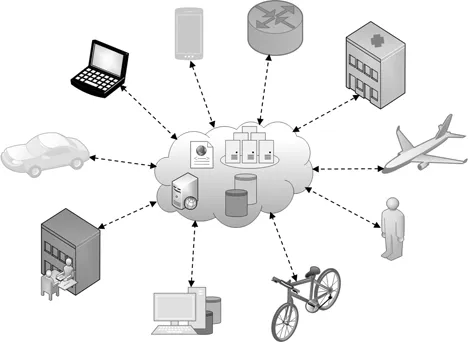
The rapid advancement in technologies has resulted in automation, and real-time analytics being applied across various interesting fields such as wildlife monitoring, agriculture, military, healthcare, manufacturing, transportation, supply chain, and inventory management. Internet connectivity has become a basic necessity around the globe where IoT connects billions of people by mobile devices, giving rise to immense processing power, storage capabilities, and knowledge access throughout the world. The interconnection of the physical devices such as appliances, vehicles, and human beings with the help of sensors, actuators, and software leads to the formation of a network. This technology enables the physical devices to communicate, interact, process, and exchange data among themselves. As shown in Fig. 1.1, physical objects such as mobile, laptop, bicycle, car, desktops, and even human beings can coordinate and communicate among themselves to form a network. The network of these physical devices is termed as ‘Internet of Things’ (IoT). Kevin Ashton, a British Technology pioneer, at The Massachusetts Institute of Technology (MIT), coined the term ‘Internet of Things.’ He used the term IoT to explain a system, which connects the physical devices over the Internet through sensors. However, CISCO estimates that the concept of IoT evolved between 2008 and 2009. With the help of IoT, physical Things are converted into smart objects, in turn enabling them to be remotely monitored and controlled over the network. Therefore, This leads to amelioration in efficiency, automation, accuracy, and advanced applications.
Figure 1.1:Internet of Things.
There has been a significant impact of IoT on the growth of connected devices in the past few years. Although IoT has intricate functionalities, its internal working is quite complicated because of the multiple sensing and communication protocols involved with it. IoT has a wide range of applications in the field of agriculture, healthcare, manufacturing, transportation, environmental monitoring, and others. There are few issues in IoT, which require addressing, such as interoperability among The devices, scalability, and processing of the colossal amount of data generated.
This chapter mainly addresses the basics of IoT, the architecture of IoT, communication protocols of IoT, basics of networking, Cloud computing, fog computing, and big data. The readers are suggested to go through the suggestions given in the CHECK YOURSELF section.
Check yourself
Networking: Basic concepts, OSI model, Layers in the OSI model, TCP/IP Protocol Suite, Physical and Logical Addressing.
1.3IoT Architecture
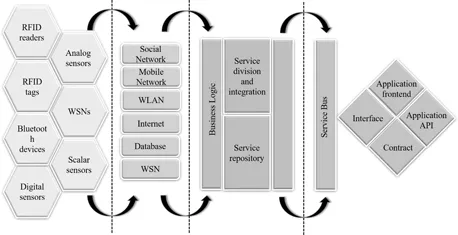
The IoT platform connects heterogeneous devices or systems over The network. A Service-Oriented Architecture (SOA) can be designed to validate the basic IoT architecture. There are four different layers of IoT — (1) sensing layer, (2) networking layer, (3) service layer, and (4) interface layer, as shown in Fig. 1.2 [6].
Sensing layer: The sensing layer consists of IoT devices that are equipped with sensor nodes, Bluetooth devices, scalar sensors, analog sensors, digital sensors, and RFID tags as outlined in Fig. 1.2. The sensor nodes sense, process the sensed information, transmit the real-time information, and communicate among themselves. Moreover, these sensor nodes consume low power and require low data-rate connectivity. They form a Wireless Sensor Network (WSN) among themselves. Based on the application type, these sensor nodes are grouped. Each of the IoT devices has a Universal Unique Identifier (UUID).
Networking layer: The networking layer helps the IoT devices to share information with other devices. Additionally, this layer handles the colossal amount of data generated by these IoT devices. Certain QoS requirements should be fulfilled to retain communication among these heterogeneous devices. Concerning Fig. 1.2, the networking layer consists of Social Networks, Mobile Networks, WLAN, Internet, Databases, and WSNs. Therefore, the design issues to be kept under primary considerations are latency, scalability, bandwidth requirements, energy efficiency, security, and privacy.
Service layer: The service layer consistently integrates the services and applications in IoT. This layer executes the overall workflow process, which includes information exchanges, communication, storage, and data management. Additionally, various forms of predictive analytics are performed in this service layer. Further, this layer also maintains trust and utilizes the information extended by the other services.
Interface layer: The heterogeneous IoT devices do not always follow the same IoT protocol. Due to the presence of various types of IoT devices, problems in interaction exist among these devices. In addition to this, with the rapid increase in IoT devices, it becomes quite difficult to connect, communicate, and operate these devices dynamically. Therefore, an interface layer is essential, which can systematically streamline the management and interconnection among things. For example, a call center operator who can communicate only in English and Chinese receives a call in Spanish. If the received call is not interpreted dynamically, the operator will fail to make sense of the ensuing communication. Therefore, there must be a common language for communication between them.
Figure 1.2:IoT architecture.
1.4Application-based IoT Protocols
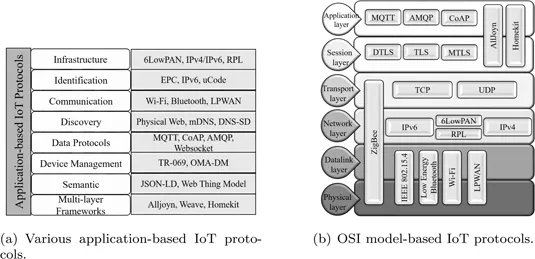
There are few standard protocols involved for various applications in IoT, as illustrated in Fig. 1.3. As the network user can be a human being, a machine, or an object, there are Few complications involved in the IoT networks [7], which are as follows:
Rapid growth in the number and heterogeneous IoT devices.
There are certain infrastructure-based IoT protocols such as 6LowPAN, IPv4/IPv6, and RPL, as depicted in Fig. 1.3.
6LowPAN: This is a low-power Internet Protocol version 6 (IPv6)-based technology for packet delivery in Wireless Personal Area Networks. 6LowPAN allows low-power devices with limited processing power to be connected over The Int...
Table of contents
Cover
Half Title
Title Page
Copyright Page
Dedication
Contents
Foreword
Author Biographies
Preface
Endorsements
1 Overview of Internet of Things
2 Overview of Industry 4.0 and Industrial Internet of Things
3 Industry 4.0: Basics
4 Industrial Internet of Things: Basics
5 Business Models and Reference Architecture of IIoT
6 Key Technologies: Off-site Technologies
7 Key Technologies: On-site Technologies
8 Sensors
9 Actuators
10 Industrial Data Transmission
11 Industrial Data Acquisition
12 Introduction to IIoT Analytics
13 Machine Learning and Data Science in Industries
14 Healthcare Applications in Industries
15 Inventory Management and Quality Control
16 Plant Safety and Security
17 Case Studies
18 Test Your Understanding
References
Index
Trusted by 375,005 students
Access to over 1.5 million titles for a fair monthly price.
Study more efficiently using our study tools.
Frequently asked questions
Yes, you can cancel anytime from the Subscription tab in your account settings on the Perlego website. Your subscription will stay active until the end of your current billing period. Learn how to cancel your subscription
No, books cannot be downloaded as external files, such as PDFs, for use outside of Perlego. However, you can download books within the Perlego app for offline reading on mobile or tablet. Learn how to download books offline
Perlego offers two plans: Essential and Complete
Essential is ideal for learners and professionals who enjoy exploring a wide range of subjects. Access the Essential Library with 800,000+ trusted titles and best-sellers across business, personal growth, and the humanities. Includes unlimited reading time and Standard Read Aloud voice.
Complete: Perfect for advanced learners and researchers needing full, unrestricted access. Unlock 1.5M+ books across hundreds of subjects, including academic and specialized titles. The Complete Plan also includes advanced features like Premium Read Aloud and Research Assistant.
Both plans are available with monthly, semester, or annual billing cycles.
We are an online textbook subscription service, where you can get access to an entire online library for less than the price of a single book per month. With over 1.5 million books across 990+ topics, we’ve got you covered! Learn about our mission
Look out for the read-aloud symbol on your next book to see if you can listen to it. The read-aloud tool reads text aloud for you, highlighting the text as it is being read. You can pause it, speed it up and slow it down. Learn more about Read Aloud
Yes! You can use the Perlego app on both iOS and Android devices to read anytime, anywhere — even offline. Perfect for commutes or when you’re on the go. Please note we cannot support devices running on iOS 13 and Android 7 or earlier. Learn more about using the app
Yes, you can access Introduction to Industrial Internet of Things and Industry 4.0 by Sudip Misra,Chandana Roy,Anandarup Mukherjee in PDF and/or ePUB format, as well as other popular books in Technology & Engineering & Cloud Computing. We have over 1.5 million books available in our catalogue for you to explore.