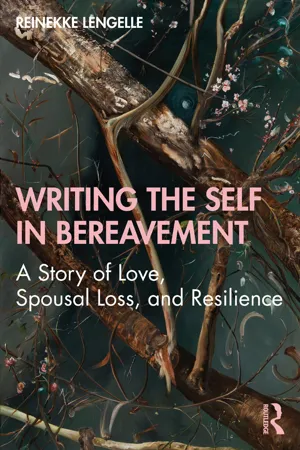
Writing the Self in Bereavement
eBook - ePub

Writing the Self in Bereavement

A Story of Love, Spousal Loss, and Resilience

  1. 206 pages
  2. English
  3. ePUB (mobile friendly)
  4. Available on iOS & Android
eBook - ePub

Writing the Self in Bereavement

A Story of Love, Spousal Loss, and Resilience

About this book

Winner, ICQI 2022 Outstanding Qualitative Book Award

In Writing the Self in Bereavement: A Story of Love, Spousal Loss, and Resilience, Reinekke Lengelle uses her abilities as a researcher, poet, and professor of therapeutic writing to tell a heartfelt and fearless story about her grief after the death of her spouse and the year and a half following his diagnosis, illness, and passing.

This book powerfully demonstrates that writing can be a companion in bereavement. It uses and explains the latest research on coming to terms with spousal loss without being prescriptive. Integrated with this contemporary research are stories, poetry, and reflections on writing as a therapeutic process. The author unflinchingly explores a number of themes that are underrepresented in existing resources: how one deals with anger associated with loss, what a healthy response might be to unfinished business with the deceased, continuing conversations with the beloved (even for agnostics and atheists), ongoing sexual desire, and secondary losses.

As a rare book where an author successfully combines a personal story, heart-rending poetry, up-to-date research on grief, and an evocative exploration of taboo topics in the context of widowhood, Writing the Self in Bereavement is uniquely valuable for those grieving a spouse or other loved one, those supporting others in bereavement, and those interested in the healing power of poetry and life writing. Researchers on death and dying, grief counsellors, and autoethnographers will also benefit from reading this resonant resource on love and loss.

2025 News - Writing the Self in Bereavement has been translated into Greek, a collaboration between the Greek publishing house PEDIO and the Institute Logo Psychis (Institute for Education and Research in Systemic Psychotherapy).

Information

Publisher
Routledge
Year
2021
Print ISBN
9780367643348
9780367643331
Edition
1
eBook ISBN
9781000337044

1

EARLY GRIEF

When a friend reaches across the table and asks
what do you miss most?
Sorrow rises in me like a lake
for a moment I cannot even speak
water fills the capillary fringe
I do not resist grief’s inner surge
I am learning to welcome it all
It is a winter morning: December 1, 2018, to be exact. Despite the snow blanketing the yard, the house sparrows in the giant blue spruce in the front are chirping their wake-up songs. My Aunt Bea calls the five huge conifers around my house divas and I have been calling them that for years now too. The birds are company for me as I start this book. They remind me there is cheer in the world.
They seem to say, as Frans did just 2 weeks ago, ā€œLife goes on, my love.ā€
Frans died of cancer on November 16, 2018. He was sick for 7 months, and in that span of time, he went from a healthy, jovial man of 190 pounds to a thin, emaciated man of 140 pounds. He did not lose his vibrant spirit, though, and he spoke about life, work, and politics until the very end. In the last hour, he even spoke about Brexit and then quipped, ā€œWell, that’s not my worry anymore!ā€
He did not want to die, but he knew he would.
āˆ—āˆ—āˆ—
I have a hunch
That missing someone
is about being known
Having a witness
to what dwells within
beyond the domestic
(but it includes that too).
I imagine how
after a day of writing
or an afternoon talking to the kids
or an evening out with friends
(when I have come home to myself again)
I will sit in bed
take out the pen you gave me
and write as many pages as it takes.
Address: him, general delivery, cosmos
because I will (still) want to tell you
what I think it all means.
I wrote this poem several months before Frans died and shared it with him. We cried together. My poems were sometimes a starting point for our conversations about his illness and impending death. A few lines from this poem were also printed on the invitation to his funeral. Some people have let me know it has touched them and reminded them of their own losses.
I realize I wrote it hoping to bridge the gap between my experience of Frans alive and Frans no longer alive. It was an exercise in throwing an object over a fence into the future so that I could pick it up on the other side and shout back to him, ā€œYes, remember, I said this would happen, now it has happened and you already knew …. So we can share this too. We can still make memories.ā€
There is no doorway between the yards of past and present, of course, but I reach across this divide through my writing.
Poetry has been a way for me to express feelings, to confront the reality of loss, and to express to Frans how much I loved him and would miss him. This poem comforted me after his death as it reassured me various times that I could reach out to him and also perceive his likely response. This is what author Blake Paxton (2018) explores in his book on continued bonds with the deceased, when he speaks about remembering those who have left us: ā€œThese rituals might include telling stories about those who have died, having imagined conversations with the deceased, celebrating their birthdays ā€¦ā€ (p. 111).
This visceral reality of having lost my companion and witness visits me often. Even upon revisiting and fine-tuning this manuscript a year and a half after his death, the pain is still palpable and sometimes sits like a watery mass just under the surface. It is the most tender thing to tell anyone, including myself.
When Frans died, a part of my conversational world died off like a favorite room, full of life, that had to be closed before either of us wanted to leave it.
I miss his touch. His voice. Our touch. Our intimate conversation about life, love, and work.
āˆ—āˆ—āˆ—

Imperfect Us

ā€œFalling in love and losing a partner are exceptionally important and intense psychological conditions within the relational sphere, confined by time.ā€ Gerard Wijers1
This morning, our friend and colleague Gerard and I spoke about the need for fuller disclosure about a life shared and a love lost. We talked on the phone about what it means to be a poet and to want to tell the truth about one’s experience.
He said, ā€œFor mere mortals, it might be okay to tell only the good things about a beloved who has died and make them into a kind of saint, but for a poet that is simply wrong.ā€
Yes, I thought, what do you give to the reader if you turn your beloved into a saint? Nothing. And first of all, I give myself nothing.
This conversation helped give me permission to explore everything that called for attention, even the anger that I experienced in the early months of grief.
I read similar sentiments in Carolyn Ellis’s (2018) book Final Negotiations, where she writes about her terminally ill partner: ā€œThe relationship story shows the ambiguous, complex and contradictory aspects of my connection to Gene as we interacted in our day-to-day lives, confronted epiphanies, managed attachment and loss, and struggled to make our life together meaningfulā€ (p. 5).
āˆ—āˆ—āˆ—
My relationship with Frans had an intensity that I would call at once whole and entangled. He was my partner and lover, my intellectual mate, and we pressed on each other’s vulnerabilities. We found in each other an equal, someone who both inspired us and challenged us mightily. We talked, we wrote, we learned, we fought, and we loved each other passionately. Our dynamic brought out the best I could be professionally, and I credit our relationship for teaching me to be more open about my needs and boundaries. He spoke most about the emotional learning he did with me, and the creative dimension that began to infuse his academic work as a result of our collaborations.
We were for each other the second spouse and each of us have two daughters from our first marriages. The road to becoming partners was long, gradual, and, at times, painful. With respect and care for our first spouses, we both divorced, committed to a life together, and spoke at the end of his life of our gratitude for having ā€œgone for itā€ despite the challenges of geographical distance and blended-family realities.
He called the years we spent together ā€œthe happiest of [his] life.ā€ As academics, we traveled frequently and spent most of our time in Canada and The Netherlands. We visited many cities in Europe and the United States and spent long summers in Alberta. We also shared our family lives: I got to know his daughters and son-in-law and my daughters spent a year in The Netherlands with us when I was on sabbatical working on my PhD. Frans and I wrote more than 25 book chapters and articles together, and we were still working actively when he was diagnosed at age 67. We had just presented our career research work in Ottawa, Ontario, when the bad news came.
We got frequent visits from my family from Canada and Frans was a generous and cheerful host. I got to know Frans’s siblings and nephews, and his friends and colleagues regularly came to see us. Frans also loved being in Canada. Having a whisky in the sunroom in Edmonton with my mother and stepfather, or with my first husband, Keath, were cherished moments that Frans reminisced about when he was ill. We felt blessed to be surrounded by so many loving people.
Death cut short the life we loved and had hoped to continue, but the way through illness and death was mostly blessed and Frans died with grace, making courageous decisions.
Frans used to say, ā€œExcept for the fact that I’m dying, I have nothing to complain about.ā€ He did not deny his illness and his death, and he went toward it openly, something that was both beautiful and meaningful to many.
āˆ—āˆ—āˆ—
I correspond with a number of people about my grief journey and I am grateful to those who make room for the range of feelings I have—not only deep sorrow and loneliness, but also anger, joy, and a sense of possibility. The ambivalence felt by those grieving is mentioned in the literature, but taboos against speaking about anything other than sorrow or positive feelings about the deceased are deep-seated and can block our ability to be honest, even with ourselves (Lengelle, 2020; Miller & Loring, 2016).
In addition, surviving spouses, as I have found, experience doubt and guilt over revealing the less-than-perfect aspects of a relationship. Doing so may be simultaneously freeing and burdening; speaking about the range of feelings we have is complicated. I, for instance, have noticed that the moment I utter a criticism about Frans, the tendency in me to defend him or to erase my potential trespass feels urgent. I realize I am true to two ethics and these don’t always align: the writer’s ethic to tell the truth and the partner’s ethic to protect one’s beloved.
It took gumption to write about our struggles as a couple, the things that felt unfinished, ongoing sexual desire after his death, and how several friendships have shifted along the road of bereavement. Yet, these are all important aspects of the grieving process; there is more to partner loss than the death itself.
Reviewing this manuscript, I am glad to notice that much has changed in the way I feel about our unfinished business. I am infrequently angry now and perceive a tender, positive regard between us. From an embodied and peaceful (and sometimes sad) place, I say, we loved each other, and we did not resolve everything I had hoped to.
This sense of healing, however, didn’t simply happen as a matter of time passing. I did some active processing and will share some of what that entailed in the pages to come.
āˆ—āˆ—āˆ—
December 2, 2018
Vocation
I wake up and
the work calls
it is a constant
while the house sleeps
and you sleep forever
the field waits
anyone with a vocation
is simply lucky
it is the love that never leaves
During the last few nights, I have been reading Didion’s (2005) The Year of Magical Thinking. Last night I had a vivid dream of a large warehouse where all the furniture was being moved. Frans was in the dream asking a colleague what she most wanted. This person values the wisdom of emotions; so, perhaps, I should take it to mean that I need to pay attention to my own feelings. I am no expert in dream analysis but am left with a feeling of things being reordered.
Yesterday afternoon, Maya, my youngest daughter, and I went out shopping. I noticed as we were walking through the mall that I was more present with her than before. Later, my neighbor Sue came and brought me hugs and conversation. My first husband and his partner came too, bringing flowers and more hugs. My mother sent pictures of her new paintings and we talked about how she painted when my stepfather died. Colleagues are sending their book suggestions and resources.
Jet lag is still getting me up early.
I would have told Frans all of this on the phone; now I tell it in my writing.
āˆ—āˆ—āˆ—

The Diagnosis

ā€œI’m toast.ā€2
These were Frans’s first words when he called me from The Netherlands on April 12, 2018, to tell me the hospital had called and told him the tumor they had found was malignant. I had just flown back to Edmonton on the 5th, still thinking (and hoping) that his next appointment would reveal the nasty kidney stones everyone was talking about. The news was as bad as it could be. The tumor was already large with ā€œunrestful areas beside it.ā€ It had closed off the left ureter—the tube between the left kidney and the bladder—and that kidney was not functioning anymore. I book...

Table of contents

  1. Cover
  2. Half Title
  3. Series Page
  4. Title Page
  5. Copyright Page
  6. Dedication
  7. Contents
  8. Book Summary
  9. Author Bio
  10. Series Foreword
  11. Acknowledgments
  12. Foreword To Writing The Self In Bereavement
  13. Note
  14. Introduction
  15. 1 Early Grief
  16. 2 Unfinished Business
  17. 3 Our History and Physical Longing in Grief
  18. 4 Grief’s Ebb and Flow
  19. 5 Writing Again and in Touch with Feelings
  20. 6 Beginnings and Adaptive Emotions
  21. 7 Death
  22. 8 Sexual Desire and Asking to be Held
  23. 9 Secondary Losses and Collateral Beauty
  24. 10 Sharing the Work
  25. 11 Writing the Self in Bereavement
  26. Epilogue
  27. Appendix: Identity in Grief, Dialogical Self Theory, and Composing a Life
  28. References
  29. Index

Trusted byĀ 375,005 students

Access to over 1.5 million titles for a fair monthly price.

Study more efficiently using our study tools.

Frequently asked questions

Yes, you can cancel anytime from the Subscription tab in your account settings on the Perlego website. Your subscription will stay active until the end of your current billing period. Learn how to cancel your subscription
No, books cannot be downloaded as external files, such as PDFs, for use outside of Perlego. However, you can download books within the Perlego app for offline reading on mobile or tablet. Learn how to download books offline
We are an online textbook subscription service, where you can get access to an entire online library for less than the price of a single book per month. With over 1.5 million books across 990+ topics, we’ve got you covered! Learn about our mission
Look out for the read-aloud symbol on your next book to see if you can listen to it. The read-aloud tool reads text aloud for you, highlighting the text as it is being read. You can pause it, speed it up and slow it down. Learn more about Read Aloud
Yes! You can use the Perlego app on both iOS and Android devices to read anytime, anywhere — even offline. Perfect for commutes or when you’re on the go.
Please note we cannot support devices running on iOS 13 and Android 7 or earlier. Learn more about using the app
Yes, you can access Writing the Self in Bereavement by Reinekke Lengelle in PDF and/or ePUB format, as well as other popular books in Psychology & Mental Health in Psychology. We have over 1.5 million books available in our catalogue for you to explore.