This book offers insights from young trans, queer, and two-spirit Indigenous people in Toronto who examine the breadth and depth of meanings that two-spirit holds. Tracing the refusals and desires of these youth and their communities, Urban Indigenous Youth Reframing Two-Spirit expands critical conversations on queerness, Indigeneity, and community and simultaneously troubles the idea that articulating a definition of two-spirit is a worthwhile undertaking. Beyond the expansion of these conversations, this book also seeks to empower community members, educators, and young people — both Indigenous and non-Indigenous — to better support the self-determination of trans, queer, and two-spirit Indigenous youth. By including a research zine and community discussion guidelines, Laing demonstrates the possibility of powerful change that comes from Indigenous people creating spaces to share knowledge with one another.
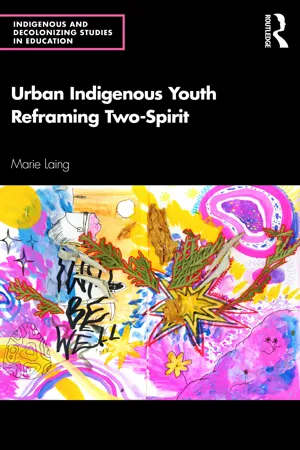
- 200 pages
- English
- ePUB (mobile friendly)
- Available on iOS & Android
eBook - ePub
Urban Indigenous Youth Reframing Two-Spirit
About this book
Information
1
INTRODUCTION
In downtown Toronto, on any given day, one can see and hear the term two-spirit being used in a variety of different ways. Taped to a telephone pole is a poster advertising an LGBTQ2S youth drop-in program; on CBC radio, a panel of Indigenous scholars and activists discusses how two-spirit was a term coined by and for Indigenous people with complex sexualities and genders; at a poetry reading, a young Indigenous writer introduces themself by sharing the community they come from and then identifies themself as a two-spirit person. One might see two-spirit spelled 2spirit, 2-spirit, two-spirited, or abbreviated to 2S. Perhaps, seeing two-spirit used in different contexts and by different people, one might have questions about what exactly the term means. Or perhaps, one might glean from all of these myriad uses of the term that two-spirit can mean many things.
Although two-spirit is used with increasing frequency within Indigenous communities, across LGBTQ communities, and in mainstream media, there is rarely nuanced discussion of the meanings that two-spirit holds for community members. As this book demonstrates, two-spirit is a complex term that is used in many different ways and holds many different meanings for different people. However, in popular usage, the word is often simultaneously used as both an umbrella term for all Indigenous people with complex genders or sexualities, and in ways that elide this breadth of meanings the term holds—such as using it with the specific, literal understanding that two-spirit means someone who has two spirits (e.g. Egale, 2016), or defining two-spirit as a person who is gay and Indigenous (e.g. Gilley, 2006; Jackson, 2003). Often, two-spirit is used as though its meaning is already understood and can be taken for granted. Yet, paradoxically, it is also a term that trans, queer, and two-spirit Indigenous people are often expected to explain to others. These multiple deployments, (mis)understandings, definitions, and expectations of the term two-spirit—visible in scholarly literature, in popular culture, and in the Indigenous communities to which I belong—prompted me to ask fellow two-spirit, trans, and queer Indigenous young people living in Toronto how they use and understand the term.
This book is based on insights shared with me by ten participants during a series of qualitative interviews, and examines what trans, queer, and two-spirit young people in Toronto have to say about two-spirit as a term. The research takes as the object of study the term two-spirit itself—rather than two-spirit identity, individual two-spirit people, or two-spirit communities—and understands the lived experiences of young trans, two-spirit, and queer Indigenous people to be expertise. Though I began this research project seeking to document what young trans, queer, and two-spirit Indigenous community members understand the term two-spirit to mean, over the course of our conversations, it became clear that this is not a question in which participants were interested. Instead, the research participants redirected our interviews towards the conversations they want to have in their own communities—conversations about Indigenous knowledges, the roots of cissexism, homophobia, and transphobia in settler-colonial oppression, and the complexity and brilliance of their communities. As a result, instead of focusing on what two-spirit means, this book is primarily concerned with the ways in which participants and their communities make the term meaningful and refuse the compulsion to define the term. This introductory chapter traces the development of this revised research focus by contextualizing two-spirit as a term, introducing the theory of change that this research seeks to operationalize, introducing myself and how I came to this work, and explaining the aims and scope of the book.
Contextualizing Two-Spirit; Contextualizing the Research Endeavour
It was at the third International Gathering of American Indian and First Nations Gays and Lesbians in 1990 that Myra Laramee, a Cree community member and scholar, coined the term two-spirit (Two-Spirited People of Manitoba, 2019). The political imperative behind the creation of the word was the replacement of the colonial term “berdache” that was used by missionaries, explorers, and anthropologists to describe Indigenous sexuality and gender complexity on Turtle Island from the 18th century onwards (Driskill, Finley, Gilley & Morgensen, 2011; McKiver, 2017; Morgensen, 2011). Though most (but not all) Indigenous nations on Turtle Island had diverse gender systems that exceeded the binary of men and women prior to colonization, the imposition of the European gender binary through Christianization, the theft of Indigenous languages, and legal regulation of sexuality led to dispossession of these teachings and exclusion of gender-complex people from Indigenous communities (Cannon, 1998; Danforth & McKegney, 2014; Deschamps, 1998; Estrada, 2011; Maracle, 2000; McKiver, 2017; Syrette, 2016; S. Wesley, 2014; A. Wilson, 2007, 2018). Over the past three decades, activism within queer, trans, intersex, and two-spirit communities has led to the growth of community services in urban, suburban, rural, reserve-based and online spaces, as well as increased awareness of gender and sexual diversity within broader Indigenous communities. Much of this work utilizes the term two-spirit as a banner under which to gather.
Colloquially, the term two-spirit is deployed in many different ways by Indigenous people. Some people use it as a way to identify both their queerness and their Indigeneity (Robinson, 2014b), and others use it to denote the responsibilities they carry in their communities (MacDonald, 2009; Walters, Evans-Campbell, Simoni, Ronquillo & Bhuyan, 2006). Some queer and trans Indigenous people choose not to use the term for a variety of reasons, including because it connotes roles and responsibilities in their communities that they do not yet hold (Robinson, 2014b), or because the connotations of having two spirits in one body contradict their traditional teachings (MacDonald, 2009; Robinson, 2014a). Some Indigenous people use direct translations of the word two-spirit into their Indigenous languages to identify themselves (McKiver, 2017; S. Wesley, 2014), while others caution against this practice as one that misrepresents both the term two-spirit and the various meanings associated with spirit in Indigenous languages (Medicine, 2001). Still other Indigenous people assert that finding words in their languages and connecting to their nation's own teachings on gender and sexuality are meaningful, personally and politically, for them and their communities (MacDonald, 2009; Walters et al., 2006).
Although two-spirit holds all of these complex and nuanced meanings (and more), a singular narrative of what two-spirit means is propagated within many Indigenous and non-Indigenous spaces. As I mentioned briefly above, this narrative defines a two-spirit in a literal way—as a person who has both male and female spirits—and asserts that two-spirit people were revered as shamans in pre-contact Indigenous societies. This understanding of two-spirit is just as valid as any other understanding of the term; some people hold specific teachings about this literal definition of two-spirit, and there are long-standing traditions in specific Indigenous nations that are connected to this understanding of the term. However, problems arise when this one understanding is taken up as the only definition of two-spirit. Indeed, this definition of a two-spirit person as one who has a female and a male spirit is identified by many Indigenous scholars and community members (Deerchild, 2017; MacDonald, 2009) as problematic because it homogenizes diverse understandings of gender, sexuality, spirituality, and community roles into a singular identity. It was the wide spread of this literal definition, and how its dominance affects the ways in which young trans, two-spirit, and queer Indigenous people are able to use the word two-spirit to effectively communicate with others, that first prompted me to ask my peers about how they use and understand the term.1 However, over the course of the interviews, the purpose of the research (and thus, its scope) shifted in response to what participants were telling me was useful and not so useful about my research questions.
Theories of Change
Over the past three decades, two-spirit scholars and community members have produced a foundational body of scholarship on two-spirit, trans, and queer communities across Turtle Island, and on two-spirit as a word. This book builds on this body of scholarship, which includes research by Alex Wilson (1996, 2007, 2008, 2016, 2018), Qwo-Li Driskill (2016), and Dana Wesley (2015)—research that is discussed at length in Chapter 2. Even though there is a body of literature and a wealth of community knowledge that clearly demonstrates that two-spirit is a complex term that holds many different meanings for different people, the literal definition of two-spirit discussed above still proliferates in both academic and non-academic spaces. The original political project of this work was to intervene in both the underrepresentation of young people's voices in the academic canon and in the hegemony of the literal definition of two-spirit by creating a citable document with young trans, two-spirit, and queer Indigenous people's thoughts on two-spirit as a term. Like all research projects, the project that I had in mind when I began this work was underscored by a specific theory of change—a theory of change in which I am no longer invested.
When I initially conceptualized this research project, the theory of change with which I was working was one described by Eve Tuck and K. Wayne Yang in their 2014 article “R-words: Refusing Research” as a fairly typical (and colonial) social science research approach. The theory of change was to represent the authentic voices of dispossessed peoples (in this case, my peers) in order to bring to light the inequalities that underpin their/our2 dispossession and therefore begin the process of redress. However, over the course of the research, the theory of change that underpins this work shifted in response to the ways in which participants enacted refusal. Here, I use refusal as it is theorized by Audra Simpson in her 2014 monograph Mohawk Interruptus: Political Life Across the Borders of Settler States. For Simpson, ethnographic refusal is a position taken by both researchers and researched communities that is animated by placing limits on what knowledge is shared with the academy as well as the participants' redirection of the research process. During the research interviews, participants steered our conversations away from my original research question—how do young trans, queer, and two-spirit Indigenous people in Toronto use and understand the term two-spirit—and towards the things they want to talk about within their own communities: the political significance of the term two-spirit, the ways in which Toronto as a place impacts their use of the word, and the ways in which they are building community with fellow two-spirit, queer, and trans Indigenous people. These redirections were a refusal of the theory of change with which I was approaching the research. Participants did not believe that change would come from non-two-spirit people learning about the complexity of the term and modifying their behaviours accordingly; instead, participants offered a theory of change that in which they and their communities are the agents of change.
Accordingly, my youth interlocutors did not want to direct our conversations to an audience of cisgender, heterosexual, and/or non-Indigenous people—especially since many of them noted that they are frequently coerced into educating people outside of trans, two-spirit, and queer Indigenous communities on what two-spirit does and does not mean. They wanted what one participant termed the “opportunities to philosophize” that we so rarely get as Indigenous communities, because we are kept in crisis by settler-colonialism. One purpose of this book is to provide some of these opportunities, and to open up avenues for conversation among two-spirit, trans, and queer Indigenous people and our communities at large. By providing a scholarly source that non-two-spirit people can consult when they have questions about what two-spirit means, I am also trying to take on some of the educational labour that is constantly foisted upon trans, queer, and two-spirit Indigenous youth.
The dual aims of this project also necessitate that I write to dual audiences in this book: two-spirit, trans, and queer Indigenous people, and everyone who is not a two-spirit, trans, or queer Indigenous person (to whom I refer as “non-two-spirit people” from this point on, for the sake of brevity). Because I am writing with two very different audiences in mind, throughout this book I will be directly addressing you, reader, in order to be clear about which parts of this book are for which audience. Just as the place from which I am doing this research impacts what I write in these pages, your lived experience impacts the ways in which you approach these ideas—the expectations you bring, the ways in which you process this information, and how you utilize what you learn. Many of the times at which I use direct address are points in the text where many readers will have expectations about what I am sharing or the conclusions I draw from participants' reflections; when I make moves that you might not be expecting, I will narrate this thwarting of expectations and tell you why I have chosen to move in another direction. Just as I entered into or brought new dimensions to relationships with each research participant, this book puts me into relationship with you as a reader; in order to make this relationship an ethical one, I need to communicate directly with you from time to time about my expectations and boundaries. There are some ways in which one might use the ideas in this book to which I do not consent, a...
Table of contents
- Cover
- Half Title
- Series Page
- Title Page
- Copyright Page
- Contents
- List of Figures
- Acknowledgments
- Artist Statement on the Cover Art
- Abstract
- Series Editors Introduction
- 1 Introduction
- 2 The Emergence of Two-Spirit
- 3 Refusing the Question “What Does Two-Spirit Mean?”
- 4 Two-Spirit as a Hashtag and a Container
- 5 Roots of the Literal Definition
- 6 Needs and Desires
- 7 Conclusion
- Appendix A: Two-Spirit: Conversations with Young Two-Spirit, Trans, and Queer Indigenous People in Toronto
- Appendix B: Community Discussion Guide
- Index
Trusted by 375,005 students
Access to over 1.5 million titles for a fair monthly price.
Study more efficiently using our study tools.
Frequently asked questions
Yes, you can cancel anytime from the Subscription tab in your account settings on the Perlego website. Your subscription will stay active until the end of your current billing period. Learn how to cancel your subscription
No, books cannot be downloaded as external files, such as PDFs, for use outside of Perlego. However, you can download books within the Perlego app for offline reading on mobile or tablet. Learn how to download books offline
Perlego offers two plans: Essential and Complete
- Essential is ideal for learners and professionals who enjoy exploring a wide range of subjects. Access the Essential Library with 800,000+ trusted titles and best-sellers across business, personal growth, and the humanities. Includes unlimited reading time and Standard Read Aloud voice.
- Complete: Perfect for advanced learners and researchers needing full, unrestricted access. Unlock 1.5M+ books across hundreds of subjects, including academic and specialized titles. The Complete Plan also includes advanced features like Premium Read Aloud and Research Assistant.
We are an online textbook subscription service, where you can get access to an entire online library for less than the price of a single book per month. With over 1.5 million books across 990+ topics, we’ve got you covered! Learn about our mission
Look out for the read-aloud symbol on your next book to see if you can listen to it. The read-aloud tool reads text aloud for you, highlighting the text as it is being read. You can pause it, speed it up and slow it down. Learn more about Read Aloud
Yes! You can use the Perlego app on both iOS and Android devices to read anytime, anywhere — even offline. Perfect for commutes or when you’re on the go.
Please note we cannot support devices running on iOS 13 and Android 7 or earlier. Learn more about using the app
Please note we cannot support devices running on iOS 13 and Android 7 or earlier. Learn more about using the app
Yes, you can access Urban Indigenous Youth Reframing Two-Spirit by Marie Laing in PDF and/or ePUB format, as well as other popular books in Education & Education General. We have over 1.5 million books available in our catalogue for you to explore.