Bayesian Analysis of Infectious Diseases
eBook - ePub

Bayesian Analysis of Infectious Diseases

COVID-19 and Beyond

  1. 332 pages
  2. English
  3. ePUB (mobile friendly)
  4. Available on iOS & Android
eBook - ePub

Bayesian Analysis of Infectious Diseases

COVID-19 and Beyond

About this book

Bayesian Analysis of Infectious Diseases -COVID-19 and Beyond shows how the Bayesian approach can be used to analyze the evolutionary behavior of infectious diseases, including the coronavirus pandemic. The book describes the foundation of Bayesian statistics while explicating the biology and evolutionary behavior of infectious diseases, including viral and bacterial manifestations of the contagion. The book discusses the application of Markov Chains to contagious diseases, previews data analysis models, the epidemic threshold theorem, and basic properties of the infection process. Also described are the chain binomial model for the evolution of epidemics.

Features:

  • Represents the first book on infectious disease from a Bayesian perspective.
  • Employs WinBUGS and R to generate observations that follow the course of contagious maladies.
  • Includes discussion of the coronavirus pandemic as well as many examples from the past, including the flu epidemic of 1918-1919.
  • Compares standard non-Bayesian and Bayesian inferences.
  • Offers the R and WinBUGS code on at www.routledge.com/9780367633868

Frequently asked questions

Yes, you can cancel anytime from the Subscription tab in your account settings on the Perlego website. Your subscription will stay active until the end of your current billing period. Learn how to cancel your subscription.
No, books cannot be downloaded as external files, such as PDFs, for use outside of Perlego. However, you can download books within the Perlego app for offline reading on mobile or tablet. Learn more here.
Perlego offers two plans: Essential and Complete
  • Essential is ideal for learners and professionals who enjoy exploring a wide range of subjects. Access the Essential Library with 800,000+ trusted titles and best-sellers across business, personal growth, and the humanities. Includes unlimited reading time and Standard Read Aloud voice.
  • Complete: Perfect for advanced learners and researchers needing full, unrestricted access. Unlock 1.4M+ books across hundreds of subjects, including academic and specialized titles. The Complete Plan also includes advanced features like Premium Read Aloud and Research Assistant.
Both plans are available with monthly, semester, or annual billing cycles.
We are an online textbook subscription service, where you can get access to an entire online library for less than the price of a single book per month. With over 1 million books across 1000+ topics, we’ve got you covered! Learn more here.
Look out for the read-aloud symbol on your next book to see if you can listen to it. The read-aloud tool reads text aloud for you, highlighting the text as it is being read. You can pause it, speed it up and slow it down. Learn more here.
Yes! You can use the Perlego app on both iOS or Android devices to read anytime, anywhere — even offline. Perfect for commutes or when you’re on the go.
Please note we cannot support devices running on iOS 13 and Android 7 or earlier. Learn more about using the app.
Yes, you can access Bayesian Analysis of Infectious Diseases by Lyle D. Broemeling in PDF and/or ePUB format, as well as other popular books in Mathematics & Probability & Statistics. We have over one million books available in our catalogue for you to explore.

Information

1

Introduction to Bayesian Inferences for Infectious Diseases

1.1Introduction

This book will introduce the reader to the latest Bayesian techniques that analyze the behavior of infectious diseases. A preview of the book is presented, followed by a list of references, and ending with online resources that provide information about emerging infectious diseases and allied subjects.

1.2A Preview of the Book

Chapter 2 describes the foundation of Bayesian statistics. First, Bayesian theorem is given for both discrete and continuous measurements. This necessitates an explanation of the components of Bayes theorem, namely prior information, the posterior distribution of the unknown parameters, and the predictive distribution of future observations. Also provided in this chapter are many examples that illustrate Bayes theorem, among then the standard populations, such as the binomial, the normal, the Poisson, the multivariate normal, and the multinomial, and the Dirichlet.
Chapter 3 explicates the biology and evolutionary behavior of infectious diseases, including viral and bacterial manifestations of the contagion. Next to be explained is that of the immune response via antibodies that attack the invading pathogens. The immune response involves various blood cells (white, red, and platelets) that defend against the disease. Next to be described are drugs that attempt to destroy the components of the disease. A good example of this is quinine and related drugs that control the malaria virus, and drugs that can nearly eradicate the HIV virus of AIDS patients. Although drugs have been very successful in controlling diseases, drug resistance can become a serious issue. This was the case for streptomycin, the breakthrough drug that controlled tuberculosis, but later developed a resistance. Of course, vaccines were a giant advance in medical theory, and one first thinks of the smallpox vaccine against polio. Of course, there are many examples of vaccines, such as those against measles, mumps, and diphtheria. It should be noted that for some viruses, a vaccine is yet to be developed. AIDS and Ebola do not have vaccines, but a very successful treatment for AIDS is successful, but not for Ebola. Of course, transmission of the disease from animals to humans plays an important role in the biology of emerging diseases. It is thought that the coronavirus first appeared in animals (birds, pigs, etc.) in China and was later transmitted to humans in the latter months in 2019. Ebola is believed to have been transmitted by nonhuman African primates to human.
Chapter 4 lays the foundation for Bayesian inference of discrete time Markov chain. The concepts of limiting distributions, transient and recurrent states, ergodic chains, and the period of a chain are defined and explai...
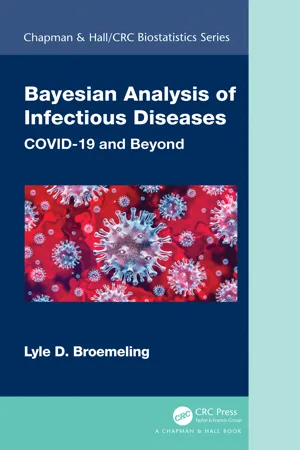
Table of contents

  1. Cover
  2. Half Title
  3. Title Page
  4. Copyright Page
  5. Table of Contents
  6. Author
  7. Chapter 1: Introduction to Bayesian Inferences for Infectious Diseases
  8. Chapter 2: Bayesian Analysis
  9. Chapter 3: Infectious Diseases
  10. Chapter 4: Bayesian Inference for Discrete Markov Chains: Their Relevance to Infectious Diseases
  11. Chapter 5: Biological Examples Modeled by Discrete Markov Chains
  12. Chapter 6: Inferences for Markov Chains 
in Continuous Time
  13. Chapter 7: Bayesian Inference: : Biological Processes that Follow a Continuous Time Markov Chain
  14. Chapter 8: Additional Information about Infectious Diseases
  15. Index