- 90 pages
- English
- ePUB (mobile friendly)
- Available on iOS & Android
eBook - ePub
About this book
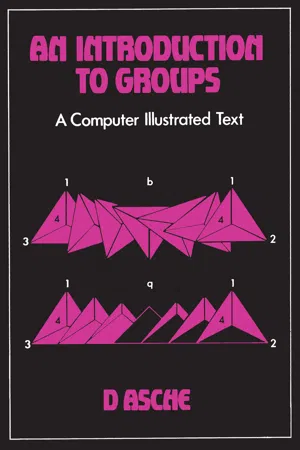
An Introduction to Groups: A Computer Illustrated Text discusses all the concepts necessary for a thorough understanding of group theory. The book covers various theorems, including Lagrange and Sylow. It also details Cayley tables, Burnside's lemma, homomorphisms, and dicyclic groups. The book is ideal for advanced mathematics students and beginning undergraduates.
Information
Chapter 1
Permutations
1.1 Notation
A permutation of a set S is a one-to-one mapping of S onto itself. To each element s of S there will correspond exactly one element of S which is the image of s under the mapping. It is also the case that each element of S will be the image of exactly one element of S. The image of an element need not be different from the element itself. If an element of S is equal to its image, we say that the permutation fixes that element, otherwise we say that the permutation moves it. The elements of S are called the symbols for the permutation. These will usually be the digits 1, 2, 3, …, 9 or a subset of these. If we need more than nine symbols, we shall use some upper-case letters A, B, C, … as well. Nowhere in this text shall we need in excess of twenty four symbols so there will be quite enough for us here.
To specify a permutation, we need to introduce some notation and there are two notations which are commonly used. The first of these is called bracket notation. For this, we have two rows enclosed in square brackets. Both rows contain all the symbols being used but the ordering is such that each symbol lies above its image under the permutation. If we take S = {1, 2, 3, 4, 5} as our set of symbols, an example of a permutation of S written in bracket notation is . The mapping goes from the top row to the bottom row so this permutation maps 1 to 3, 2 to 5, 3 to 1, 4 to 2 and 5 to 4. You will notice that each element of S occurs exactly once in the top row and exactly once in the bottom row so this is a one-to-one mapping of S onto itself, in other words a permutation of S.
It is convenient to give names to our permutations so that we can refer to them. We shall never require to examine more than twenty four permutations at once so we can select them from the set of lower case letters a, b, c, …. There is one special permutation of a set which is always given the name ‘i’ When using the computer and giving names to permutations, you will find that this name is reserved. Apart from this case, a name may be used to denote any permutation occurring in a particular example.
Returning to our permutation above, let us give it the name p. You will notice that we wrote the symbols in the top row in their natural order 1, 2, 3, 4, 5. This is by no means necessary and the permutation p could equally well have been written as since this will associate the elements of S in exactly the same way and hence specify the same permutation. In most cases it is convenient to use the natural ordering of the symbols in our top row but there will be occasions when we shall use some other ordering.
Another notation for permutations which is particularly useful is called cycle notation. To write a permutation in cycle notation involves a sequence of steps which will now be described. Firstly, write down a round bracket ‘(’ and place on its right any symbol from the set S. Then, next to this symbol, write down the symbol to which it is mapped by the permutation. Then write down the symbol to which this second symbol is mapped and continue in this way until you find that you have arrived back at the first symbol chosen, at which point you write down a closing round bracket ‘)’. If all the symbols of S have now been written down, your task is complete. If not, then write down another opening bracket ‘(’, choose a starting symbol from the remaining elements of S and proceed exactly as above. Keep going until all the symbols have been used.
To illustrate this procedure, let us apply it to the permutation p above. Firstly we write down ‘(’. Choosing 5, say, as our starting symbol, at successive stages we get
(5, (54, (542, (542).
This is because 5 is mapped to 4, 4 is mapped to 2 and 2 is mapped back to 5. We see that not all the symbols of S have yet appeared so we open a new cycle, choosing 3, say, as our starting symbol. We then get
(542)(3, (542)(31, (542)(31).
Since every symbol of S has now been written down, we know that we are finished. This is a cycle notation for the permutation p. Because we have a choice for the starting symbol at each stage, there will be variant forms for the notation. For example, (31)(425) would be an alternative cycle notation for the same permutation p. When the computer is storing permutations in cycle notation, it always starts a cycle with the first available symbol in the natural ordering. It would therefore write this permutation as (13)(254) but it will happily accept any valid notation from the user.
If a permutation maps any symbol to itself, we often omit that symbol entirely from the expression. The convention is that any symbol not appearing is understood to be fixed. To illustrate this, let us take the permutation which, when written in bracket notation, is
In cycle notation, it can be written as (142)(3)(56) but we would normally write it as (142)(56) where the symbol 3 is omitted since it is fixed by t. The computer will store it in this form.
Within the permutation t above, the cycle (142) is called a 3-cycle because it contains three symbols. Similarly, (3) is a 1-cycle and (56) is a 2-cycle. When we speak of a permutation having a certain cycle structure, we are referring to the number of 1-cycles, 2-cycles, etc, which occur when it is written in full cycle notation. Two permutations with the same cycle structure share some important properties which we shall discover later. In most of our future discussions, it will be cycle notation that we shall use but it is important that you become familiar with bracket notation as well. Here is the first of a set of activities which have been designed to give you practice in the use of these notations.
Activity 1.1
Run the program called ‘Bracket and Cycle Notation’ and choose the number of symbols that you wish to use. Using either bracket or cycle notation, ...
Table of contents
- Cover
- Half Title
- Series Page
- Title Page
- Copyright Page
- Contents
- Introduction
- 1 Permutations
- 2 Groups
- 3 Group Actions
- 4 Conjugacy
- 5 Homomorphisms and Quotient Groups
- 6 Constructing Groups
- Appendix 1 Program Notes
- Appendix 2 List of Groups
- Index
Trusted by 375,005 students
Access to over 1.5 million titles for a fair monthly price.
Study more efficiently using our study tools.
Frequently asked questions
Yes, you can cancel anytime from the Subscription tab in your account settings on the Perlego website. Your subscription will stay active until the end of your current billing period. Learn how to cancel your subscription
No, books cannot be downloaded as external files, such as PDFs, for use outside of Perlego. However, you can download books within the Perlego app for offline reading on mobile or tablet. Learn how to download books offline
Perlego offers two plans: Essential and Complete
- Essential is ideal for learners and professionals who enjoy exploring a wide range of subjects. Access the Essential Library with 800,000+ trusted titles and best-sellers across business, personal growth, and the humanities. Includes unlimited reading time and Standard Read Aloud voice.
- Complete: Perfect for advanced learners and researchers needing full, unrestricted access. Unlock 1.5M+ books across hundreds of subjects, including academic and specialized titles. The Complete Plan also includes advanced features like Premium Read Aloud and Research Assistant.
We are an online textbook subscription service, where you can get access to an entire online library for less than the price of a single book per month. With over 1.5 million books across 990+ topics, we’ve got you covered! Learn about our mission
Look out for the read-aloud symbol on your next book to see if you can listen to it. The read-aloud tool reads text aloud for you, highlighting the text as it is being read. You can pause it, speed it up and slow it down. Learn more about Read Aloud
Yes! You can use the Perlego app on both iOS and Android devices to read anytime, anywhere — even offline. Perfect for commutes or when you’re on the go.
Please note we cannot support devices running on iOS 13 and Android 7 or earlier. Learn more about using the app
Please note we cannot support devices running on iOS 13 and Android 7 or earlier. Learn more about using the app
Yes, you can access An Introduction to Groups by D Asche in PDF and/or ePUB format, as well as other popular books in Mathematics & Algebra. We have over 1.5 million books available in our catalogue for you to explore.