First published in 1939 and long out of print, this book remains unique as the only full and detailed account by a social anthropologist of a complete pagan Polynesian ritual cycle. This new single-volume edition omits some of the Tikopia vernacular texts, but includes a new theoretical introduction; postscripts have also been supplied to some of the chapters comparing the performances of 1928-9 with those witnessed by Professor Firth on his second visit to Tikopia in 1952. There is a specially written Epilogue on the final eclipse of the traditional ritual, based on a third visit by the author during the summer of 1966.
- 208 pages
- English
- ePUB (mobile friendly)
- Available on iOS & Android
eBook - ePub
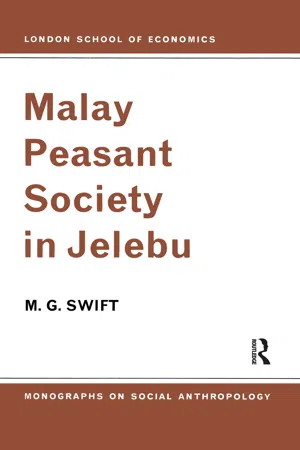
Malay Peasant Society in Jelebu
About this book
Information
CHAPTER IX Family and Domestic Groups (1)
Where matrilineal tracing of descent is combined with exogamy and a matrilocal residence rule, kinship groupings are not those of domestic and community organization. Given male predominance, a universal feature of human society, it follows that any society following these three rules is faced with potential conflict in areas of social organization where groupings based on descent and those based on common residence and domestic interests overlap.
In Negri Sembilan the ideal solution to the ‘matrilineal puzzle’ (Richards, 1950, p. 246) is the complete subordination of a man to his wife’s kin-group. The sources of strain, however, continue to exist, and the superiority of the tempat semanda in the tempat semanda-orang semanda relationship depended to a great extent on the sanctioning of this relationship as part of the traditional political organization.
The decline of adat perpateh as a political system may therefore be expected to alter the balance between kin and domestic groupings in favour of the latter.
NUCLEAR FAMILY
The nuclear family of husband, wife and dependent children is the most common form of domestic grouping, and also the major social unit in day-to-day living.
Husbands attempt to build tbeir own house as soon as possible after the birth of their first child (which ideally will occur within a year of marriage), and to establish their own family of procreation as an independent unit. This is a legitimate goal to which the wife’s father should give such help as he can. This help is seen not as help to the son-in-law but rather as an attempt to establish his daughter securely by providing her with a house, m the same way as she has been provided with a husband, and (ideally) land for the sustenance of herself and her children.
People continually refer to the notion of paying debts to one’s children. These debts are the duty of all Muslim parents to arrange for the religious education, circumcision (or a comparable rite for girls), and marriage of their children. This rehgious duty does not depend on, or imply, any definite reciprocity from the child. Islam has much to say about a child’s duty towards its parents, but this is not as precise and formal as the three debts of a parent.
There is a significant difference in the relative weight of the three debts to sons and daughters respectively. For a son his preparation for Islam (education and circumcision) is more important than marriage. Informants frequently commented that you cannot make a man marry unless he wants to. For a daughter religious education and subincision are light matters. The former usually consists merely of a little instruction in reading the Koran from her father at home, and the latter is usually not considered worth any special ceremony, but fitted in when convenient, as a minor adjunct to a brother’s or cousin’s circumcision. A daughter’s marriage, however, is a great responsibility, and a daughter who has to be found a spouse is a source of worry to her parents. For a youth circumcision, taking place during the early teens, is the rite de passage marking the change to adult status. For a girl the important rite is her marriage. Although the onset of puberty shows that she is nubile, and so may affect her parents’ attitude
| Household Type | Number of Cases |
|---|---|
| Nuclear Family* | 33 |
| Nuclear Family & Wife's Father | 1 |
| Nuclear Family & Wife's Mother | 3 |
| Joint Family | 6 |
| Single Individual | 3 |
| Husband, Wife & Grandchildren | 6 |
| Mother & Dependent Children | 6 |
| Mother, Children & Stepfather | 11 |
* Husband-wife households are counted as nuclear families.
towards her, it does not mark such an important transition in social status as marriage.
When a son has married his life is very much his own, but the ‘debt’ to a daughter, although formally discharged when she is married, implicitly also involves a duty to see her as securely provided for as possible. The concern shown over a daughter’s marriage makes it seem a parents’ major problem, and this is an accurate reflection of the relative vulnerability of the sexes to domestic misfortune.
When established in a separate dwelling the nuclear family is the main producing and consuming unit of the society. During the interim period between marriage and the birth of a child, when there is a joint household with the wife’s parents, there is no fixed rule for the division of expenses. If anything the father should bear more, but the son-in-law must contribute as generously as he can, and provide some items, such as clothes for his wife, on his own.
Wage earning outside the village has long been common in Negri Sembilan. The Emergency enormously increased the opportunities for wage employment and now a very large proportion of young men, and their families, are living outside the village. A village of 70 houses may contain no young man between about 18 and 25 years of age, but it is not possible to give a precise percentage, as there is quite a marked variation between villages, apparently explained by the importance of connections in opening the way for youth to leave the village. With these wageearning families the rule is best described as neolocality. As soon as the young man is given quarters, or can rent a house, he will send for his wife, and the independent household may therefore be established sooner than it would be in the village. But leave will be spent mainly with the wife’s parents, for the wage-earner will not want to build a house in the village to stand empty most of the time. In this discussion I shall be concerned with these service families only in so far as I observed them when on leave, or when a wife returned to bear a child or to wait for her husband to get a house after posting to a new area.
THE FAMILY ROLES
Before discussing institutions such as marriage and divorce I wish to describe the general pattern of relationships within the family.
(a) Husband-wife
The attributes stressed as desirable for a successful marriage relate to the abibty of the couple to cooperate successfully in the division of labour by sexes.
A woman's work is hrst or all the ordinary domestic duties of the household. In addition the wife often assumes the main burden of work in the ricefields, and industry here is highly valued. A wife should also possess enough rice land for the family’s subsistence needs (although an increasing proportion do not) and a house site.
Men also work in the ricefields, and some of them are very industrious, but this is something extra about a good husband rather than an essential quality. Many men plead their work rubber tapping as a sufficient excuse for not giving any significant help in rice cultivation. It is the provision of an adequate cash income that is the husband’s main responsibility, and the main indicator of a good husband in public judgement.
An intimate relationship persisting over the years naturally has a marked emotional aspect, but this is not recognized by the people in their ideology of marriage. Parents should love their children, but affection is not necessary between husband and wife. They are partners in a joint enterprise which will persist for as long as it is mutually profitable. Displays of affection between men and women are thought comical or disgusting, and may give rise to the suspicion that one partner has bewitched the other. A man is not criticized if he shows grief, or even weeps, at the death of a child or parent, but the loss of a wife should be accepted calmly in the spirit that one can always look for another. If one spouse dies, or a couple divorce, people immediately begin to consider the possibility of remarriage, and to refuse a suitable offer is regarded as unreasonable.
A woman is not supposed to play any part in the major affairs of the society, but should contentedly confine herself to caring for her husband and children. She should accept the decisions of her male kin, or her husband without hesitation. This is the picture presented by the formal institutions: women must keep modestly to the background. Should a woman refuse to accept the limitations of her role she is at first regarded with amusement, and then with increasing indignation. Only if she is prepared to be regarded as ‘three-quarters’, i.e. mentally unbalanced, can a woman escape the strict requirements of modesty. Both men and women say that women ‘cannot understand affairs’. Women who step right out of their traditional role, say as schoolteachers, or leaders of Kaum Ibu (women’s branch of the U M N O), are regarded with considerable suspicion and some hostility by the peasants.
Such is society’s image of itself, and in some situations it is accurate enough. But even if not formally recognized, woman’s role in the direction of society is very important. Men do not make decisions concerning their families without prior discussion with their wives, and in this discussion the wife may well be the dominant party. Even in public discussion, where women may not participate (although older women may call out comments during pre-ceremonial kin gatherings berkampong) the opinions which a man expresses may well have been formed by discussion with his wife in the privacy of evening.
Economic interests are merged in the partnership of marriage to only a limited extent. Within the household there is a clear division of property between the husband, wife, and even children. This will not be apparent in the day to day use of the property, but it is nevertheless a factor affecting management decisions.
Women wish to accumulate land registered in their own name, or gold. They want some provision for their future security in a society where divorce is regarded as an ever present possibility. Also a husband should be prepared to give property to his wife, whenever he is able, as an earnest that he is not contemplating divorce, and for the maintenance of his children should he ever do so. A man may secure almost the same result by registering property in the name of a child, which ensures that it will not be misused by the mother, or any future stepfather, during the child’s minority. Rice land and homestead are particularly appropriate for a woman to own, and for a man to buy such property, and register it in his own name, would be seen as a sure sign that he was planning a divorce.
(b) Parent-child
In the family the authoritarian element essential in the parentchild relationship is reduced to a minimum. Punishment is rare, and makes a parent run the risk of being considered cruel. The whims of children are satisfied as far as possible, even at the expense of the family as a whole: for example the continual demands for cakes and sweets which can, with a large family of small children, make serious inroads into a small budget.
Until the age of six or seven years there is little distinction made in the treatment of boys and girls. Parents are equally pleased with the birth of a son or a daughter, ‘whatever God gives’. If a couple already have a daughter they would like a son, and vice-versa. Having a daughter first is a good thing, for she will be able to help later with her younger siblings. But there is nothing to approach the Chinese concern with male offspring, and this points to an interesting characteristic of the Negri Sembilan system. For a society in which the major groups are recruited by unilineal descent there is very little concern with lineage. The ancestors have no specific importance to their descendants, and in the same way there is very little concern with the perpetuation of a descent line. A daughter is desired as a comfort in old age, and as a source of grandchildren to enjoy. A son cannot be these things as he will move away on marriage, and his children will be seen only occasionally. A daughter may also be desired so that property will not pass to strangers. But all these evaluations of sons and daughters may be expressed by fathers too; they are family rather than kinship sentiments. A kin-group is its living members; there is no stress on it as an unbroken chain ascending into the past, and descending into the future for ever if possible.
As the children grow older distinctions are made approximating to the appropriate adult roles. As she approaches puberty a girl is increasingly confined to the household, while a son will gain increasing independence and freedom. A girl is fully integrated into the economy of the household, helping her mother with domestic tasks, although, for modesty, not going to the ricefields. With a son the situation is quite different. As an adolescent he can make as much money, rubber tapping, as an adult with family responsibilities, but only in exceptional circumstances, for example if his mother is a widow, will he make more than small and irregular contributions to the household expenses. The adolescent youth passes his time in the company of his peers, a band of youths sleeping in each other’s houses or in the prayer house, as convenient, and eating where they are invited.
Before starting as an independent tapper, a boy commonly spends a period helping someone else, collecting scrap, and cleaning latex cups, for a small fee. I know of no case in which a boy worked with his father in this way. This is partly because the boy wants money and he cannot expect his father to pay for such help. But there is also a c...
Table of contents
- Cover
- Half Title
- Series Page
- Title Page
- Copyright Page
- Dedication
- Preface
- Contents
- I. INTRODUCTION
- II. THE TRADITIONAL POLITICAL SYSTEM
- III. THE NATURE OF THE ECONOMY
- IV. THE MAJOR PRODUCTS: RICE
- V. THE MAJOR PRODUCTS: RUBBER AND FRUIT
- VI. SAVING AND CAPITAL
- VII. THE DECLINE OF THE TRADITIONAL POLITICAL ORGANIZATION
- VIII. SOME RECENT ADAT DISPUTES
- IX. FAMILY AND DOMESTIC GROUPS (1)
- X. FAMILY AND DOMESTIC GROUPS (2)
- XI. THE VILLAGE, STATUS AND SOCIAL STRATIFICATION
- XII. ECONOMY AND SOCIETY
- GLOSSARY
- BIBLIOGRAPHY
- INDEX
Trusted by 375,005 students
Access to over 1.5 million titles for a fair monthly price.
Study more efficiently using our study tools.
Frequently asked questions
Yes, you can cancel anytime from the Subscription tab in your account settings on the Perlego website. Your subscription will stay active until the end of your current billing period. Learn how to cancel your subscription
No, books cannot be downloaded as external files, such as PDFs, for use outside of Perlego. However, you can download books within the Perlego app for offline reading on mobile or tablet. Learn how to download books offline
Perlego offers two plans: Essential and Complete
- Essential is ideal for learners and professionals who enjoy exploring a wide range of subjects. Access the Essential Library with 800,000+ trusted titles and best-sellers across business, personal growth, and the humanities. Includes unlimited reading time and Standard Read Aloud voice.
- Complete: Perfect for advanced learners and researchers needing full, unrestricted access. Unlock 1.5M+ books across hundreds of subjects, including academic and specialized titles. The Complete Plan also includes advanced features like Premium Read Aloud and Research Assistant.
We are an online textbook subscription service, where you can get access to an entire online library for less than the price of a single book per month. With over 1.5 million books across 990+ topics, we’ve got you covered! Learn about our mission
Look out for the read-aloud symbol on your next book to see if you can listen to it. The read-aloud tool reads text aloud for you, highlighting the text as it is being read. You can pause it, speed it up and slow it down. Learn more about Read Aloud
Yes! You can use the Perlego app on both iOS and Android devices to read anytime, anywhere — even offline. Perfect for commutes or when you’re on the go.
Please note we cannot support devices running on iOS 13 and Android 7 or earlier. Learn more about using the app
Please note we cannot support devices running on iOS 13 and Android 7 or earlier. Learn more about using the app
Yes, you can access Malay Peasant Society in Jelebu by M. G. Swift in PDF and/or ePUB format, as well as other popular books in Politics & International Relations & Politics. We have over 1.5 million books available in our catalogue for you to explore.