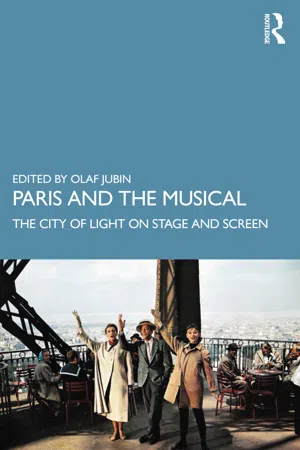
Paris and the Musical explores how the famous city has been portrayed on stage and screen, investigates why the city has been of such importance to the genre and tracks how it has developed as a trope over the 20th and 21st centuries.
From global hits An American in Paris, Gigi, Les Misérables, Moulin Rouge! and The Phantom of the Opera to the less widely-known Bless the Bride, Can-Can, Irma la Douce and Marguerite, the French capital is a central character in an astounding number of Broadway, Hollywood and West End musicals. This collection of 18 essays combines cultural studies, sociology, musicology, art and adaptation theory, and gender studies to examine the envisioning and dramatisation of Paris, and its depiction as a place of romance, hedonism and libertinism or as 'the capital of the arts'.
The interdisciplinary nature of this collection renders it as a fascinating resource for a wide range of courses; it will be especially valuable for students and scholars of Musical Theatre and those interested in Theatre and Film History more generally.
Paris, according to German literary critic and sociologist Walter Benjamin, was ‘the capital of the nineteenth century’ (Benjamin, 1999, pp. 3–26).1 During the years spanning the Second Empire to World War I (1852–1914), Paris became not only a leading cultural and intellectual centre – the birthplace of the avant-garde and the capital of pleasure – it also emerged as the most modern city in the world, indeed, the ‘capital of the world’ (Higonnet, 2002, p. 232). While Americans tend to associate modernity with the United States, during the years of the late 19th and early 20th centuries, especially during what the French call the belle époque, roughly from 1880 to 1914, Paris was the capital of modernity. It boasted arguably the world’s largest department store – the Bon Marché – as well as its largest press. The recently transformed city was also home to wide tree-lined boulevards, housing shops, cafés and theatres, which attested to a vibrant boulevard culture. Constructed in honour of the centennial of the French Revolution in 1889, the Eiffel Tower was the tallest manmade structure in the world and the perfect symbol of the newly renovated city. The Tower was the highlight of the 1889 Universal Exposition, which attracted visitors from all over the world. In the late 19th century, Paris became the major stop on Americans’ world tours, as Mark Twain’s The Innocents Abroad, published in 1867, illustrates. Around this time, Paris also gained notoriety as a place of pleasure and hedonism, or for some, a place of debauchery and depravity, especially in Montmartre. This reputation only served to increase the numbers of foreign visitors to the city.
In the 1950s, the Paris of the belle époque was immortalised in such major American motion pictures as An American in Paris (1951), Funny Face (1957) and Gigi (1958), to name just three.2 These films, while often viewed as a nostalgic nod to Paris of the past, were actually a way for Hollywood filmmakers to celebrate the modernity of Paris and its status as home of the avant-garde, all the while laying claim to this legacy in the 20th century (Schwartz, 2007, p. 21). The story of Paris’s role as the capital of modernity is the subject of this chapter. To that end, it will trace not only the evolution of Paris during this key period, it will also examine the role it occupied in the cultural imaginary, both as an emblem of French identity and of modernity.3
FIGURE 1.1 The Eiffel Tower upon completion in 1889. Today the most famous sight of Paris, the structure caused a lot of controversy when it was built.
Source: Photo provided by the editor.
Paris in the mid-19th century
In the mid-19th century, Paris was a second-rate city, surprising visitors from London with its ‘backwardness’. It was dirty and insalubrious, with waste thrown into the Seine, which was also the source of drinking water. Although the construction of sewers was begun under Napoleon I, little work was completed until the Second Empire (1852–1870) and even later in the century. Meanwhile, cholera epidemics wiped out tens of thousands of residents. Indeed, a major epidemic in 1832 killed more than 18,000 Parisians, mostly in poor areas (Horne, 2004, p. 218). Paris remained a medieval city until the second half of the 19th century, with narrow streets and warrens of old houses, immortalised in such novels as Eugène Sue’s Les Mystères de Paris, published from 1842 to 1843, and Victor Hugo’s 1862 novel, Les Misérables. Most of the poor lived in dingy, overcrowded hovels. Paris at this time was a series of little villages; travel both from east to west and from north to south was nearly impossible. Plunged in darkness at night, the city was often dangerous.
Worth noting is the mix of social classes in Paris in the earlier 19th century, often in the same buildings. The poorest residents occupied the higher floors, while the wealthy occupied the noble lower ones. Furthermore, many shopkeepers lived above their shops, meaning a variety of different types of buildings on the same street; modest wood and plaster homes could thus be found on the same block as more elegant ones in stone (Taunton, 2009, p. 21).
The restructuring of Paris was one of the largest urban renewal programmes in the world. This momentous economic and social change, however, could not take place without the growth of industrial production, which brought great wealth to the middle and upper classes. The development of a modern banking system was also necessary to raise the capital required, not only for public works in Paris; it also allowed for the establishment of private enterprises, among them department stores, many of which were founded at this time. By the middle of the 19th century, the Bourse – France’s Wall Street – was the biggest money market on the continent. The extension of the railway too allowed for the facility of movement of people and goods. This economic growth brought greater numbers of workers to the city and led to overcrowding, contributing to the explosion of Paris’s population from 786,000 to over a million between 1831 and 1851 (Horne, 2004, p. 232).
Haussmannisation
Napoleon’s nephew Louis-Napoleon came to power in 1848, when he was elected president of the Second Republic. In 1851, he affected a coup d’état and established himself as emperor the following year, dubbing himself Napoleon III (Napoleon’s son had died in 1832). Having travelled extensively and lived in London, Napoleon III wanted to create a Paris that would rival London on the world stage. He and Georges-Eugène Haussmann, a civil servant whom he named Prefect of the Seine, transformed Paris, truly making it the capital of the 19th century. Napoleon III ruthlessly appropriated buildings and land and partnered with private firms to build elegant houses and shops, a process brilliantly described in Emile Zola’s 1872 novel, La Curée, in which the author used the language of the hunt to describe speculation in Paris during the Second Empire.
The goals of Napoleon III and Haussmann were economic, sociological, aesthetic and political. First and foremost, they sought to rid the city of congestion by facilitating the circulation of both people and goods. To that end, they built an east-west axis from the place de la Nation on the east side, to the place de l’Étoile, on the west, also building the avenues around the Étoile. They constructed a north-south axis with the boulevard Sebastopol cutting through the Île de la Cité to become the boulevard Saint-Michel on the Left Bank. The most radical change was on the Île de la Cité – site of Notre-Dame and also of some of the worst slums in Paris. In fact, hundreds of small shacks stood in front of Notre-Dame, blocking the view of the cathedral. Haussmann cleared out the hovels, giving us the panoramic view we have today, and established the Île de la Cité as an administrative centre housing law courts and police headquarters.
Haussmannisation also involved building the boulevards Arago, de Magenta, de Port-Royal, Voltaire (originally the boulevard du Prince-Eugène), de la Madeleine and Haussmann, which, ironically, was only completed in the early 20th century. The city also witnessed the multiplication of green spaces – represented by the construction of the Parc Monceau and the Parc Montsouris, the Bois de Boulogne to the west and the Bois de Vincennes to the east. A sewer system was built, although it was not finished until the early 20th century, at which time the metro was also constructed. Transforming Paris into the ‘City of Light’, 32,000 gas lamps replaced 15,000 oil lanterns, and by 1877, electric lights supplanted the gas streetlamps (Horne, 2004, p. 236).4 Finally, Napoleon and Haussmann also authorised the construction of the uniform buildings on the new wide tree-lined boulevards. One of the crowning achievements of the plan was the construction of the Opéra Garnier, which became part of the neighbourhood associated with the new Paris and a destination for entertainment and shopping. While some grands boulevards predated Haussmann, the new ones henceforth came to be associated with modern Paris. As one contemporary noted: ‘This place de l’Opéra, with its big ways that open onto everything, with these vast luxury stores, these gigantic cafés, the Grand Hôtel and the Opéra. This is modern Paris’ (Gustave Fraipont, quoted in Schwartz, 1998, p. 23). Indeed, the process which became known as Haussmannisation pushed the city centre to the west of the city.
Furthermore, Haussmannisation doubled the area of Paris, which absorbed 500,000 inhabitants at this time. In 1860, Paris had just 12 arrondissements, when it expanded to 20, through the annexation of Auteuil, Passy, Grenelle and other areas, including Montmartre. Finally, Napoleon III and Haussmann also had new railroad stations built, such as the Gare de Lyon and the Gare du Nord, thereby facilitating visits to the capital by foreign and provincial visitors. Railway stations were a favourite subject of some of the Impressionist painters depicting modern life, among them Édouard Manet and Claude Monet. These changes led to the tremendous growth of the city. By 1870, the population stood at two million, and by 1914, three million (Jones, 2004, p. 299). Finally, political motivations, linked to aesthetic and economic ones, also motivated Napoleon III and Haussmann. Their goal to embellish Paris meant moving poor people out into the outer arrondissements. Paris had historically been the centre of the revolution – in 1789, 1830 and 1848 – when, ironically, Napoleon III himself came to power. Building the grands boulevards made it both easier ...
Table of contents
Cover
Half Title
Title
Copyright
Dedication
Contents
Acknowledgements
Notes on contributors
Introduction
Part I Capital Paris
Part II Broadway Paris
Part III Hollywood Paris
Part IV West End Paris
Part V Naughty Paris
Part VI Artistic Paris
Index
Trusted by 375,005 students
Access to over 1.5 million titles for a fair monthly price.
Study more efficiently using our study tools.
Frequently asked questions
Yes, you can cancel anytime from the Subscription tab in your account settings on the Perlego website. Your subscription will stay active until the end of your current billing period. Learn how to cancel your subscription
No, books cannot be downloaded as external files, such as PDFs, for use outside of Perlego. However, you can download books within the Perlego app for offline reading on mobile or tablet. Learn how to download books offline
Perlego offers two plans: Essential and Complete
Essential is ideal for learners and professionals who enjoy exploring a wide range of subjects. Access the Essential Library with 800,000+ trusted titles and best-sellers across business, personal growth, and the humanities. Includes unlimited reading time and Standard Read Aloud voice.
Complete: Perfect for advanced learners and researchers needing full, unrestricted access. Unlock 1.5M+ books across hundreds of subjects, including academic and specialized titles. The Complete Plan also includes advanced features like Premium Read Aloud and Research Assistant.
Both plans are available with monthly, semester, or annual billing cycles.
We are an online textbook subscription service, where you can get access to an entire online library for less than the price of a single book per month. With over 1.5 million books across 990+ topics, we’ve got you covered! Learn about our mission
Look out for the read-aloud symbol on your next book to see if you can listen to it. The read-aloud tool reads text aloud for you, highlighting the text as it is being read. You can pause it, speed it up and slow it down. Learn more about Read Aloud
Yes! You can use the Perlego app on both iOS and Android devices to read anytime, anywhere — even offline. Perfect for commutes or when you’re on the go. Please note we cannot support devices running on iOS 13 and Android 7 or earlier. Learn more about using the app
Yes, you can access Paris and the Musical by Olaf Jubin in PDF and/or ePUB format, as well as other popular books in Media & Performing Arts & Music. We have over 1.5 million books available in our catalogue for you to explore.