1
Ten Concepts for Critical Psychology Praxis
Robert K. Beshara
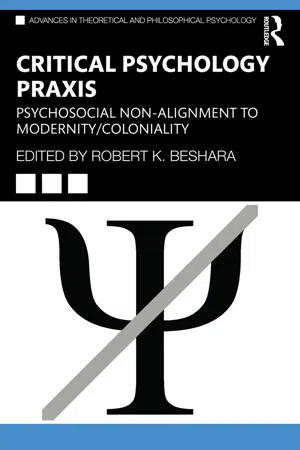
Critical Psychology Praxis is an edited volume based primarily upon conference proceedings from the 2019 International Critical Psychology Praxis Congress (ICPPC), a transdisciplinary event that brought together global scholars, activists, and practitioners who desire to cooperatively imagine a worldcentric critical psychology from the perspective of the damnés (Fanon, 1961/2004)—what Burton and Osorio (2011), following the decolonial turn (Maldonado-Torres, 2017; Pickren, 2020), have termed a transmodern, or analectical, psychology, but which can also be qualified as a pluriversal psychology (Beshara, 2019). The Congress took place on September 27–28, 2019, at Northern New Mexico College in Española, NM; a campus dedicated to underserved Hispanic and Native American students and surrounded by the eight northern Pueblos of Taos, Picuris, Santa Clara, Ohkay Owingeh, San Ildefonso, Nambé, Pojoaque, and Tesuque.
The book chapters are united around the theme of psychosocial non-alignment to modernity/coloniality. Psychosocial Studies (Frosh, 2003) emerged in the United Kingdom as a critical psychological approach that recognizes the inherent link between psyche and society and, therefore, rejects the reductionist impulse of mainstream (Euro-American) psychology (i.e., reducing psyche to behavior, cognition, and/or the brain).
Non-alignment is a reference to the Global South’s Non-Aligned Movement, which embodies a third option beyond the First World’s (e.g., the United States and the European Union) laissez-faire capitalism and the Second World’s (e.g., the People’s Republic of China after the collapse of the Soviet Union) state capitalism. The Global South is both a politico-economic and a geographical designation that refers to transmodern cultures in the continents of South America, Africa, and Asia. Furthermore, the Global South signifies outsiders within—that is, decolonial subcultures in the Global North (i.e., the descendants of Indigenous, Black, and Brown peoples who were colonized, enslaved, and/or over-exploited since 1492).
Modernity/coloniality is the name of a Latin American research program, which is theoretically grounded in liberation theology and other non-European intellectual developments (e.g., liberation philosophy and psychology) since the 1960s (Escobar, 2007). Arturo Escobar (2007) describes modernity/coloniality as “a framework constructed from the Latin American periphery of the modern colonial world system” that “helps explain the dynamics of eurocentrism in the making of modernity” and “reveals the dark sides of modernity” (p. 189). He adds, “Modernity/coloniality also shows that the perspective of modernity is limited and exhausted in its pretended universality” and “not only re-focuses our attention on the overall fact of development, it provides a context for interpreting the various challenges to development and modernity as so many projects that are potentially complementary and mutually reinforcing” (Escobar, 2007, p. 189).
To put it succinctly, following Mignolo (2007), what the modernity/coloniality research program clearly shows is that the oppressive rhetoric of modernity—for example, arguments regarding the supposed civilizational superiority of European cultures—is always sustained in practice by the violent logic of coloniality, particularly the “coloniality of power” (Quijano, 2000). In other words, coloniality is the unconscious of Euromodernity. Subsequently, Enrique Dussel rejects the two main critiques of modernity (i.e., critical modernity and postmodernity) since they are essentially Eurocentric and proposes instead transmodernity as not only a critique of modernity but also, and more significantly, as a worldcentric project that “embraces both modernity and its alterity” (Dussel, 1995, p. 139) and which is realized through liberation praxis.
Following from this, I encouraged authors to write their chapters in response to the above-mentioned theme and in the spirit of praxis (cf. Burton, 2013). The goal of this edited volume then is to bridge the North–South divide in critical psychology, a function of ethnocentrism, through solidarity and dialogue. It is worth mentioning here that the fifth volume of the Annual Review of Critical Psychology, a peer-reviewed journal published by the Discourse Unit, is dedicated to contributions to critical psychology from different geo-political regions. What follows are ten “polycentric” (Amin, 1990) concepts for critical psychology praxis, which is my contribution to liberation psychology (Burton & Ordóñez, 2015; Martín-Baró, 1994; Watkins & Shulman, 2008).
The Politics of Citation
I identify as a scholar-activist because I do not believe, as a human scientist, that knowledge is a neutral affair. I borrow this insight from Michel Foucault (1980), who theorized the interdependence between power and knowledge through his concept of “power/knowledge.” The production of knowledge, in other words, is inherently a political act, which has productive, or oftentimes, disciplinary effects, and so we have an ethical obligation, as academics, to think about the effects of our specific positions within the network of power called academe.
In Living a Feminist Life, Sara Ahmed (2017) writes, “A citational chain is created around theory: you become a theorist by citing other theorists that cite other theorists” (p. 8). In other words, citation is a political act (Ahmed, 2013) because, as scholars, we have to consciously, or unconsciously, decide which theorists to cite. Citation is also an act of solidarity. Ahmed (2017) writes, “Citation is how we acknowledge our debt to those who came before; those who helped us find our way when the way was obscured because we deviated from the paths we were told to follow” (pp. 15–16). For Ahmed (2017), citations “are the materials through which, from which, we create our dwellings” (p. 16). Furthermore, what Ahmed (2017) calls “citational practice” refers to “not only who is cited in written texts but who is speaking at events” (p. 148), which informed my decision of who to invite as keynote speakers at the 2019 ICPPC. Another source of inspiration, another citation, is the Cite Black Women1 project, which is described as follows: “In November 2017 Christen A. Smith created Cite Black Women as a campaign to push people to engage in a radical praxis of citation that acknowledges and honors Black women’s transnational intellectual production.”
I want to build upon these feminist initiatives, and urge the reader to Cite Southern Theorists, or theorists from the Global South. They may be literally outside of your comfort zone, hence the challenge. I recommend that you (the reader) visit the following website, which is an open-access encyclopedia of Global Southern Theory: globalsocialtheory.org. This is the site’s description: “This site is intended as a free resource for students, teachers, academics, and others interested in social theory and wishing to understand it in [a] global perspective.”2
The Ethics of Liberation
In Pedagogy of the Oppressed, Paulo Freire (1970/2018) shows that oppression is dehumanizing for both the oppressed and the oppressor; however, he argues that the oppressed must lead the way toward liberation because they know oppression first-hand. Oppressors can become “comrades” as opposed to allies (Dean, 2019) in the collective struggle toward liberation but, Freire (1970/2018) emphasizes, they must authentically follow the leadership of the oppressed without exhibiting “false generosity” (p. 44), which entails “a profound rebirth” (p. 61). Solidarity necessitates, among other things, a radical commitment to both antiracism—as opposed to the two forms of racism: segregation and assimilation—and anticapitalism given the historical and ongoing oppressive reality of “racial capitalism” (Robinson, 1983/2000). In sum, an ethics of liberation, as Enrique Dussel (2013) asserts, is “transmodern” (p. 39), or from the perspective of modernity’s alterity: the oppressed, the colonized, or the damnés, to use Frantz Fanon’s (1961/2004) term.
For Dussel (2013), there are three principles to liberation as an ethics of responsibility: (1) the material principle, which is concerned with “the production, reproduction, and development of human life” (p. 99); (2) the formal principle as “the principle of practical-intersubjective discursive rationality of the agreement that reaches, from the truth of the material principle … rational (and effective) grounding of the ends, values, and means to be accomplished” (p. 106); and (3) the principle of feasibility or what is “technically and economically possible” (p. 159). In other words, liberation ethics is truthful and valid when it is both material (as opposed to ideological) and formal (as opposed to illegitimate) in its claims; these ethical claims about truthfulness and validity are then applied, hence the praxis, according to the principle of feasibility, which is also the goodness claim (p. 159).
Decolonial Aesthesis
Walter Mignolo argues:
Along similar lines, in his 1935 essay, “The work of art in the age of mechanical reproduction,” Walter Benjamin (1935/2012) distinguished between the aestheticization of politics, which the Nazis mastered with their propaganda campaign against the subaltern, and the politicization of art. For example, think of the omnipresence of the swastika (originally a spiritual symbol in Hinduism) in Leni Riefenstahl’s (1935) Triumph of the Will. Incidentally, this propaganda film was released during the same year Benjamin’s essay was published. For Benjamin (1935/2012), when art is mechanically reproduced, it loses its aura, and becomes divorced from its ...