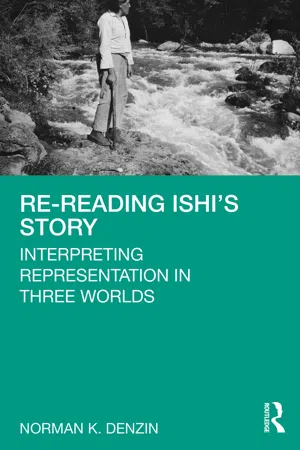
Re-Reading Ishi's Story
eBook - ePub

Re-Reading Ishi's Story

Interpreting Representation in Three Worlds

  1. 128 pages
  2. English
  3. ePUB (mobile friendly)
  4. Available on iOS & Android
eBook - ePub

Re-Reading Ishi's Story

Interpreting Representation in Three Worlds

About this book

Rereading Ishi's Story offers a manifesto of sorts through a critical reading of an anthropological classic, Theodora Kroeber's 1961 book, Ishi in Two Worlds: A Biography of the Last Wild Indian in North America.

The heart of the analysis involves a five-play cycle, built around Gerald Vizenor's trickster-survivance model. It gives Ishi a voice he never had in Kroeber's book and imagines an Ishi who was not the happy warrior in Kroeber's book. The author follows the story line in Kroeber's book, focusing on key events as recounted by Alfred Kroeber and his associates Saxton Pope and Thomas Waterman. Chapter 1 tells Ishi's story in his own words; Chapter 2 retells Ishi's capture narrative, which includes the recording of his story of the wood ducks; Chapter 3 builds on stories told about Ishi by Zumwalt Jr.; Chapter 4 criticizes Kroeber and associates for making Ishi return to his homeland, asking him to 'play' Indian; and Chapter 5 takes up his death and the recovery of his brain. The concluding chapters address repatriation practices, genocide, Indigenous ethics, discourses of forgiveness, and a performance autoethnography ethic for this new century, returning to the Kroebers and their autoethnographic practices.

This book continues a four-volume project on Native Americans, the postmodern Wild West shows, museums, violence, genocide, and the modern U.S. American use of the Native American in a collective search for an authentic identity (Denzin, 2015, 2013, 2011, 2008). It will be of great interest to scholars and students of qualitative inquiry, anthropology, and Native American studies.

Frequently asked questions

Yes, you can cancel anytime from the Subscription tab in your account settings on the Perlego website. Your subscription will stay active until the end of your current billing period. Learn how to cancel your subscription.
No, books cannot be downloaded as external files, such as PDFs, for use outside of Perlego. However, you can download books within the Perlego app for offline reading on mobile or tablet. Learn more here.
Perlego offers two plans: Essential and Complete
  • Essential is ideal for learners and professionals who enjoy exploring a wide range of subjects. Access the Essential Library with 800,000+ trusted titles and best-sellers across business, personal growth, and the humanities. Includes unlimited reading time and Standard Read Aloud voice.
  • Complete: Perfect for advanced learners and researchers needing full, unrestricted access. Unlock 1.4M+ books across hundreds of subjects, including academic and specialized titles. The Complete Plan also includes advanced features like Premium Read Aloud and Research Assistant.
Both plans are available with monthly, semester, or annual billing cycles.
We are an online textbook subscription service, where you can get access to an entire online library for less than the price of a single book per month. With over 1 million books across 1000+ topics, we’ve got you covered! Learn more here.
Look out for the read-aloud symbol on your next book to see if you can listen to it. The read-aloud tool reads text aloud for you, highlighting the text as it is being read. You can pause it, speed it up and slow it down. Learn more here.
Yes! You can use the Perlego app on both iOS or Android devices to read anytime, anywhere — even offline. Perfect for commutes or when you’re on the go.
Please note we cannot support devices running on iOS 13 and Android 7 or earlier. Learn more about using the app.
Yes, you can access Re-Reading Ishi's Story by Norman K. Denzin in PDF and/or ePUB format, as well as other popular books in Psychology & Ethnic Studies. We have over one million books available in our catalogue for you to explore.

Information

Publisher
Routledge
Year
2021
Print ISBN
9780367687472
eBook ISBN
9781000358407
Edition
1

Part 1

1
You can call me Ishi

The story of a trickster

Let’s begin here:
Dear reader, this is my story. You need to hear from me first. My name is Ishi, but you could call me Ishmael, for I too am an exile, a social outcast, a victim of robbery, the last surviving member of a small society (Melville, 1851; Kroeber, 1961, p. 4). The anthropologists named me Ishi. Kroeber said I was the last man of the Stone Age. I was born in 1860 and died in 1916. I came out of the Northern California mountains in an undershirt and rags. First, you put me in jail, and then you put me on a train and took me to San Francisco and put me in a museum next to a room that contained human bones. You dressed me up in Western clothes and then asked me to pose bare chested for photographers and journalists.
You said I was shy at first but gentle and had a good sense of humor. You said I sometimes used pantomime to make myself understood. You said I blushed easily, was easily embarrassed, and I learned very little English (Kroeber 1961, pp. 124–25). The newspapers said I was civilization’s last wild man, a well-born Yahi. You put me behind glass. You recorded my voice and transcribed my stories. Hucksters wanted the museum to promote a two-man act of me and Kroeber. It would be for educational and edifying purposes (Kroeber, 1961, p. 129). On Sunday afternoons between two and four-thirty, Kroeber and I received visitors at the museum. Later, the museum made a movie of me entering, leaving, and working in my little museum house (Kroeber, 1961, p.132).
Call me Ishi. It was never my name. I never told them my real name. Kroeber, the Big Chiep, named me Ishi, which means ā€œmanā€ in Yana, my language, one of the people. I am the last man. I am absence. I am Gerald Vizenor’s post-Indian. You gave me a watch, but I cannot tell time.
Call me Ishi. I lived in exile, a fugitive pursued by pioneers and miners bent on genocide, $0.25 a scalp, $5 for an Indian’s head. I am part of your creation story. I was there before there was a beginning—before there were Native Americans (Vizenor, 1949, p. Vii). There are no real Native Americans or Indians. The word is an invention. I am a simulation. I am trickster, coyote, a make-believe aboriginal.
You put me on stage as if in a Wild West show, like one of the Fox Indians in George Catlin’s Traveling Indian Gallery (Denzin, 2013; Catlin, 1848a, 1848b). I told tricky Wood Duck stories, smiled, made bows and arrows, chipped arrowheads out of pieces of broken glass and built campfires.
I said I want to grow old here.
I was like Gloria Anzaldua’s New Mestiza, safely locked up in a reservationor urban ghetto, or behind glass in the museum (Anzaldua, 1987, p. 183, paraphrase). I never learned how to shake hands, I never went bare chested, wore leather clothes, or feathers. I smiled at tourists. I was more than a starved-out Yahi from the wilds of Dear Creek.
Big Chiep said I had perceptive powers far keener than those of highly educated white men, a higher mentality than most aboriginals. You said I proved that a savage from the wilds can be civilized.
I gained 40 pounds in two months of captivity.
I was a Native hunter in a museum. I bought a certificate that said I was a Yahi, but there is nobody left from my tribe.
I am a tribe of one. I am my own sovereign tribal nation. I am an artist. I am a man. I am as real as every fictional Indian: noble savage, proud warrior Tonto, Little Beaver, Squanto, Pocahontas, Chief Joseph, Geronimo, Sacajawea, Crazy Horse, Hiawatha Big Foot. Yippee ki-yay. I even went to Buffalo Bill’s Wild West Show. And a Sioux warrior asked what tribe is this Indian?
Everywhere I turned, they were taking my picture. I became an expert on matters of lighting, posing, and exposure. They sold photographs of me to tourists. They dressed me up as a civilized man in a suit, tie, and leather shoes. I died of TB in a museum. They divided my estate between the state and the hospital. The medical school got $265. You found my brain in a vat at the Smithsonian. Friends returned my brain and my ashes to a sacred site in my homeland.
My name is Ishmael, or ā€œI am Ishmael,ā€œ but rather ā€œCall me Ishmaelā€ (Melville, 1851). Never call me Ishi. My name is Ishmael, or ā€œI am Ishmael,ā€ but rather ā€œCall me Ishmael,ā€ your orphan, your outcast (Melville, 1851).
***
Another version of the story begins with this 1911 report in the Oroville Register:
Dateline: August 29: An aboriginal Indian, clad ...

Table of contents

  1. Cover
  2. Half Title
  3. Title Page
  4. Copyright Page
  5. Table of Contents
  6. List of figures
  7. Foreword
  8. Acknowledgements
  9. Dramatis personae
  10. PART I
  11. PART II
  12. Appendix
  13. Reference
  14. Index