This book examines the nature of the conflict between right-wing populism and multiculturalism: the West's defining conflict in the modern age. Drawing on a plethora of evidence from politics and culture in the West, it argues that these two positions, while antagonistic on the surface, are in fact similar: nationalism and multiculturalism are two names for one idea, the difference between them being simply a matter of geography; both outlooks have their roots in romanticism, sentimentalism, arrogance and a racist outlook. Rather than defend either approach, this volume urges us to consider the importance of roots and argues for greater consideration of what classical liberalism, socialism and feminism can do to break this impasse in our political thinking, with a concern for equality and concern for solidarity, regardless of cultural practice. As such it will appeal to social and political theorists with interests in political sociology and culture.
eBook - ePub
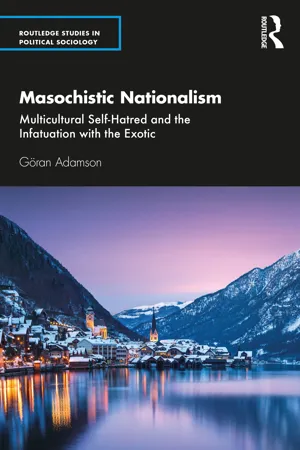
Masochistic Nationalism
Multicultural Self-Hatred and the Infatuation with the Exotic
- 134 pages
- English
- ePUB (mobile friendly)
- Available on iOS & Android
eBook - ePub
About this book
Information
1
INTRODUCTION
The concept of nationalism is generally seen as an uncalled for defence of the culture and history of one's own nation.1 As such, it is linked to an intense interest in this nation – its history, cultural expression and general particulars – and to a limited knowledge of and interest in other nations. Its perception of the nation is emotionally charged, and the worldview is sentimental and pessimistic.
There is, however, another and seemingly very different form of nationalism. While an advocate of the previous form would say: “We are the best, and all the others are inferior,” the supporter of this other form of nationalism claims: “We should be cautious in passing judgments on others, until we have come to terms with our own severe injustices.” Even if these self-critical nationalists rarely declare we are the worst of the lot, they would still conclude we are no better than others and at any rate more superficial and less interesting. “We simply have no right to sit on our high horses,” and to support their case, they bring up discrimination against women and minorities. One's own nation is not, under this form of nationalism, an object of unswerving defence, but one of relentless attack. Self-aggrandisement has been replaced by self-accusation.
One may argue that this latter idea is the opposite of a self-righteous nationalism. The respective advocates could not disagree more, and while one is a self-proclaimed rightist, the other one is a leftist, or at least claims to be. The antagonism between these two world-views defines the current political discussion. But under the surface similarities abound, the self-critical nationalist is also energetically preoccupied with his own nation. His view of the nation is also based on strong sentiments and a dark, sentimental outlook of the world. While self-righteousness and self-criticism are square opposites, they both emanate from the same basket of concepts, views and sentiments, as they are both the outcome of unchecked emotions. On either side, their respective supporters are surrounded by like-minded, and so their views become increasingly brash and hollow. Passionate advocacy of one's own nation, and intense criticism against it are two manifestations of one idea.
Self-critical nationalism has a peculiar side-taste. Normally, a sense of inferiority is not infused by other emotions. It is simply dull and painful, and associated with regret or shame. But this particular self-criticism has a different origin. It is linked to a sense of wellbeing. It is a form of collectivist pain associated with pleasure. Underneath this self-critical nationalism lies not a sense of shame, but of pride and snobbishness. This paradoxical self-importance and pleasure could not exist in case the shortcomings were real. A nation plagued by famine or corruption has no time to boast about it. Instead, this pleasure in pain reveals that the pain is not based on social realities but is purely fabricated. Self-critical nationalism can only occur in wealthy societies.
It is an odd fruit among those who are troubled by the fact that they are privileged and fortunate.
Note
1 The term “nationalism” is a rather vague concept ranging from “civic,”
liberal nationalism, to nationalism based on “ethnicity.” or even, during
the Nazi epoch, skin colour. For an overview of various forms of conservatisms and
nationalisms, see Pfahl-Traughber, 1994.Many, however, are deeply attached to their
country, even though they would never try to force these nationalist views on others.
These emotions were embraced by George Orwell himself, although he called it patriotism
(Orwell, 1945). The kind of nationalism discussed here, however, is somewhat more
radical. An inward and tolerant attitude of live-and-let-live has been replaced by
certain self-righteousness, proselytising, and an obsession with hierarchies, whether
this attitude is attached on one’s own country or a country overseas.
2
HISTORICAL BACKGROUND
The discussion about various forms of nationalism is not new. A classic critique can be found in George Orwell's Notes on nationalism from 1945. “A nationalist,” he says, is one who thinks solely, or mainly, in terms of competitive prestige. He may be a “positive” or a “negative” nationalist – that is, he may use his mental energy either in boosting or in denigrating – but at any rate his thoughts always turn on victories, defeats, triumphs and humiliations.1 Similar sentiments emerge from opposite corners. “All nationalists,” Orwell continues, “have the power of not seeing resemblances between similar sets of facts. A British Tory will defend self-determination in Europe and oppose it in India with no feeling of inconsistency.” A negative nationalist, on the other hand, will favour nationalist movements in India and oppose them in Europe with no sense of contradiction. “Actions,” Orwell maintains, “are held to be good or bad, not on their own merit, but according to who does them.” On the part of the country where he has sunk his personality, every “nationalist is capable of the most flagrant dishonesty, but he is also – since he is conscious of serving something bigger than himself – unshakeably certain of being in the right.”2 Whether positive or negative, any form of nationalist will, says Orwell, “claim superiority of the language, the physical beauty of the inhabitants, and perhaps even in climate, scenery and cooking.”3 Orwell's positive and negative nationalist could not disagree more. But they still share a deeper obsession with hierarchies – who is better and who is worse. Orwell describes “Anglophobia,” the British version of negative nationalism, in the following manner:
Within the intelligentsia, a derisive and mildly hostile attitude towards Britain is more or less compulsory, but it is an un-faked emotion in many cases. During the war it was manifested in the defeatism of the intelligentsia, which persisted long after it had become clear that the Axis power could not win. Many people were undisguisedly pleased when Singapore fell or when the British were driven out of Greece, and there was a remarkable unwillingness to believe in good news, e.g. al Alamein, or the number of German planes shot down in the battle of Britain.
They were trained to oppose British interests, but still could not embrace Hitler. Therefore, they offered a kind of negation of conservative opinion.
English left-wing intellectuals did not, of course, actually want the Germans or Japanese to win the war, but many of them could not help getting a certain kick out of seeing their own country humiliated, and wanted to feel that the final victory would be due to Russia, or perhaps America, and not to Britain. In foreign politics many intellectuals follow the principle that any faction backed by Britain must be in the wrong. As a result, “enlightened” opinion is quite largely a mirror image of Conservative policy. Anglophobia is always liable to reversal, hence that fairly common spectacle, the pacifist of one war who is a bellicist in the next.4
Negative nationalism among British intellectuals was not only linked to hostile emotions against England. They also, Orwell claims, got “a certain kick” out of it. Negative nationalism combines collectivist self-abuse with excitement. It is not the mark of the downtrodden but of the superior.5 In Notes on Nationalism Orwell adds another concept. He calls it “transferred nationalism.” While negative nationalism does not require any positive object of loyalty – such as in “Trotskyists who have become simply enemies of the USSR without developing a corresponding loyalty to any other unit,” transferred nationalism has gone overseas; it is a form of nationalist allegiance “fastened up on some foreign country.”6 Familiar nationalist sentiments have found a less politically suspect point of reference. It is a kind of Shang-ri-la, Utopia and Eldorado – an object of intense romanticism for a certain Western mind-set. The difference is merely geographical: it is simply there, not here. For more than a century, Orwell continues, “transferred nationalism has been a common phenomenon among literary intellectuals.”7
Transferred nationalism is like negative, self-critical nationalism and in addition a positive point of cultural reference. Today, a negative and hostile attitude towards one's own nation only rarely comes “without any positive object of loyalty.” Those who hold their own country in low esteem also tend to embrace a positive object of loyalty overseas.8 Therefore, negative and transferred nationalism may be combined. I propose to call this combination “masochist nationalism.”
Masochist nationalism may be separated into five aspects:
- Hostility towards one's own nation.
- Self-inflicted pain with no basis in reality.
- This pain is infused with a sense of pleasure and grandeur.
- Nationalist sentiments are curtailed only to be unpacked later on behalf of a nation overseas.
- Loyalty towards another nation as a mirror image of positive nationalism.
Who is a masochist nationalist? To try to illustrate this, we shall return to the citation at the beginning of the chapter, where a Dutch UN Program Officer once said: “Dutch politics, oh, it's so bloody uninteresting!” Why does he say this? Because he thinks nothing is happening politically in Holland. After perhaps 20 years in a country where the UN is needed, politics, to him, is “interesting” when everything is constantly in the balance, when there is a state of emergency, and so on. The Program Officer has acquired a taste for political turmoil, and this taste translates into his preferred image of interesting politics. In this sense, Dutch politics is of course uninteresting because it is uneventful. But this is not necessarily a bad thing. Couldn’t you say Dutch politics is uninteresting because it works? Violence and coups have been replaced by calm, efficient negotiations. And is Dutch politics really uninteresting? Subtle negotiations are complicated and very interesting, under the surface at least. When the UN Program Officer dismisses all those fine-tuned achievements for the benefit, it seems, of social unrest, he not only reveals a taste for the primitive and the exotic, but he is also, at least in part, an anti-intellectual.
This Program Officer, then, idealises an exotic culture, and prefers to live in it rather than in his country of birth. If somebody asks him why he stays there when he does not have to, he says it does not disappear just because you are somewhere else, assuming suffering is always present, and we have no right to escape it. But why shouldn’t we when millions of refugees are risking their lives for it? Why not live in comfort if you can? And yet he does seem to escape suffering because he lives in a compound guarded by security and surrounded by nannies, cooks, helpers and gardeners, and socialises very little, if at all, with the locals. He lives the life of a colonialist although it is not labelled as such. Of course, he opposes colonialism. He hates Israel but will be air-lifted to a Tel Aviv hospital in hours. He wants to visit Cambodia, but he does not want to experience it. He finds it extremely fascinating, but not because he knows a lot about it, but because he knows almost nothing. His fascination is a sign of his ignorance. He has left his country of origin without ever arriving anywhere else. Somehow, he knows that his dismissive comments about Dutch politics are not really true. He says it because he, and people like him, take pleasure in holding their native country in low esteem.
Just like other expatriates working for international organizations, this UN Program Officer is a good illustration of a masochist nationalist. He holds a hostile attitude towards his own nation. There is an air of pleasure and excitement around his self-patronising phrase above, and there is little reality behind it – Holland is a prosperous country. He prefers violence to efficiency – a surprising trait for someone employed to reduce poverty. The anti-nationalist character of UN-staff does not convince. He merely saves those curtailed nationalist emotions for an overseas country. His loyalty and identification to his faraway duty station resembles an old-fashioned nationalist's loyalty to Britain.
But there is a confusion here. What happened to the conflict between nationalists and globalists? Between the narrow-minded Trump-voter, and the progressive, unprejudiced internationalist open to the world? This is the way the antagonism is generally framed, at least by th...
Table of contents
- Cover
- Half Title
- Series Page
- Title Page
- Copyright Page
- Dedication Page
- Contents
- Preface
- Foreword
- Acknowledgements
- 1 Introduction
- 2 Historical background
- 3 The power of the past
- 4 The virtue of amnesia and the vice of difference
- 5 The purpose of art, well, that’s really none of our business
- 6 The ogre of collectivism
- 7 Power and emotions
- 8 On moral show-off and the hidden benefits of self-abasement
- 9 Death cult and the reactionary onslaught in wit
- 10 1789 and the gestures of condescension
- 11 Racism
- 12 A liberal way out of nationalist ossification?
- 13 A final word
- References
- Index
Trusted by 375,005 students
Access to over 1.5 million titles for a fair monthly price.
Study more efficiently using our study tools.
Frequently asked questions
Yes, you can cancel anytime from the Subscription tab in your account settings on the Perlego website. Your subscription will stay active until the end of your current billing period. Learn how to cancel your subscription
No, books cannot be downloaded as external files, such as PDFs, for use outside of Perlego. However, you can download books within the Perlego app for offline reading on mobile or tablet. Learn how to download books offline
Perlego offers two plans: Essential and Complete
- Essential is ideal for learners and professionals who enjoy exploring a wide range of subjects. Access the Essential Library with 800,000+ trusted titles and best-sellers across business, personal growth, and the humanities. Includes unlimited reading time and Standard Read Aloud voice.
- Complete: Perfect for advanced learners and researchers needing full, unrestricted access. Unlock 1.5M+ books across hundreds of subjects, including academic and specialized titles. The Complete Plan also includes advanced features like Premium Read Aloud and Research Assistant.
We are an online textbook subscription service, where you can get access to an entire online library for less than the price of a single book per month. With over 1.5 million books across 990+ topics, we’ve got you covered! Learn about our mission
Look out for the read-aloud symbol on your next book to see if you can listen to it. The read-aloud tool reads text aloud for you, highlighting the text as it is being read. You can pause it, speed it up and slow it down. Learn more about Read Aloud
Yes! You can use the Perlego app on both iOS and Android devices to read anytime, anywhere — even offline. Perfect for commutes or when you’re on the go.
Please note we cannot support devices running on iOS 13 and Android 7 or earlier. Learn more about using the app
Please note we cannot support devices running on iOS 13 and Android 7 or earlier. Learn more about using the app
Yes, you can access Masochistic Nationalism by Göran Adamson in PDF and/or ePUB format, as well as other popular books in Politics & International Relations & Conservatism & Liberalism. We have over 1.5 million books available in our catalogue for you to explore.