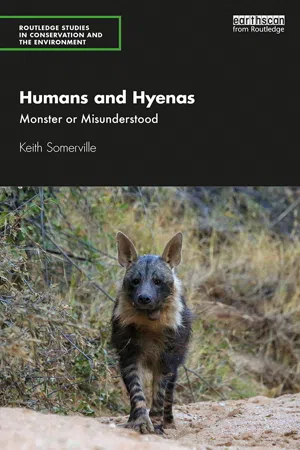
Humans and Hyenas examines the origins and development of the relationship between the two to present an accurate and realistic picture of the hyena and its interactions with people. The hyena is one of the most maligned, misrepresented and defamed mammals. It is still, despite decades of research-led knowledge, seen as a skulking, cowardly scavenger rather than a successful hunter with complex family and communal systems.
Hyenas are portrayed as sex-shifting deviants, grave robbers and attackers of children in everything from African folk tales through Greek and Roman accounts of animal life, to Disney's The Lion King depicting hyenas with a lack of respect and disgust, despite the reality of their behaviour and social structures. Combining the personal, in-depth mining of scientific papers about the three main species and historical accounts, Keith Somerville delves into our relationship with hyenas from the earliest records from millennia ago, through the accounts by colonisers, to contemporary coexistence, where hyenas and humans are forced into ever closer proximity due to shrinking habitats and loss of prey. Are hyenas fated to retain their bad image or can their amazing ability to adapt to humans more successfully than lions and other predators lead to a shift in perspective?
This book will be of great interest to students and scholars in the environmental sciences, conservation biology, and wildlife and conservation issues.
Brown, striped hyena and spotted hyenas belong to the subfamily Hyaeninae, a subfamily that includes all living and extinct bone-cracking hyenas.1 Aardwolves are the only members of the Hyaenidae subfamily Protelinae and are insectivores. The hyenas are surprisingly varied in their ecologies and social behaviours2 and are distributed across most of Africa (except the most arid areas of the Sahara, high mountains and dense Congo Basin and West African rainforest); the Middle East (from Turkey to southern Arabia); and West, Central and parts of South Asia. Population numbers are hard to assess and throughout, the estimates given are within broad ranges based on spoor, scat, camera trap and observational surveys. These all have a margin for error.3
The striped hyena is found across the hyena range, excepting the southern half of Africa. It is the only hyena found outside Africa. The IUCN Red List places it in Afghanistan; Algeria; Armenia; Azerbaijan; Burkina Faso; Cameroon; Chad; Djibouti; Egypt; Ethiopia; Georgia; India; Iran, Islamic Republic of; Iraq; Israel; Jordan; Kenya; Lebanon; Libya; Mali; Mauritania; Morocco; Nepal; Niger; Nigeria; Oman; Pakistan; Saudi Arabia; Senegal; Syria; Tajikistan; Tanzania; Tunisia; Turkey; Turkmenistan; Uganda; Uzbekistan; Western Sahara; Yemen; with a possible presence in Benin; Central African Republic; Eritrea; Guinea; Kuwait; Qatar; Somalia; Sudan; United Arab Emirates. It is listed as “near threatened”, with a population globally estimated at 5,000–9,999.4 It is very possible that the difficulty in counting striped hyenas accurately means the population could be larger, as some conservationists believe.5
Map 1.1 Striped hyena IUCN Red List
The spotted hyena is only found in Africa. The IUCN Red List records it in Angola; Benin; Botswana; Burkina Faso; Burundi; Cameroon; Central African Republic; Chad; Congo; Democratic Republic of Congo; Côte d’Ivoire; Djibouti; Equatorial Guinea; Eritrea; Eswatini; Ethiopia; Gambia; Ghana; Guinea; Guinea-Bissau; Kenya; Malawi; Mali; Mauritania; Mozambique; Namibia; Niger; Nigeria; Rwanda; Senegal; Sierra Leone; Somalia; South Africa; South Sudan; Sudan; Tanzania; Uganda; Zambia; Zimbabwe; and possibly Algeria and Togo. It is listed as of “least concern” but decreasing in numbers. A “tentative estimate of the total global population is between 27,000 and 47,000”. The largest known populations occur in the Serengeti ecosystem in Tanzania and Kenya (7,200–7,700 in the Tanzanian sector and 500–1,000 in the Kenyan sector); in Kenya’s Tsavo East and Tsavo West NPs (3903 +/- 514)6; and the Kruger NP in South Africa (1,300–3,900).7 Yirga et al.’s suggestion that there could be 28,620 spotted hyenas in Ethiopia’s Tigray province would make that the largest population and would require a recalculation of the overall spotted hyena population,8 but it remains to be verified.
The brown hyena is found in Angola; Botswana; Namibia; South Africa; and Zimbabwe; with possible presence in Eswatini (Swaziland) and Mozambique. It is listed as “near threatened”, with a population between 4,365 and 10,111. Botswana has the largest population at about 3,900 animals, followed by Namibia with between 566–2,440 and South Africa with 800–2.200; no reliable population size estimates are available for Zimbabwe, Angola, Mozambique or Eswatini.9
Striped hyena (Hyaena hyaena)
This hyena weighs between 26–34kg (females) and 26–41kg (males), and is 1.00–1.10m in length, 0.66–0.75m in height.10 It is dog-like, with a sloping back, black vertical stripes on a background of grey or beige, pointed muzzle and ears and a mane along its back.11 It occurs in open habitat or light thorn bush country, avoiding altitudes above 2,500m and dense forest.12 It favours rocky areas, ravines and hills, preferably with caves in which to rest during the day. Mainly nocturnal and shy of humans, it does nevertheless reside in some areas (Palestine/Israel, for example) close to human settlements.13 They generally occur at low densities.
Although the research has increased in recent years, with research on behavioural ecology by Wagner,14 on status and conservation in Lebanon by Abi-Said15 and in Rajasthan by Singh16 and a few earlier papers by Kruuk17 and Leakey et al.,18 it is comparatively little studied.19
Map 1.2 Spotted hyena IUCN Red List
Map 1.3 Brown hyena IUCN Red List
Diet
Striped hyenas have a diverse diet including carrion, medium and small vertebrates, invertebrates and fruits and vegetables (melons, dates and other fruits and vegetables matter), as well as utilising waste produced by humans.20 They are capable of killing medium-sized ungulates and livestock.21 Kruuk said they were “inveterate scavengers of human waste” and that in the Serengeti, they fed on “domestic refuse such as fruits…bread, boiled potatoes and any animal offal such as bones, pieces of leather”.22 He also referred to reports that they had killed and eaten people.23 Studies in Kenya, Israel and Lebanon document that they take human remains from graveyards.24 Faecal analysis of their diet in Tanzania showed the following: zebra in 4% of samples; wildebeest 22%; kongoni 4%; topi 2%; Grant’s gazelle 24%; impala 2%; Thomson’s gazelle 42%; dik-dik 12%; hare 10%; lizard or snake 32%; birds 44%; vegetable matter 36% – most would have been scavenged but the smaller mammals, reptiles and birds may have been hunted.25 Bhandari et al. examined scats in two lowland districts of Nepal. The analysis showed the following percentages – wild boar 26.2; hare 16.23; rhesus monkey 15.58; muntjac deer 11.03; langur monkey 8.44; domestic goat 5.15; domestic sheep 2.59; and dog 2.59.26
Foraging and hunting
Striped hyenas are solitary foragers and don’t regularly feed in large groups.27 The exceptions being where there are particularly rich food sources, including man-made feeding stations established to observe feeding behaviour, at which large groups may gather.28 Although this does not alter the size of groups in which they live, it means they are less solitary than thought.29 They are almost totally nocturnal in their foraging. The sub-species found in North Africa, India and Syria are slightly larger than the others and periodically hunt and kill larger mammals. Leakey believed that striped hyenas in Kenya were not successful hunters of large mammals,30 and were inefficient hunters of smaller mammals like hare, porcupine and small rodents, reptiles, birds and insects.31
In its Middle Eastern and West Asian range, hyenas scavenge the remains of camels, wild goats, domestic sheep and goats and donkeys, with some hunting of domestic animals (including dogs) and small-to-medium-si...
Table of contents
Cover
Half Title
Series Page
Title Page
Copyright Page
Table of Contents
Foreword
List of abbreviations
Acknowledgements
Introduction
1. Dramatis Personae: The spotted, striped and brown hyenas
2. Humans and hyenas from the Pleistocene to the Holocene
3. Humans and hyenas in Africa to 1600CE
4. Humans and hyenas in West, Central and South Asia to 1600CE
5. Humans and hyenas from 1600CE to the end of the 19th century
6. Persecution increases under colonial rule
7. Contemporary Africa, West, Central and South Asia
8. Myths and representations from early humans to The Lion King
Index
Trusted by 375,005 students
Access to over 1.5 million titles for a fair monthly price.
Study more efficiently using our study tools.
Frequently asked questions
Yes, you can cancel anytime from the Subscription tab in your account settings on the Perlego website. Your subscription will stay active until the end of your current billing period. Learn how to cancel your subscription
No, books cannot be downloaded as external files, such as PDFs, for use outside of Perlego. However, you can download books within the Perlego app for offline reading on mobile or tablet. Learn how to download books offline
Perlego offers two plans: Essential and Complete
Essential is ideal for learners and professionals who enjoy exploring a wide range of subjects. Access the Essential Library with 800,000+ trusted titles and best-sellers across business, personal growth, and the humanities. Includes unlimited reading time and Standard Read Aloud voice.
Complete: Perfect for advanced learners and researchers needing full, unrestricted access. Unlock 1.5M+ books across hundreds of subjects, including academic and specialized titles. The Complete Plan also includes advanced features like Premium Read Aloud and Research Assistant.
Both plans are available with monthly, semester, or annual billing cycles.
We are an online textbook subscription service, where you can get access to an entire online library for less than the price of a single book per month. With over 1.5 million books across 990+ topics, we’ve got you covered! Learn about our mission
Look out for the read-aloud symbol on your next book to see if you can listen to it. The read-aloud tool reads text aloud for you, highlighting the text as it is being read. You can pause it, speed it up and slow it down. Learn more about Read Aloud
Yes! You can use the Perlego app on both iOS and Android devices to read anytime, anywhere — even offline. Perfect for commutes or when you’re on the go. Please note we cannot support devices running on iOS 13 and Android 7 or earlier. Learn more about using the app
Yes, you can access Humans and Hyenas by Keith Somerville in PDF and/or ePUB format, as well as other popular books in History & African History. We have over 1.5 million books available in our catalogue for you to explore.