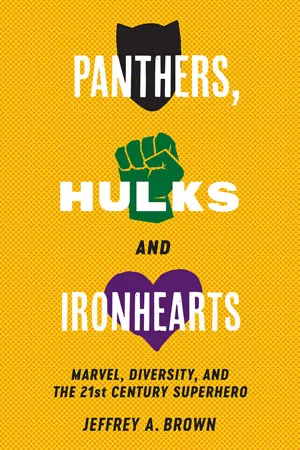
Marvel is one of the hottest media companies in the world right now, and its beloved superheroes are all over film, television and comic books. Yet rather than simply cashing in on the popularity of iconic white male characters like Peter Parker, Tony Stark and Steve Rogers, Marvel has consciously diversified its lineup of superheroes, courting controversy in the process. Panthers, Hulks, and Ironhearts offers the first comprehensive study of how Marvel has reimagined what a superhero might look like in the twenty-first century. It examines how they have revitalized older characters like Black Panther and Luke Cage, while creating new ones like Latina superhero Miss America. Furthermore, it considers the mixed fan responses to Marvel's recasting of certain "legacy heroes," including a Pakistani-American Ms. Marvel, a Korean-American Hulk, and a whole rainbow of multiverse Spidermen.If the superhero comic is a quintessentially American creation, then how might the increasing diversification of Marvel's superhero lineup reveal a fundamental shift in our understanding of American identity? This timely study answers those questions and considers what Marvel's comics, TV series, and films might teach us about stereotyping, Orientalism, repatriation, whitewashing, and identification.
eBook - ePub
Panthers, Hulks and Ironhearts
Marvel, Diversity and the 21st Century Superhero
- English
- ePUB (mobile friendly)
- Available on iOS & Android
eBook - ePub
About this book
Information
Publisher
Rutgers University PressYear
2021Print ISBN
9781978809215
9781978809222
eBook ISBN
9781978809239
Chapter 1
Spider-Analogues
UNMARKING AND UNMASKING WHITE MALE SUPERHEROISM
Marvel Comics’ massive crossover event Spider-Verse (2014–2015) brought together hundreds of different analogues of their most popular character, Spider-Man, to fight an interdimensional threat to all the Spider people in the multiverse. Marvel returned to this extreme superhero team-up in various Spider-Man video games, the televised cartoon Ultimate Spider-Man, the comic book sequel event known as Spider-Geddon (2018–2019), and the animated feature film Spider-Man: Into the Spider-Verse (2018). These stories all emphasize the flexibility of the core characterization of Spider-Man, who has been presented in wildly diverse and often contradictory forms: from Cowboy Spider-Man, to Cyborg Spider-Man, to Cosmic Spider-Man, to even Spider-Monkey. Marvel’s imaginative depictions of Spider-Man in a range of different characterizations conform to the comic book convention of “multiplicity,” wherein modifications to familiar heroes are assigned to alternate universes or timelines. While many Spider-Man analogues are simply whimsical or humorous, a significant number of the variations are more serious and explore ideas about what Spider-Man would mean if he were not a white American male. Among the Spider-themed characters who inhabit the Spider-Verse are multiple female variations—Spider-Women and Spider-Girls—as well as a range of ethnic and national variants such as Spider-Men who are African American, Indian, Latino, Chinese, and Japanese. The depiction of nonwhite, non-American, and nonmale analogues within the larger Spider-Man mythology represents a potentially progressive, and inclusionary, step for a genre traditionally overpopulated by heroic Aryan supermen. Conversely, the reliance on analogues of such a familiar character and the narrative logic of the genre reinforces a presumption that the white American male is the baseline or default requirement of superheroism. The balance between these two different perspectives (challenging the norm of white male heroic hegemony or reinforcing it) becomes a crucial terrain for understanding the possibilities and limitations of a popular media form attempting to address modern racial and gender politics.
The Spider-Verse
The coexistence of different versions of a figure as popular as Spider-Man is a logical result of thousands of different writers and artists in different time periods and across different media formats, all telling stories featuring a specific character. Every creator has a unique style and vision that allows a personal twist on the hero within the broad editorial parameters of what defines a character. After decades of different stories exploring different themes and possibilities related to iconic superheroes, characters and narratives often become splintered, contradictory, and mercurial. In her discussion of comic book storyworlds, Karin Kukkonen (2010) notes, “The stories of heroes like Superman, Batman, and Wonder Woman have been published for decades on a weekly or biweekly basis, written by ever-changing authors. As a result, inconsistencies emerged in the different storyworlds and encounters involving these characters, and continuity, or the coherent and consistent development of the characters and their storyworlds, became a problem” (155). Definitive continuity and character authenticity became difficult to stick to when there were multiple versions of iconic superheroes, from both Marvel and DC Comics, all in play at the same time. But as Kukkonen goes on to argue, in order to address these variations and canonize the emerging multiplicity of characters, “superhero comics made a virtue out of necessity and presented their storyworlds as part of a larger ‘multiverse,’ in which a variety of mutually incompatible narrative worlds existed as parallel realities” (156). The narrative device of a multiverse of realities allows both Marvel and DC to rationalize the accumulated character variations and creates a safe place to explore topics that may not be possible within the central continuity of a specific superhero. As Kathryn M. Frank notes in relation to introducing ethnically diverse characters, “Alternate universes can provide creators with more freedom in constructing story lines and creating characters since there are fewer (or no) existing canonical elements to which they must adhere. New universes can also be used as a strategy for drawing in new readers, who can start reading the comics without needing to first familiarize themselves with years of continuity” (242).
Every alternate universe is a specific twist on the central continuity of major characters. “For each of these storyworlds one element of its basic premises has been changed,” Kukkonen goes on to explain. “They work as counterfactuals, ‘what if’ versions, relative to one another” (161). The premise of each alternative universe revolves around a central variable: What if Spider-Man existed in Elizabethan England? What if Spider-Man was older and had a teenage daughter? What if Spider-Man was a different ethnicity? What if Spider-Man was a hard-boiled assassin? A cartoonish animal? A British punk rocker? Or a vampire? It is the ramifications of these single changes that create new pleasures for the readers and allow a wider range of subjects to be addressed in relation to an iconic character. This idea of character variation has become relatively synonymous with superhero comics and formalized through Marvel’s imaginative What If . . . ? series and DC Comics’ Elseworlds imprints. Marvel’s What If . . . ? series has been an on-again, off-again publication that first launched in 1977 with the story “What If Spider-Man Joined the Fantastic Four?” By 2018, Marvel was on the thirteenth volume of the What If . . . ? series, described on Marvel.com as “What if something else happened? What if an event—poised on a knife edge—fell in the other direction? What if the Marvel universe was . . . different?” Similarly, DC’s Elseworlds books are described as “Heroes are taken from their usual settings and put into strange times and places—some that have existed, or might have existed, and others that can’t, couldn’t, and shouldn’t exist. The result is stories that make characters who are as familiar as yesterday seem as fresh as tomorrow.” The multiverses at both companies have become so extensive that both Marvel and DC have printed charts and graphs for fans to keep track of the variations, and both have required occasional crossover events in order to clean house and explain how these different universes exist in relation to each other.
Henry Jenkins (2009) describes this narrative flexibility and the seemingly limitless variations on popular characters as “multiplicity.” As Jenkins argues, multiplicity has become a notable trend that can be taken as symbolic of current multimedia texts, but character variations have long been a recognized feature of superhero comic books. Rather than a shift from modernist ideas of narrative continuity to an era of postmodern multiplicity, Jenkins reasons, “comics have entered a period where principles of multiplicity are felt at least as powerfully as those of continuity. Under this new system, readers may consume multiple versions of the same franchise, each with different conceptions of the character, different understandings of the relationships with the secondary figures, different moral perspectives, exploring different moments in their lives, and so forth” (2009, 20–21). But as Jenkins goes on to argue, to assume that multiplicity has replaced continuity would be a mistake. Today’s superhero genre may have a predilection for revisionist stories that question some of the basic principles of superheroes, but while “the era of multiplicity exaggerates and extends the generic instability . . . there is not a moment in the history of the genre when the superhero is not under active revision” (29). Instead, principles of continuity and multiplicity work not in opposition to each other but in relation to each other. Meaning becomes layered on top of variations, and continuity is derived through a ready acceptance of multiplicity. In other words, a central and standard idea of Spider-Man is crucial for a sake of continuity (Peter Parker, a nerdy white American male bitten by a radioactive spider, Aunt May, Mary Jane Watson, web-swinging, etc.), but variations of Spider-Man seamlessly coexist under the logic of multiplicity.
According to the Hollywood Reporter (Block 2014), Spider-Man is one of the most famous fictional characters in the world and is indisputably the most profitable superhero, bringing in over $1.3 billion in licensing revenues in 2014 alone. To capitalize on Spider-Man’s popularity and to appeal to consumers’ desires for variation, Marvel has subjected the concept of Spider-Man to an incredible amount of character multiplicity. Spider-Man’s ubiquitous media presence has resulted in an almost unparalleled number of variations (DC Comics’ perennial favorite Batman has also been the subject of an avalanche of multiplicity; see Brown 2019). Hundreds of spin-offs, impersonators, clones, and other variations have been added to the basic concept of Spider-Man. In his discussion of multiplicity, Henry Jenkins uses Spider-Man as an obvious example of the core concept: “So in some storylines, Aunt May knows Spiderman’s secret identity while in others she doesn’t; in some, Peter Parker is still a teen and in others he is an adult science teacher; in some, he is married to Mary Jane and in others they have broken up, and so forth” (2009, 21). The incredible popularity of Spider-Man ensures a base audience for each variation of the character, and the core idea of Spider-Man serves as a familiar touchstone for understanding the analogues.
In addition to the numerous variations on the original premise of Peter Parker as Spider-Man that Jenkins highlights, the familiar Spider motif and Spider powers have increasingly been associated with characters who are not white men. Among some of the most popular of these diverse versions of Spider heroes are the earliest explicit Spider-Man analogue, Miguel O’Hara, a half-Irish, half-Mexican Spider-powered hero in a futuristic timeline who starred in Spider-Man 2099 (vol. 1, 1992–1996; vol. 2, 2014–2017); Pavitr Prabhakar, the Spider-Man of Mumbai, who appeared in the 2004 miniseries Spider-Man: India in an attempt to capitalize on the international popularity associated with the film Spider-Man 2 (2004); Peter and Mary Jane’s daughter May “Mayday” Parker, who became the first Spider-Girl and starred in Spider-Girl (1998–2006) and The Amazing Spider-Girl (2006–2009); Anya Corazon, who is of Puerto Rican and Mexican descent and initially went by the superhero name Araña when she premiered in the pages of Amazing Fantasy in 2004 and later switched to Spider-Girl for her own self-titled series (2010–2011); Miles Morales, a black/Puerto Rican Spider-Man who premiered in Ultimate Comics Spider-Man (2011–2013), Miles Morales: Ultimate Spider-Man (2014–2015), and then Spider-Man (2016–ongoing); Spider-Gwen, who was introduced in 2014 leading up to the Spider-Verse event and became popular enough to headline her own series, Spider-Gwen (2015–2018); and the Korean American character of Cindy Moon, who has powers nearly identical to Peter Parker’s and was introduced in a relaunched The Amazing Spider-Man #1 (2014) and then was featured in her own series Silk (2015–2017).
These Spider-Man analogues structured around changes in ethnicity and gender facilitate a greater diversity of heroism without challenging the preeminence of the original character. In his analysis of geopolitics in comics, Jason Dittmer (2013) argues that stories set in other worlds “offer both reinforcement of primary themes found throughout these heroes’ continuities and also opportunities to narrate political alternatives that may or may not be more politically progressive” (143). Dittmer’s focus is primarily on nation-states and symbolic heroes such as Captain America, Captain Britain, and Captain Canada, but the multiversal Spider heroes function in a similar way to explore the “political alternatives” of identity politics. The central and original conception of Spider-Man as a young, white Peter Parker, who lives in New York and develops powers thanks to a radioactive spider bite, serves as a familiar foundation against which any number of analogues can emerge. Changes to crucial features like gender and ethnicity are understood in relation to the primary concept of Spider-Man.
Spider-Verse was a massive crossover event orchestrated at Marvel in 2014. The story line ran across numerous Spider-Man and Spider-Man-related titles and introduced a number of new miniseries, one-shot tie-ins, and original ongoing series for new solo characters and Spider teams. The premise for bringing hundreds of different Spider analogues into contact with each other revolves around a godlike family of villains (Morlun and his siblings, called the Inheritors) who travel from universe to universe hunting and devouring Spider people in order to consume their powerful essences. The Inheritors travel the multiverse across the “Web of Life” with the help of the “Master Weaver,” whom they have enslaved. Many Spider analogues are killed by the Inheritors before dozens of Spider-Men, Spider-Women, Spider-Girls, and Spider-animals team up to fight back and help save the multiverse. Part of the pleasure for fans is the sheer number and imaginativeness of the Spider variations presented, from the stiff 1960s animation style of Spider-Man, to an obscure Japanese newspaper strip incarnation, to mentions of both the Tobey McGuire and Andrew Garfield versions from the live-action feature films. The promotional text on the back cover of the collected trade paperback (2016) emphasizes the allure of the incredible range of Spider-Men involved:
No single hero stands any chance of survival. To have any hope, the Spiders will have to unite—from the Amazing to the Ultimate, the Spectacular to the Sensational, the Friendly Neighborhood to the Superior, the 1602 to the 2099, Cartoon Spideys! Cloned Spideys! Cool-costumed Spideys! Even Cosmic Spidey! This one has it all, from old favorites like Ben Reilly and—yes!—Spider-Ham, to breakout stars like giant robot SP//dr and the rocktacular Spider-Gwen. Join Spider-Woman, Scarlet Spider, Silk, Spider-Man 2099, a time-torn Superior Spider-Man, Ultimate Spider-Man, Spider-Girls present and future, and—of course—the one true Spider-Man as they join the wall-crawlers of all the worlds for the most incredible team-up of all.
Inevitably, the original Spider-Man (from Earth 616) and his Spider allies defeat Morlun and the Inheritors and save the multiverse. The Spider-Verse event was a huge commercial success for Marvel, who, along with parent company Disney, leveraged the popularity of the characters into a number of ongoing series and sequels. Though some of the Spider analogues had previously met each other across dimensional divides, the Spider-Verse event was the first large-scale uniting of all the different characters in a single story that strives to explain and contextualize the coexistence of so many Spider-Man variations (figure 1.1).
In Spider-Verse, the previously established ethnic and/or female Spider analogues that some fans were already familiar with (Pavitr Prabhakar, Anya Corazon, Miguel O’Hara, May Parker, Miles Morales, Cindy Moon, etc.) are joined by many other nonwhite and nonmale variations. Some of these, like Spider-Gwen and Spider-team Japan, receive a significant amount of attention, while others merely populate the background in crowd scenes. The implicit message of all these different Spider characters is that anyone can be a hero, can be a “Spider-Man,” regardless of their ethnicity, gender, nationality, or even species. Spider-Verse depicts the inclusionary logic that has become associated with modern comic book multiplicities that true superheroism comes from within and is not dependent on a specific ethnicity or gender. So long as a character has some type...
Table of contents
- Cover
- Title Page
- Copyright Page
- Dedication
- Contents
- Introduction: Marvel and Modern America
- Chapter 1. Spider-Analogues: Unmarking and Unmasking White Male Superheroism
- Chapter 2. The Replacements: Ethnicity, Gender, and Legacy Heroes in Marvel Comics
- Chapter 3. Superdad: Luke Cage and Heroic Fatherhood in the Civil War Comic
- Chapter 4. Black Panther: Aspiration, Identification, and Appropriation
- Chapter 5. Iron Fist: Ethnicity, Appropriation, and Repatriation
- Chapter 6. Totally Awesome Asian Heroes versus Stereotypes
- Chapter 7. A New America: Marvelous Latinx Superheroes
- Chapter 8. Ms. Marvel: A Thoroughly Relatable Muslim Superheroine
- Afterword: “Because the World Still Needs Heroes!”
- References
- Index
- About the Author
Trusted by 375,005 students
Access to over 1.5 million titles for a fair monthly price.
Study more efficiently using our study tools.
Frequently asked questions
Yes, you can cancel anytime from the Subscription tab in your account settings on the Perlego website. Your subscription will stay active until the end of your current billing period. Learn how to cancel your subscription
No, books cannot be downloaded as external files, such as PDFs, for use outside of Perlego. However, you can download books within the Perlego app for offline reading on mobile or tablet. Learn how to download books offline
Perlego offers two plans: Essential and Complete
- Essential is ideal for learners and professionals who enjoy exploring a wide range of subjects. Access the Essential Library with 800,000+ trusted titles and best-sellers across business, personal growth, and the humanities. Includes unlimited reading time and Standard Read Aloud voice.
- Complete: Perfect for advanced learners and researchers needing full, unrestricted access. Unlock 1.5M+ books across hundreds of subjects, including academic and specialized titles. The Complete Plan also includes advanced features like Premium Read Aloud and Research Assistant.
We are an online textbook subscription service, where you can get access to an entire online library for less than the price of a single book per month. With over 1.5 million books across 990+ topics, we’ve got you covered! Learn about our mission
Look out for the read-aloud symbol on your next book to see if you can listen to it. The read-aloud tool reads text aloud for you, highlighting the text as it is being read. You can pause it, speed it up and slow it down. Learn more about Read Aloud
Yes! You can use the Perlego app on both iOS and Android devices to read anytime, anywhere — even offline. Perfect for commutes or when you’re on the go.
Please note we cannot support devices running on iOS 13 and Android 7 or earlier. Learn more about using the app
Please note we cannot support devices running on iOS 13 and Android 7 or earlier. Learn more about using the app
Yes, you can access Panthers, Hulks and Ironhearts by Jeffrey A. Brown in PDF and/or ePUB format, as well as other popular books in Literature & Comics & Graphic Novels Literary Criticism. We have over 1.5 million books available in our catalogue for you to explore.