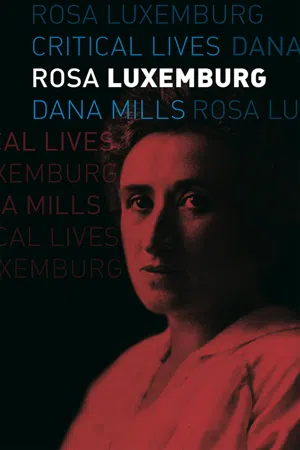
As an economist and political theorist, Rosa Luxemburg created a body of work that still resonates powerfully today. Born in Poland in 1871, she became a revolutionary leader in Berlin, publishing works including 'Reform or Revolution' and The Accumulation of Capital. In this account of her short yet extraordinary life, Dana Mills examines Luxemburg's writings, including her own correspondence, to reveal a woman who was fierce in professional battles and loving in personal relationships.
What is her legacy today, a hundred years after her assassination in Berlin in 1919 at the age of 47? Luxemburg's emphasis on humanity, equality and her insistence on revolution gave coherence, as this compelling biography illustrates, to a fraught life story and a colossal economic and political legacy.
- English
- ePUB (mobile friendly)
- Available on iOS & Android
eBook - ePub
Rosa Luxemburg
About this book
Information
Print ISBN
9781789143270
1
A Clap of Thunder
Rozalia (Rosalie, Rosa) Lukensburg (Luxemburg) entered the world as a Jewish Polish citizen of the Russian empire on 5 March 1871 in the small town of Zamość. She was the youngest to join the Luxemburg family after Anna (born 1854), Mikolaj (1855), Maximilian (1860) and Jozef (1866).
The Luxemburgs were a middle-class Jewish Polish family. Jews in the Russian empire were twice oppressed: once as imperialist subjects, then as victims of religious discrimination, excluded from the minimal civil rights that even their fellow Poles had.1 They were committed to the values of the Haskalah movement, a Jewish enlightenment movement that sprung out of Central and Western Europe between the 1770s and 1880s, as well as to the Continental culture that would be Rosa’s intellectual cradle. The Luxemburg family was friendly with another famous descendant of Zamość, the Yiddish author Isaac Lieb Peretz.2 The family was involved in both gentile and Jewish life. Rosa’s paternal grandfather, Abraham Luxemburg, was a successful timber merchant. Edward Luxemburg was born to Abraham on 17 December 1803. His Hebrew name was Elisha, and later he adopted the name Eliasz. Edward was raised with both Polish and Yiddish, and attended school in Germany, where he embraced progressive ideas and in particular a passion for West European literature.3 Rosa’s mother, Lina Lowenstein, was the daughter of a rabbi. Lina was deeply religious and a passionate advocate of art, but the Luxemburg household was an assimilated Jewish home, with great sensitivity to culture. Rosa recalled in 1917 that her mother considered Schiller to be the second-highest source of wisdom, after the Bible.4
Eliasz strove to give his children better possibilities in the world. The Luxemburg home was filled with poetry, which became intertwined with the narrative of Rosa’s life. Rosa herself preferred Goethe throughout her life; yet the Jewish strands of her home never left her. She was also a dedicated reader of the Polish poet Adam Mickiewicz, part and parcel of her Polish-Jewish household. At age 47, she wrote about the Russian author Vladimir Korolenko, ‘my soul, of a threefold nationality, has at last found a home – and this above all in the literature of Russia.’5 She writes:
descended at once from Poland, Russia and the Ukraine, Korolenko had to bear, even as a child, the brunt of the three ‘nationalisms’, each one expecting him to ‘hate or persecute someone or other’. He failed these exceptions, however, thanks to his healthy common sense . . . And thus, from the conflict of three nationalities that fought in his native land of Volhynia, he made his escape into humanitarianism.6
Rosa’s early days were of internationalism and from the womb her focus on humanity as a whole is echoed in the paths she took as she wrote and walked.
The Luxemburg family moved to Warsaw when Rosa was two and a half years old, as Eliasz was searching for a better education for his children.7 Shortly after arriving in Warsaw, Rosa developed a disease of the hip,8 which was wrongly diagnosed and left her with a limp that would remain a lifelong condition.9 Her intellectual excellence as well as her disability made the Luxemburg siblings protective of her, and she quickly became the family’s favourite. Rosa’s sister Anna had suffered the same hip disease as Rosa and was not perceived as suitable for a life as married woman and mother due to her disability. She stayed with her parents while Rosa was granted freedom to explore her destiny along a remarkably different path. A warm disposition combined with sharp intellectual wit allowed her to quickly win over the affections of all who met her. Her brilliant mind shone early; it is believed that at the age of nine she was already translating German poems and prose into Polish.10
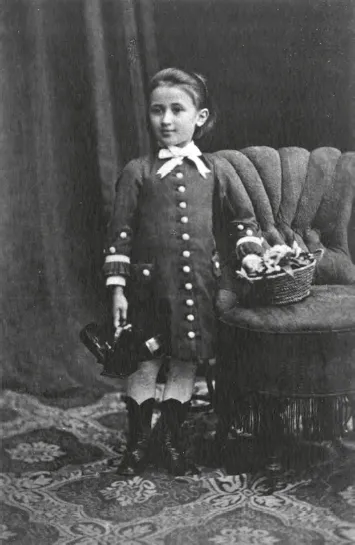
Rosa Luxemburg aged four, in 1875.
The use of the Polish language was not allowed in the school Rosa attended in Warsaw.11 At school, the combination of the repression of culture and absolutist rule created hotbeds of resistance. Young Rosa, with a feisty and disobedient nature, soon became a leader in those circles. In 1884, at the age of thirteen, she wrote a poem at the occasion of the visit of the German emperor William I to Warsaw:
Finally we shall see you, mighty man of the West,
At least, if you deign to enter our local park,
Since I don’t visit at your courts.
Your honours mean nothing to me, I would have you know,
But I would like to know what you’re going to chatter about.
With our ‘royalty’ you are supposed to be on intimate terms.
In politics I’m still an innocent lamb,
That’s why I anyhow don’t want to talk to you.
Just one thing I want to say to you, dear William.
Tell your wily fox Bismarck,
For the sake of Europe, Emperor of the West,
Tell him not to disgrace the pants of peace.12
A complete irreverence to authority combined with a sharp perception of the world accompanied Rosa from childhood. And this disregard for authority and ceaseless questioning of order went hand in hand with her deep engagement with humanity – as a concept and in practice. Rosa recalled waking up one day before her father when everything was still asleep; a cat crept by on its soft paws across the courtyard, a pair of sparrows were having a fight with a lot of cheeky chirping, and long, tall Antoni in his short sheepskin jacket, which he wore summer and winter, stood by the pump with both hands and chin resting on the handle of his broom, deep reflection etched on his sleepy, unwashed face.
Rosa about twelve years old, possibly a photo taken to commemorate her Bat Mitzvah. | 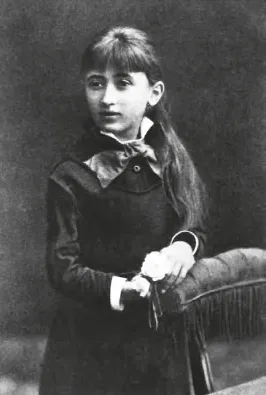 |
She recounts how Antoni, a man of ‘higher aspirations’ to whom she gave books, but who was apparently a caretaker around the Luxemburg household, was guided by a higher interest in arts and letters – he loved letters in and for themselves. ‘Back then I firmly believed the “life”, that is “real life”, was somewhere far away, off beyond the rooftops. Ever since then I’ve been chasing after it. But it is still hiding beyond one rooftop or another.’13 For Rosa humanity and nature were always linked; she delved into the core of the matter she investigated, whether that was herself or another natural being she was studying. And whereas ‘life’ could be far away, she would never really stop from trying to chase it. One particular photo of Rosa as a child reveals deep, warm eyes, a confident gaze that warmed the hearts of others and an assured posture. She would never suffer fools gladly. The young Rosa Luxemburg displayed some characteristics that would be part of the older Rosa’s psyche in later life; strong-headed, extremely empathic, extraordinarily intelligent, with a fierce sharpness alongside immeasurable emotional depth, teenage Rosa showed her commitment to justice early. She had a fiery temperament, and would love and hate with the same passion; her vivid eyes and mischievous smile would accompany her throughout her life.
In the year of Rosa’s birth, 1871, Warsaw’s Jews experienced one of the worst pogroms in Poland’s history. Anti-Jewish violence was prevalent in the Russian empire of the nineteenth century, yet its surge in 1881–2 was a watershed moment for both imperial policy and Jewish response. Rosa’s childhood was at a time of escalating tensions between Poles, Russians and Jews. Rosa was homeschooled by her mother, Lena, until she was nine. Her multilingual childhood enabled her to acquire further languages. As an adult Luxemburg spoke Polish, Yiddish, Russian, German, English and French, and often undertook work in translation in addition to her own writing.14
There were quotas for Jews in educational institutions, and discrimination and oppression continued even if they did manage to be accepted. Despite being top of her high-school class Rosa did not receive the distinction she deserved – Jews were not awarded these prizes. In 1887/8, Rosa joined her first ever political organization, the Proletariat Party,15 which stood against strands of Polish independence gaining prevalence at that time; as stated in a party pamphlet, ‘the Polish proletariat is completely separate from the privileged classes and enters the struggle as an independent class, distinct in its economic, political and moral undertakings.’16 In 1883–4 the main activists of the party were arrested, and in 1886 many were either in prison or executed. Rosa was fifteen and already highly involved in her homeland’s politics when four executions of central revolutionaries in the party were carried out.17 The party later changed its name to the Second Proletariat. In 1903, in ‘In Memory of the Proletarian Party’, she wrote about the first political organization she had joined, seventeen years earlier, and in it she recounted the emphasis on education of the masses: even if their final goal was far from achieved, education nonetheless helped to galvanize them into action.18 It was in this party that Rosa’s own political education commenced. The death of the martyred politicians urged Rosa to acknowledge the high price human beings may pay for dissent:
Men who stood on such a high intellectual plane as those four, who met death for an idea with heads held high, and who in dying encouraged and inflamed the living, are doubtless not the exclusive property of any particular party, group, or sect. They belong in the pantheon of all mankind, and anyone to whom the idea of freedom, no matter what its content or form, is truly precious should embrace them as kindred spirits and honor their memory.19
From childhood she would be sensitive to the cause of fighting for the right to think differently, including within socialist circles themselves.
In 1889 an unusual shipment crossed the border to Switzerland. Rosa was hidden in a peasant’s cart, disguised by straw, travelling away from her place of birth. This was the first political move – of many to come – for the now exiled Rosa Luxemburg. She was smuggled abroad with the aid of her friend and mentor Marcin Kasprzak.20
Rosa took rooms in Zurich towards the end of 1889 in 77 Universitätstrasse.21 While spending time in her rooms there, she loved glimpsing out the windows to the famous Lake Zurich and the winding path towards it, decorated in trees. She enrolled at the University of Zurich to study natural sciences and mathematics in 1890, but switched to law in 1892 – yet her interest in nature and natural sciences continued throughout her life.22 She studied formally under Professor Julius Wolf, Professor Vogt, Professor Treichler and Professor Fleiner. Of all those names the most significant is Wolf. The relationship between young Rosa and Professor Wolf is telling of her unequivocal dismissal of all authority. Rosa was already famous in her circles for her sharp tongue and outstanding intellect. In classes her peers and friends would ask difficult questions, and young Rosa Luxemburg would argue back with confidence, well versed in the latest critical and cultural commentaries – even more so, perhaps, than her professor. Professor Wolf later acknowledged that ‘she came to me from Poland already as a thorough Marxist.’23
The nineteenth century saw a surge in the opening of educational facilities to women. Rosa’s enrolment in higher education was an example of these new paths for women. The campaign for higher education was part of the bourgeois women’s campaign in the 1880s, though the process was incremental and differed in its pace around the world. In 1877 Helen Magill White was the first woman to be awarded a doctorate in the United States. In Sweden, Ellen Fries received her PhD in 1883. In France, Dorothea Klumpke was awarded a doctorate in sciences in 1893. In Germany, women were admitted to higher education on the same terms as men in the different states between 1900 and 1909.24
At the height of her student days, in 1893, at the age of 22, Rosa co-founded with Leo Jogiches the first political organization in her life, alongside leading members of the Polish Left: Adolf Warski, Julian Marchlewski, Feliz Dzerzhinki, Karl Solbelson, Jakob Furstenberg and Stanislaw Pestkowski. The Social Democratic Party of Poland and Lithuania (SDKPIL) was an illegal organization whose paper, Sprawa Robotnicza (Workers’ Cause), was published in Paris. Its raison d’être was opposing the claims for Polish nationalism that were backed by the Polish Socialist Party (PPS). SDKPIL was a group of young peopl...
Table of contents
- Front Cover
- Half Title
- Title Page
- Copyright
- Contents
- Introduction
- 1 A Clap of Thunder
- 2 Dress Rehearsal for the Revolution
- 3 The Last Two Men of German Social Democracy
- 4 The Countess of Wronke Fortress
- 5 Ultimate Revolutionary Duty
- 6 Discord Marching On
- References
- Select Bibliography
- Acknowledgements
- Photo Acknowledgements
Trusted by 375,005 students
Access to over 1.5 million titles for a fair monthly price.
Study more efficiently using our study tools.