Assassins have been killing the powerful and famous for at least 3,000 years. Personal ambition, revenge and anger have encouraged many to violent deeds, like the Turkish sultan who had nineteen of his brothers strangled or the bodyguards who murdered a dozen Roman emperors. More recently have come new motives like religious and political fanaticism, revolution and liberation, with government also getting in on the act, while many victims seem to have been surprisingly careless – Abraham Lincoln was killed after letting his bodyguard go for a drink.
So do assassinations work? Drawing on anecdote, evidence and statistical analysis, Assassins' Deeds delves into some of history's most notorious acts, unveiling an intriguing cast of characters, ingenious methods of killing, and many unintended consequences.
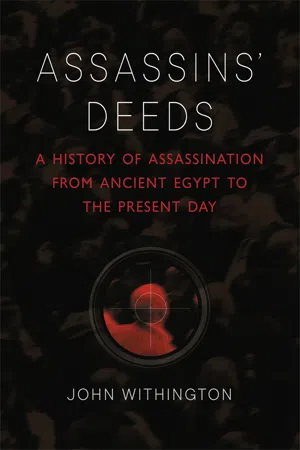
eBook - ePub
Assassins’ Deeds
A History of Assassination from Ancient Egypt to the Present Day
- English
- ePUB (mobile friendly)
- Available on iOS & Android
eBook - ePub
Assassins’ Deeds
A History of Assassination from Ancient Egypt to the Present Day
About this book
Information
1
THE ANCIENT WORLD
Humans being what they are, it is probably reasonable to assume that assassinations have been happening ever since there was any kind of organized society. Lawrence Keeley, an anthropologist from the University of Chicago, investigated how violent ancient communities were, and decided the answer was: ‘very’. Excavating a prehistoric Californian Indian village, he discovered the percentage of inhabitants who appeared to have suffered violent deaths was four times what you would find in modern America and Europe, while in an ancient Egyptian cemetery dating back 12,000 to 14,000 years he found that 40 per cent of those buried had evidence of wounds from sharp stones, with a number having multiple injuries to their heads or necks.
Egypt
A good candidate for ‘first known victim of an assassination’ is an Egyptian pharaoh named Teti (sometimes known as Othoes) who died in 2333 BC. The ancient Egyptian historian Manetho, writing around 300 BC and probably drawing on materials that have since been lost, says Teti was ‘murdered by his bodyguard’. The pharaoh was dubbed ‘He who pacifies the Two Lands’, and this is seen by some historians as implying that he came into his kingdom at a time of strife. Certainly he was the first pharaoh of a new dynasty, the sixth, and his predecessor, Unas, had died without leaving a male heir. Teti took Iput, Unas’ daughter, as one of his wives, and while he ruled there is evidence of Teti trying to tighten up security. He greatly increased the number of guards and sentries and introduced a new job entitled ‘overseer of the protection of every house of the king’.
Estimates of the length of Teti’s reign range from 12 to 23 years, and not all historians are convinced he was assassinated. After all, Manetho was writing about 2,000 years after the event, but there is other evidence. A number of senior officials including a vizier, the chief physician and the overseer of weapons had their memorials defaced. Some had their names erased, their images chiselled away or their remains moved. This was a dreadful fate usually meted out to hated criminals, because it meant that in the afterlife they would be homeless and condemned to endless wandering. Do these punishments suggest there was a major conspiracy? Were the plotters emboldened by the fact that Teti’s claim to the throne was rather shaky, based as it was on his wife’s lineage rather than his own? As usual for a pharaoh, he had a number of wives and children, spawning plenty of family rivalries and jealousies that ambitious would-be usurpers might exploit. We know that he was succeeded for a short time by a man named Userkare. Some have suggested he may have been Teti’s son by a wife other than Iput. Was he the chief conspirator? Or was he actually on Teti’s side, keeping the dead king’s throne warm for Pepy I, the son he had with Iput? Certainly, Pepy did eventually follow his father and ruled for forty years or more.
A similar ‘was he murdered or wasn’t he?’ mystery used to surround another pharaoh who reigned more than a millennium after Teti. Ramesses III met his end in 1155 BC, after thirty years on the throne, and thanks to the survival of 3,000-year-old papyrus court records, we know that more than thirty ‘great criminals’ from his court were put on trial over their part in a conspiracy against him. We also know that before then, Ramesses had had his share of trouble, with economic and political problems building up as his reign went on. Towards its end, Egypt experienced the earliest known strike when skilled workers at the Royal Necropolis at Deir el-Medina downed tools because they had not been paid for two months. Ramesses had other difficulties too. He had taken a Syrian wife, which may have stirred up discord, and he had no designated principal, or Great Royal Wife, throwing the question of which son would succeed him up in the air.
The assassination plot took place at the time of a major celebration, the Festival of the Valley at Medinet Habu, near Luxor. The leading instigator appears to have been one of Ramesses’ wives, Queen Tiye, and her objective to kill Ramesses and secure the throne for her son Pentawere. A whole swathe of the royal household was accused of being involved, including the royal butler, Mesedsure, and the ‘Chief of the Chamber’, Pebekkamen. The names used in the court documents, incidentally, were terms of abuse, so Mesedsure means ‘Re [the sun god] hates him’. Pebekkamen subverted the overseer of the royal herds, getting him to supply magic wax figures that were supposed to weaken or disable people’s limbs. Similar objects were procured from two other sources. The conspirators believed these supernatural aids would neutralize Ramesses’ guards. Mesedsure and Pebekkamen secured the help of ten harem officials, including an overseer of the treasury. They also turned three royal scribes and an army commander. Six wives of officers of the harem-gate were recruited to pass on messages, while relatives of the plotters outside the harem were roped in too. A harem woman named Binemwese sent a letter to her brother, who was a captain of archers from Nubia, urging him to incite people to rise against the pharaoh, so perhaps the plotters were hoping a rebellion would break out when they killed Ramesses.
By the time the conspirators came to trial, we know Ramesses was dead, but some historians argued that the court documents provided evidence only that there had been a plot, and not that it had been successful. Then, in 2012, a team of researchers from the Institute for Mummies at the European Academy of Bozen-Bolzano in Italy used CT scans to reveal that Ramesses had a wide and deep wound to the throat, probably caused by a sharp blade, which would have killed him instantly. Further investigation showed he had suffered other injuries inflicted by different weapons, suggesting there had been a number of assailants. The plotters’ trial was pretty lurid. Two judges and two guards were accused of ‘carousing’ with some of the women prisoners. They were sentenced to having their noses and ears cut off. One committed suicide. The trial documents indict some of the accused with conspiring ‘to commit hostility against their lord’. In a foretaste of modern UK anti-terrorist legislation, which makes it an offence to fail to inform the police if you know an attack is being prepared, ten, including six former inspectors of the harem and three butlers, were charged with omitting to report seditious words they had heard. Altogether more than thirty people were condemned. Their punishment, historians believe, would have been death. A number ‘took their own lives’ with the agreement of the court.
That appears to have been the fate of Pentawere. The researchers who found the throat wound to Ramesses examined the body of a young man aged about eighteen to twenty, who appeared from genetic evidence to be Ramesses’ son. It had been buried in a ‘ritually impure’ goatskin, probably as a punishment. They believed the cause of his death may have been strangulation. The fate of Tiye is not recorded, but we do know that Ramesses’ eldest son succeeded to the throne as Ramesses IV.
The Penn Museum in Philadelphia reckons that between 3150 BC and 31 BC, there were about 170 pharaohs, though other authorities put the figure at 190 or more. We know of only around half a dozen who were assassinated, though some murders may, of course, have been lost in the mists of ancient history, but the pace of killing seems to have picked up towards the end of the pharaohs’ era. In the ninth decade before Christ, Ptolemy IX married his daughter Berenice III. This was unusual, but by no means unique as pharaohs strove to keep the bloodline pure. Ramesses the Great is said to have married at least three of his daughters. With Berenice, it is probable the arrangement was strictly business. According to the Roman scholar Cicero, who was also a statesman and orator, she was very popular in Alexandria, and Ptolemy desperately needed to shore up his position in the face of local unrest. Anyway, when he died in 80 BC, she was his only surviving legitimate child, and she succeeded to the throne, ruling alone for five months from March to August.
Queens had held power in Egypt before, but they had found it hard to gain acceptance. And now the Romans were taking a growing interest in the affairs of the kingdom, on which they depended for corn, and they decided they wanted their man installed as her husband. The only legitimate male descendant of the Egyptian royal line was Berenice’s cousin, Alexander, the son of Ptolemy X, who had kept being eased on and off the throne in a series of power struggles with Ptolemy IX. Alexander was in his mid-twenties, and fortunately for Rome, very much under its influence. As a boy he had been captured on the island of Cos by Mithradates, king of Pontus in modern Turkey. Alexander was brought up a royal hostage at the Pontic court, but managed to escape and take refuge with the Romans, and it was Rome’s dictator, Sulla, who sent him off to marry Berenice and become Ptolemy XI. The marriage evidently was not a great success. Perhaps Berenice wanted Alexander to play second fiddle. Whatever the reason, after a few days, he killed her and became sole ruler, but this enraged the Alexandrians, and just nineteen days later, they lynched him.
Ptolemy XI was succeeded by his cousin Ptolemy XII, but he was overthrown by a popular uprising in 58 BC and fled to Rome. His daughter Berenice IV took over. She would have her husband assassinated, but apparently for reasons of personal disgust rather than dynastic ambition. After two matches had fallen through, she was married off to an illegitimate Syrian princeling, Seleucus, whom the Alexandrians nicknamed ‘seller of salt-fish’. Whether the problem was his smell or just general crassness, Berenice had him strangled after only a few days of matrimony. But in 55 BC, Ptolemy XII bribed the Romans to provide an army to reinstate him, and he had Berenice put to death. The Roman cavalry commander, incidentally, was Mark Antony, who, during the operation, caught his first glimpse of Berenice’s sister, the great femme fatale Cleopatra.
Persia, Syria and Other Parts of the Middle East
Assassination may have been relatively rare in Egypt, but if you were a Persian king of the Achaemenid dynasty, you had a more than fifty-fifty chance of meeting your end that way. Between 550 and 330 BC, out of thirteen, seven were murdered and five died of natural causes, while Cyrus the Great died peacefully in his bed or in battle; we are not sure which. This same Cyrus, though, thought a good deal about the danger of assassination. The ancient Greek historian Xenophon recorded that the emperor ‘realized men are nowhere an easier prey to violence than when at meals, or at wine, or in bed and asleep’. And it was while he was asleep that one of Cyrus’ successors was shuffled off this mortal coil.
His grandson, Xerxes the Great, ruled half a century after him, and was remembered for his ambitious but unsuccessful attempt to conquer Greece, during which his huge army was held up by three hundred Spartans. Xerxes met his end in the great imperial capital, Persepolis, which he had played an important part in building. Ancient sources differ on the details of his murder, but the story seems to go something like this. The commander of the royal bodyguard, Artabanus, who came from Hyrcania on the southern shores of the Caspian Sea, had become very powerful and influential. So powerful that he perhaps began to have ambitions of overthrowing Xerxes’ dynasty and replacing it with his own family. By 465 BC, he had managed to place his seven sons in important positions at court, and working with them and Xerxes’ chamberlain, the eunuch Aspamithres, he had the king assassinated in his bedroom. (In spite of Cyrus’ strictures and the opening of Malraux’s La Condition humaine, few assassination victims seem to meet their end in their sleep. Imad ad-Din Zengi, a Muslim leader who fought hard against the Crusaders, was killed as he lay in a drunken stupor in 1146, while Alessandro de’ Medici in 1537 and Albrecht von Wallenstein in 1634 were both attacked while they slept but awoke before breathing their last.)
According to some accounts, Artabanus managed to persuade Xerxes’ son, Artaxerxes, that his elder brother, the Crown Prince Darius, was guilty of the king’s murder, and Artaxerxes then had Darius put to death. Others have Artabanus killing Darius before he had Xerxes murdered. Either way, Artabanus remained a dominant force. Some say he became king himself, others that he remained the power behind the throne as Artaxerxes reigned as King Artaxerxes I. Whatever the truth, after a few months Xerxes’ son learned what had really happened to his father. At this point, Artabanus decided to mount a coup, but an important general betrayed the plot, and Artaxerxes survived. Artabanus was then either executed, killed by Artaxerxes or dispatched by his fellow conspirators as they fell out among themselves.
Artaxerxes ruled for forty years. He left seventeen sons by his many concubines, but just one legitimate heir, who in 425 BC became Xerxes II. While his father lasted forty years, Xerxes barely managed forty days. A Greek historian from the fifth century BC, Ctesias, was also physician to the Persian king Artaxerxes II, grandson of Artaxerxes I. He records that six and a half weeks after his accession, while he ‘lay drunk in his palace’, Xerxes II was killed by a couple of assassins on the orders of his younger half-brother Sogdianus, the son of Artaxerxes and a Babylonian woman named Alogyne, which means ‘rose-coloured’. Sogdianus then became king. When this news reached another half-brother, Ochus, the governor of Hyrcania, he was incensed, believing he had a much better claim to the throne than Sogdianus. Not only was he Artaxerxes I’s son, by another Babylonian concubine, but he was also married to one of his half-sisters, the daughter of yet another of Artaxerxes’ Babylonian concubines. Ochus put together a formidable army and within six months he had deposed Sogdianus. Having promised his half-brother that he would not be killed by the sword, poison or starvation, Ochus had him smothered in ashes, and became the emperor Darius II, ruling for nineteen years.
Apart from the murder of Seleucus, who may have been assassinated because of his smell, the thread that runs through all these ancient killings is personal ambition, the wish to seize power for oneself or one’s protégé. So, as the warning of Cyrus the Great suggests, it would be wise to keep a close eye on those who had easy access to you, such as your household staff or your bodyguards, who ironically had been recruited to protect you from assassination. But very often the ones to be most afraid of were your closest loved ones – spouses, children, siblings. Indeed, in the Assyrian empire, patricide appears to have been a favoured means of regime change.
The emperor Tukulti-Ninurta I was a highly cultured man who commissioned an epic poem about his exploits, the only one of its kind to survive from ancient Assyria. He also founded a great library, much of it stocked with loot from his wars because Ninurta was a formidable conqueror who greatly extended the Assyrian Empire. When he took Babylon he sacked the city and plundered the temple, enslaved prisoners, and said in an inscription that he had ‘filled the caves and ravines of the mountains with the corpses’ of those who resisted him. As for the Babylonian king, Ninurta ‘trod on his royal neck with my feet like a footstool’, then marched him ‘naked and in chains’ to the Assyrian capital.
The Assyrians and the Babylonians shared the same gods and the same cuneiform alphabet, and they had once been part of the same empire. This had led to Assyrian kings observing a measure of restraint when there was conflict, so many at Ninurta’s court now felt he had overstepped the mark. In 1208 BC, the Babylonian Chronicles report that ‘his son and the nobles of Assyria revolted’. They ‘cast him from his throne . . . and then killed him with a sword’. His son Ashur-Nadin-Apli is generally believed to have been his assassin, or at least one of the leading conspirators, and the murder plunged the empire into a period of civil war from which Ashur emerged as the new emperor to restore order.
In 681 BC, one of Ninurta’s successors was also to fall victim to his son – Sennacherib, the Assyrian, who in Byron’s famous poem ‘came down like the wolf on the fold’. The verses tell of a mysterious catastrophe that destroyed Sennacherib’s army. The emperor’s first campaign in Palestine in 701 BC had been a great success as he plundered a number of towns, but when he invaded again, some time after 689 BC, something very odd happened. Though ‘unsmote by the sword’, his soldiers died en masse in their sleep. The Bible talks of the ‘Angel of the Lord’ killing more than 5,000 in the Assyrian camp. Was it cholera that struck down so many? Whatever it was, it forced Sennacherib to withdraw in confusion, and his prestige never recovered.
‘And it came to pass,’ continues the Bible, as Sennacherib, ‘was worshipping in the house of Nisroch his god, that Adrammelech and Sharezer his sons smote him with the sword’, though a more colourful version has it that the emperor was crushed under a huge statue of a winged bull. Sennacherib had designated his son Esarhaddon as his successor even though Adrammelech and Sharezer were older, perhaps thanks to the machinations of Esarhaddon’s mother, who had risen to be chief lady in the royal harem. An inscription written by Esarhaddon about ten years after the event said his brothers ...
Table of contents
- Front Cover
- Half Title
- Title Page
- Copyright
- CONTENTS
- Prologue
- 1. The Ancient World
- 2. The Roman Empire and the Dark Ages
- 3. The Age of Chivalry
- 4. The Wars of Religion
- 5. The Age of Revolution
- 6. The Modern Age: World Wars and Terrorism
- 7. The Ones That Got Away
- Select Bibliography
- Photo Acknowledgements
- Index
Trusted by 375,005 students
Access to over 1.5 million titles for a fair monthly price.
Study more efficiently using our study tools.
Frequently asked questions
Yes, you can cancel anytime from the Subscription tab in your account settings on the Perlego website. Your subscription will stay active until the end of your current billing period. Learn how to cancel your subscription
No, books cannot be downloaded as external files, such as PDFs, for use outside of Perlego. However, you can download books within the Perlego app for offline reading on mobile or tablet. Learn how to download books offline
Perlego offers two plans: Essential and Complete
- Essential is ideal for learners and professionals who enjoy exploring a wide range of subjects. Access the Essential Library with 800,000+ trusted titles and best-sellers across business, personal growth, and the humanities. Includes unlimited reading time and Standard Read Aloud voice.
- Complete: Perfect for advanced learners and researchers needing full, unrestricted access. Unlock 1.5M+ books across hundreds of subjects, including academic and specialized titles. The Complete Plan also includes advanced features like Premium Read Aloud and Research Assistant.
We are an online textbook subscription service, where you can get access to an entire online library for less than the price of a single book per month. With over 1.5 million books across 990+ topics, we’ve got you covered! Learn about our mission
Look out for the read-aloud symbol on your next book to see if you can listen to it. The read-aloud tool reads text aloud for you, highlighting the text as it is being read. You can pause it, speed it up and slow it down. Learn more about Read Aloud
Yes! You can use the Perlego app on both iOS and Android devices to read anytime, anywhere — even offline. Perfect for commutes or when you’re on the go.
Please note we cannot support devices running on iOS 13 and Android 7 or earlier. Learn more about using the app
Please note we cannot support devices running on iOS 13 and Android 7 or earlier. Learn more about using the app
Yes, you can access Assassins’ Deeds by John Withington,Withington, John in PDF and/or ePUB format, as well as other popular books in History & World History. We have over 1.5 million books available in our catalogue for you to explore.