- English
- ePUB (mobile friendly)
- Available on iOS & Android
eBook - ePub
About this book
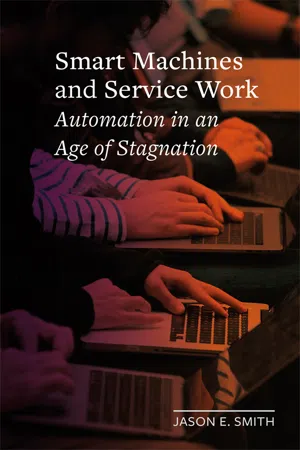
In recent decades digital devices have reshaped daily life, while tech companies' stock prices have thrust them to the forefront of the business world. In this rapid, global development, the promise of a new machine age has been accompanied by worries about accelerated joblessness thanks to new forms of automation. Jason E. Smith looks behind the techno-hype to lay out the realities of a period of economic slowdown and expanding debt: low growth rates and an increase of labour-intensive jobs at the bottom of the service sector. He shows how increasing inequality and poor working conditions have led to new forms of workers' struggles. Ours is less an age of automation, Smith contends, than one in which stagnation is intertwined with class conflict.
Information
References
Automation 2.0
1 James Boggs, The American Revolution: Pages from a Negro Worker’s Notebook (New York, 1963), p. 36.
2 John Lewis, “Bitesize: The Past Decade’s Productivity Growth in Historical Context,” Bank Underground, April 25, 2018, https://bankunderground.co.uk.
3 Robert Solow, “We’d Better Watch Out,” New York Times Book Review, July 12, 1987, p. 36.
4 Mark Muro, Robert Maxim and Jacob Whiton, The Brookings Institute, “The robots are ready as the covid-19 recession spreads,” March 24, 2020, available at www.brookings.edu.
5 Nitasha Tiku, “Desperate Workers Rush to Delivery App Jobs to find Low Pay and Punishing Rules,” Washington Post, May 23, 2020, www.washingtonpost.com.
1 A Little History of Automation
1 Erik Loomis, “The Case for a Federal Jobs Guarantee,” New York Times, April 25, 2018, www.nytimes.com.
2 Peter Frase, Four Futures: Life after Capitalism (New York, 2016), p. 9.
3 Carl Benedikt Frey and Michael Osborne, “The Future of Employment: How Susceptible Are Jobs to Computerisation?,” Oxford Martin School, September 2013. Frey has recently published a follow-up book, The Technology Trap: Capital, Labor, and Power in the Age of Automation (Princeton, NJ, 2019).
4 Stuart W. Elliott, “Anticipating a Luddite Revival,” Issues in Science and Technology, XXX/3 (Spring 2014), pp. 27–36.
5 Andrew Ure, The Philosophy of Manufactures; or, An Exposition of the Scientific, Moral, and Commercial Economy of the Factory System of Great Britain (London, 1835), p. 9.
6 Among Ure’s litany of automatic devices, one particularly important self-acting machine is absent: the mechanical clock. The Greek world knew an earlier variant of this mechanism, the clepsydra or water clock, which functioned through the use of constant flows of water pressure (most Greek automata used either water or air power). Such clocks measure the passing of time using constant, invariable units of time. But this abstract time had little effect on the organization of social life, particularly the “productive” activities taking place either in the countryside or the cities. These were still largely regulated by natural cycles and sequences, and the notion of labor productivity—the measurement of output per given, constant unit of time—was unknown. On the historical production of “abstract time” and the invention of the mechanical clock, see Moishe Postone, Time, Labor and Social Domination (Cambridge, 1993), pp. 200ff., and Jacques Le Goff, Time, Work and Culture in the Middle Ages, trans. Arthur Goldhammer (Chicago, IL, 1982).
7 See Book 1, section IV of Aristotle’s Politics.
8 Rabelais’ Gargantua was first published in 1532.
9 Amazon named its online platform for a “global, on-demand, 24×7 workforce” to perform “microtasks” Mechanical Turk, presumably because these human workers carry out repetitive tasks machines should, but cannot yet, perform. Cf. Ure, The Philosophy of Manufactures, p. 11. Edgar Allan Poe’s famous essay on the device, “Maelzel’s Chess Player,” was published in 1836. In his “Theses on the Philosophy of History,” Walter Benjamin invoked the image of Maelzel’s chess player, naming the automaton “historical materialism,” the hidden chess master, “theology.” See “Theses on the Philosophy of History,” Selected Writings, vol. IV, p. 389.
10 Ure, The Philosophy of Manufactures, p. 18.
11 Quoted in David Noble, Forces of Production: A Social History of Automation (Piscataway, NJ, 2011), p. 68. See especially its fourth chapter, “Toward the Automatic Factory.”
12 Quoted in Frederick Pollock, Automation: A Study of Its Economic and Social Consequences, trans. W. O. Henderson and W. H. Chaloner (New York, 1956), p. 16n.1.
13 Ure, The Philosophy of Manufactures, p. 301.
14 Pollock, Automation, p. 108.
15 Karl Marx, Grundrisse: Foundations of the Critique of Political Economy, trans. Martin Nicolaus (Harmondsworth, 1973), p. 705.
16 Thomas O. Boucher, Computer Automation in Manufacturing: An Introduction (London, 1996), p. 6.
17 Pollock, Automation, pp. 82, 82n.1.
18 Ibid., p. 248.
19 James Boggs, The American Revolution: Pages from a Negro Worker’s Notebook (New York, 1963), p. 36.
20 “All Employees: Manufacturing/All Employees: Total Nonfarm Payrolls,” Federal Reserve Bank of St. Louis, March 2, 2020; https://fred.stlouisfed.org.
21 Bureau of Labor Statistics, “Women in the Labor Force, 1970–2009,” Economics Daily, January 5, 2001; www.bls.gov.
22 As has the total labor force participation rate since 2000, when it peaked.
23 Cited in Jeremy Rifkin, The End of Work: The Decline of the Global Labor Force and the Dawn of the Post-market Era (New York, 1995), p. 141.
24 Rifkin, The End of Work, p. 291.
25 Matthew C. Klein, “The Great American Make-work Programme,” Financial Times Alphaville blog, September 8, 2016; https://ftalphaville.ft.com.
2 The Robot and the Zombie
1 Jean Baudrillard, The System of Objects, trans. James Benedict (London, 1996), pp. 124–5.
2 Erik Brynjolfsson and Andrew McAfee, The Second Machine Age: Work, Progress, and Prosperity in a Time of Brilliant Technologies (New York and London, 2014), pp. 9, 79–80, 104. In fact, investment in IT has fallen off considerably since 2000.
3 Robert Solow, “We’d Better Watch Out,” New York Times Book Review, July 12, 19...
Table of contents
- Front Cover
- Half Title
- Title Page
- Copyright
- Contents
- Automation 2.0
- one A Little History of Automation
- two The Robot and the Zombie
- three Army of Shadows
- four Approaching Zero
- five Circulation and Control
- six The Servant Economy
- seven An Absolute Law
- References
- Acknowledgments
Trusted by 375,005 students
Access to over 1.5 million titles for a fair monthly price.
Study more efficiently using our study tools.
Frequently asked questions
Yes, you can cancel anytime from the Subscription tab in your account settings on the Perlego website. Your subscription will stay active until the end of your current billing period. Learn how to cancel your subscription
No, books cannot be downloaded as external files, such as PDFs, for use outside of Perlego. However, you can download books within the Perlego app for offline reading on mobile or tablet. Learn how to download books offline
Perlego offers two plans: Essential and Complete
- Essential is ideal for learners and professionals who enjoy exploring a wide range of subjects. Access the Essential Library with 800,000+ trusted titles and best-sellers across business, personal growth, and the humanities. Includes unlimited reading time and Standard Read Aloud voice.
- Complete: Perfect for advanced learners and researchers needing full, unrestricted access. Unlock 1.5M+ books across hundreds of subjects, including academic and specialized titles. The Complete Plan also includes advanced features like Premium Read Aloud and Research Assistant.
We are an online textbook subscription service, where you can get access to an entire online library for less than the price of a single book per month. With over 1.5 million books across 990+ topics, we’ve got you covered! Learn about our mission
Look out for the read-aloud symbol on your next book to see if you can listen to it. The read-aloud tool reads text aloud for you, highlighting the text as it is being read. You can pause it, speed it up and slow it down. Learn more about Read Aloud
Yes! You can use the Perlego app on both iOS and Android devices to read anytime, anywhere — even offline. Perfect for commutes or when you’re on the go.
Please note we cannot support devices running on iOS 13 and Android 7 or earlier. Learn more about using the app
Please note we cannot support devices running on iOS 13 and Android 7 or earlier. Learn more about using the app
Yes, you can access Smart Machines and Service Work by Jason E. Smith in PDF and/or ePUB format, as well as other popular books in Economics & Sociology. We have over 1.5 million books available in our catalogue for you to explore.