eBook - ePub
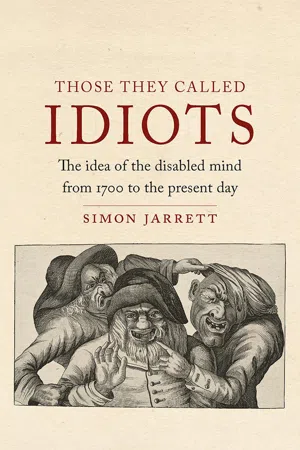
Those They Called Idiots
The Idea of the Disabled Mind from 1700 to the Present Day
- English
- ePUB (mobile friendly)
- Available on iOS & Android
eBook - ePub
About this book
The Idiot traces the little-known lives of people with learning disabilities from the communities of eighteenth-century England to the nineteenth-century asylum and care in today's society. Using evidence from civil and criminal court-rooms, joke books, slang dictionaries, novels, art and caricature, it explores the explosive intermingling of ideas about intelligence and race, while bringing into sharp focus the lives of people often seen as the most marginalized in society.
Information
PART ONE
Idiocy and Imbecility in the Eighteenth Century, c. 1700–1812
1
Poor Foolish Lads and Weak Easy Girls: Legal Ideas of Idiocy
The idea of an idiotic person has been part of law since antiquity. In early Greek society idiota signified a private person, living in solitude and divorced from public and social life. For the Romans, such a person was illiteratus. This concept of the solitary person, isolated from the social and public connections and networks that most people enjoy, underpinned early English legal understandings of idiocy. It was the ‘naturalness’ of the condition, the fact that it was there from birth, that exercised legal minds. Did such a person, born this way, count as a full person or not under the law? The British legal writer John Cowell explained in 1607 that those whom the Greeks called idiota, and whom the Romans called illiteratus, are ‘taken . . . in our Law for non-compos mentis or a natural fool’.1 The idiot was a person alien from human society from birth, illiterate, uncommunicating and locked into a private mental world. An immediate question that arose from this was whether such a way of living made that person dangerously alien and unpredictable, or simply a harmless person living in a state of benign innocence. The precise status and location of the idiot between these two poles, benign or malign, has been debated for centuries.
A feature of Roman and Byzantine law was to make those deemed idiotic through lack of judgement and comprehension wards of either their families or their lords. In England such wardship became the responsibility of the monarch from the late thirteenth century (under Edward I) as part of the Prerogativa Regis, a medieval document asserting the rights of the Crown over those considered to lack mental capacity.2 Idiots were perceived as, in a childlike way, lacking capacity to contribute to the affairs of the nation, and also represented a threat to healthy bloodlines. This incurred obligations from the monarch of both protection and control, and gave the crown rights over their land and assets.3 The Prerogativa gave the sovereign custody of the lands of ‘natural fools’, with an obligation to maintain the person during their lifetime. It also sought to distinguish between the natural fool, whose condition would never change, and the lunatic or mad person, whose loss of mind might be temporary and who might recover or have lucid intervals. Lunatics therefore enjoyed greater rights.4
Idiots, from the medieval period onwards, were identified through inquisitions ordered by the monarch and carried out by lay (never medical) officials.5 These centred on numeracy, knowledge of others and knowledge of self.6 By the seventeenth century more sophisticated knowledge was required, including weights and measures and days of the week.7 Idiocy was seen as a legal problem with implications for wealth and property, which meant that for the landless labouring poor it was not an issue. Bloodline and the protection of family wealth and inheritance were all-important. As far as the small educated elite were concerned, the great masses of the poor, for whom illiteracy was the norm and inheritance irrelevant, were all idiotic.
In 1540, under Henry VIII, the Tudor administration established a powerful Court of Wards.8 This brought a sharper definition of and focus on what constituted legal incapacity after the loose and sporadically used medieval guidance.9 This court consolidated and shaped the conventions and practices of the legal treatment of those deemed incapacitated through idiocy into a form that persisted through the eighteenth and nineteenth centuries.10 Despite the abolition of the Court of Wards in 1661, after the Civil War and the restoration of the Stuart monarchy, its functions simply passed over to the Court of Chancery (they survive today in the Court of Protection).11
As the state strengthened, and increasingly profited from, the law on capacity, it faced growing challenges from families to eliminate the use of ‘idiocy grants’: permanent confiscation by the state, in the name of the monarch, of the land and assets of people deemed idiots under law, which was seen as unfair and punitive. The pressure rose as the early Stuart kings in England, James i and Charles i, milked the court for all they could gain from it. Gradually, in response to this pressure, terms and conditions for idiots moved into line with those for lunatics, meaning that their estates were not permanently confiscated, there was proper accounting for profits, and maintenance of both idiots and their families had to be in line with their degree and estate in life.12
The still quite vague legal definition of what constituted idiocy was shaken up by the jurist Lord Coke in 1628. He defined four categories of ‘non compos mentis’, or those of unsound mind, the first of which was the ‘idiot’: ‘Idiota . . . from his nativitie, by a perpetuall infirmitie’. The other categories were those who had accidentally lost their understanding though sickness or accident; lunatics who slipped in and out of understanding; and people who lost understanding through their own fault, such as drunks. However, Coke then added something of a catch-all fifth category of incapacity, which he defined as ‘all other persons, who from natural imbecility, disease, old age or any such causes, are incapable of managing their own affairs’.13 These ‘natural imbeciles’ were a new legal concept. They were not idiots, but they had an impaired mind from birth and a question mark over their capacity. On which side of the capacity border did they lie? This was the point at which the idea of the imbecile as a type of idiot – a person mentally feeble from birth but not quite idiotic – was born. The meaning of the word ‘imbecile’ began to pass from a general concept of mental and physical weakness to a more specific notion of a person born with a dull intellect. The effect was to widen the segment of the population whose mental capacity from birth to be full members of society came under question.
This, then, was the legal understanding of the idiot with which the eighteenth century began. Idiots were solitary beings, unable to understand money, numbers or social relationships and lacking self-awareness and memory. In an increasingly dynamic and commercial society in which growing numbers were escaping from the poorest class, it was becoming harder for the idiot to blend in unseen as part of the illiterate masses. Unchanging idiots were joined by the scanty outline of a new imbecile class, the simpleton group also challenged by the demands of the rapidly changing world around them. Through ‘mere weakness of understanding’,14 their right to social status was being questioned. The idiot in law was coming into sharper social focus, becoming a complex and noteworthy matter, with families increasingly in conflict with the state and its over-mighty laws of appropriation of the lands and wealth of idiots.
At this juncture in 1700 the lawyer John Brydall produced a book called Non Compos Mentis; or, The Law Relating to Natural Fools, Mad-Folks and Lunatick Persons, which gives us an excellent summary of both the law and common understandings of idiocy at the beginning of the eighteenth century.15 He described the system of ‘begging an idiot’, which referred to the process of demanding an inquiry by the Court of Chancery to determine whether a person was legally idiotic or not. From this derives our modern saying ‘Do you take me for an idiot?’ According to Brydall, the king’s right to identify idiots and take possession of their lands remained intact at this point. He also stated that idiots could be easily discerned by appearance, could not make a promise or a contract, marry, make a will or give voluntary consent. They were distinguished from lunatics and others of unsound mind in that they were ‘wholly destitute of reason . . . by a perpetual infirmity, as . . . Fools Natural ’.16
He then tackled what was evidently a tricky legal question. This was an apparent paradox whereby idiots could sometimes appear perfectly reasonable by making a rational remark and ‘it may appear, then such a one is no idiot naturally.’ If they were capable of such rational glimmers of light, did this not mean that they were in fact capable of having sufficient reason to make a lawful contract? Yet how could they be both an irrational idiot and say rational things at the same time? Brydall’s answer to this paradox was that such moments were a divine act, ‘because Almighty God doth sometimes so illuminate the Minds of the foolish they are not much inferior to the wise’. These random rational remarks were the appearance of reason, but not its substance.17
The 18th-century view: ‘John Donaldson, A Poor Idiot who usually walked before Funeral Processions at Edinburgh’, etching published by Henry Sawyer. | 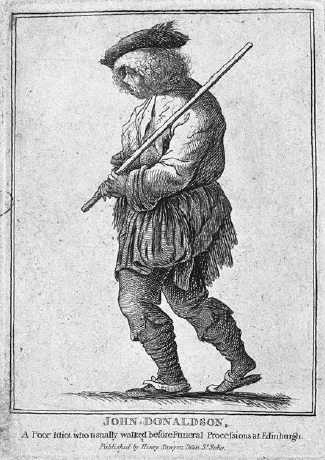 |
How could the law distinguish between the two? Brydall raised the stakes for qualification as a fully rational human. This would now include the ability to understand abstractions, ideas and meanings rather than simple facts. Therefore, an apparently reasonable testament made by an idiot was insufficient in law, because it would not display true understanding. Even if what they said was reasonable, the idiot would not have intended it. Saying the right words, in the right order, even if these words were given by God, was not enough. The words of idiots had no meaning because they lacked understanding or intention and meant no more than ‘a Parrot speaking to the Passengers [passers-by]’. Brydall left a small amount of room for conjecture, suggesting that if further proof of reason and understanding could be provided then an idiot’s testimony might be allowed to stand. However, his argument was clear – even those idiots who could speak did not understand language, they merely parroted it, however wise their words might seem at times.18
Brydall also had words to say about the imbecile. There was, he argued, a human type ‘that only is of mean capacity or understanding, or one who is, as it were betwixt a man of Ordinary Capacity and a Fool’ and who, it appeared, could make a testament. However, this should only be with the proviso ‘that he understands the nature of a Testament – if not, [he] is not fit to make a Will’. The mental shortcomings of the person of ‘dull capacity . . . lacking virtue moral and theological, or to be of a quick understanding’ did not in themselves justify depriving them of their legal rights. Yet nor did it mean they were automatically entitled to them. Although seen ambivalently as somewhere on the cusp between having capacity and lacking it, the idea of the lifelong born imbecile class, a cut above the idiot but below the rest of humankind, began to take legal shape. The law must in future consider how to respond to their complexity.19
How was legal knowledge about idiocy being formed and transmitted? It was not simply a top-down formation from sharp legal minds. The idiot not only had a legal identity by the beginning of the eighteenth century but occupied a space in the minds of people, defined in popular terms and talked about in jokes, slang and everyday conversation. As well as using case law and earlier legal theory, Brydall drew on this popular cultural wisdom, this ‘common sense’ and cultural understanding about what constituted idiocy. He acknowledged the interplay between common understanding and formal, legalistic definitions: ‘Idiot signifies commonly an unlearned or illiterate person, but among the English Jurists is a term of law, and taken for one that is wholly deprived of his Reason and Understanding from his birth and . . . in our common speech is called a fool natural.’20 To explain the idea of the ‘glimmer of reason’ that could occur with idiots, he described at length a ‘merry accident’ that occurred in Paris when an idiot was asked to judge a dispute between a diner and a cook.21 This apparent real-life account had in fact appeared, much more concisely, in a jestbook thirty years earlier:
A fellow in a Cook’s shop in France filled his belly only with standing by whilst the meal was dished up, and the Cook would be paid for a meal. So it was left to the decision of the next Passenger [passer-by], which happened to be an Idiot, who said that the man’s money should be put between two dishes, ringing it for a time, and the Cook should be content with the jingling of the money as the man was satisfied with the smelling of the meat.22
The (rather excruciatingly laboured) joke was that a person was satisfying his hunger simply by smelling, rather than eating, the cook’s food, and refusing to pay for the privilege: the idiot had wisely, yet also naively, solved the dispute by judging that if the customer was only smelling the food, the cook should only hear the money. Brydall presented this as a ‘case’, demonstrating the ability of the irrational idiot to appear to have a rational thought. He acknowledged that it had been recounted by ‘divers credible writers’.23 The use of a joke as an illustration in a book of legal theory is one of many examples of knowledge passing both ways between popular knowledge and legal theory. The popular idea of the idiot having a lucky, random lucid thought would endure: ‘Well Mr Random, a lucky thought may come into a fool’s head sometimes,’ Tobias Smollett’s eponymous hero was told half a century later.24
It was a...
Table of contents
- Cover
- Title Page
- Copyright
- Contents
- Introduction
- Part One: Idiocy and Imbecility in the Eighteenth Century, c. 1700–1812
- Part Two: New Ways of Thinking, c. 1812–70
- Part Three: From Eugenics to Care in the Community, 1870 to the Present Day
- References
- Selected Secondary Reading
- Acknowledgements
- Photo Acknowledgements
- Index
Trusted by 375,005 students
Access to over 1.5 million titles for a fair monthly price.
Study more efficiently using our study tools.
Frequently asked questions
Yes, you can cancel anytime from the Subscription tab in your account settings on the Perlego website. Your subscription will stay active until the end of your current billing period. Learn how to cancel your subscription
No, books cannot be downloaded as external files, such as PDFs, for use outside of Perlego. However, you can download books within the Perlego app for offline reading on mobile or tablet. Learn how to download books offline
We are an online textbook subscription service, where you can get access to an entire online library for less than the price of a single book per month. With over 1.5 million books across 990+ topics, we’ve got you covered! Learn about our mission
Look out for the read-aloud symbol on your next book to see if you can listen to it. The read-aloud tool reads text aloud for you, highlighting the text as it is being read. You can pause it, speed it up and slow it down. Learn more about Read Aloud
Yes! You can use the Perlego app on both iOS and Android devices to read anytime, anywhere — even offline. Perfect for commutes or when you’re on the go.
Please note we cannot support devices running on iOS 13 and Android 7 or earlier. Learn more about using the app
Please note we cannot support devices running on iOS 13 and Android 7 or earlier. Learn more about using the app
Yes, you can access Those They Called Idiots by Simon Jarrett in PDF and/or ePUB format, as well as other popular books in History & World History. We have over 1.5 million books available in our catalogue for you to explore.