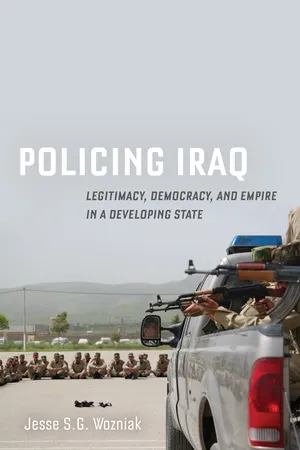
Policing Iraq chronicles the efforts of the Kurdistan Regional Government of Iraq to rebuild their police force and criminal justice system in the wake of the US invasion. Jesse S. G. Wozniak conducted ethnographic research during multiple stays in Iraqi Kurdistan, observing such signpost moments as the Arab Spring, the official withdrawal of coalition forces, the rise of the Islamic State, and the return of US forces. By investigating the day-to-day reality of reconstructing a police force during active hostilities, Wozniak demonstrates how police are integral to the modern state’s ability to effectively rule and how the failure to recognize this directly contributed to the destabilization of Iraq and the rise of the Islamic State. The reconstruction process ignored established practices and scientific knowledge, instead opting to create a facade of legitimacy masking a police force characterized by low pay, poor recruits, and a training regimen wholly unsuited to a constitutional democracy. Ultimately, Wozniak argues, the United States never intended to build a democratic state but rather to develop a dependent client to serve its neoimperial interests.
Sulaymaniyah is known as the intellectual and cultural capital of the Kurdistan Regional Government (KRG), the semiautonomous region of Northern Iraq. Upon arrival, you leave the heavily fortified airport and turn east down
(Salim, a street) and head into town. Immediately you pass the gleaming new classrooms and office buildings of the American University of Iraq in Sulaymaniyah, one of many expensive US projects in the area. Continuing a few kilometers down the freshly paved four-lane road, you enter Suly proper. In the distance, towering over the city, you can see the
(Shari Jwan, Grand Millennium hotel), modeled after
(Burj Al Arab), the famous sailboat skyscraper of Dubai. The smooth blacktop takes you past a number of gleaming high-rises and beautiful storefronts selling the latest fashions and technologies, until you arrive at the historical bazaar in the center of the city. Were you to take Salim from the airport to the bazaar and back (as is a typical route for visiting politicians and dignitaries), you’d believe Suly is an incredibly prosperous city, free from the economic and political strife of the rest of the nation, a sure sign the reconstruction is delivering a prosperous new future to at least this corner of Iraq.
And to some extent, you’d be correct; Suly has a relatively prosperous economy and is much more secure and stable than most of the nation. But step out of the car and wander around the corner, down any side street off Salim, and suddenly you’re confronted with a very different view. You quickly see that the gleaming façades of the stores and hotels are quite literally that; while the front side facing Salim is shiny and new, the other three sides of the building are likely drab, crumbling concrete that looks ready to topple at any time. The roads stop being wide with fresh, smooth pavement and instead become narrow, neglected pathways marked by sizable potholes. Leaving the car and wandering the neighborhoods of the city quickly demonstrates the largess of Suly to be in many ways a Potemkin village of progress, a shiny façade masking a region and a nation embroiled by civil war, unemployment, financial crisis, and shortages of basic necessities.
In many ways, the projected extravagance of Salim serves as an apt metaphor for the reconstruction of the Iraqi criminal justice system. On paper, police training is a compact-yet-thorough introduction to the various important roles these men and women will be tasked with fulfilling. A quick drive-by view of the training process in action looks impressive, as rows of police march in unison, their stiff limbs swinging with military precision. Extravagant new courthouses and dozens of station houses appear to be the new government in action throughout the city. Yet step out of the metaphorical car, and these are revealed to be a façade as misleadingly flimsy as those on Salim.
This book is about stepping out of the car and exploring what happens behind the glistening façade. Previous scholars have examined the historical development of criminal justice systems and police forces1 and established the importance of criminal justice reform to ensuring the stability of emerging democracies.2 Yet few, if any, existing works examine the development of these as they occur, with some even arguing that to do so would be impossible.3 This work serves to demonstrate that it is possible to directly observe things like the training of police or the operation of criminal trials, and that doing so provides insights impossible to gain in any other way, allowing us to examine the unstable reality behind the shiny façade.
WHY CRIMINAL JUSTICE? WHY THE POLICE?
Police are known as the sole group in democratic society with a legitimate monopoly on the use of force, and as such, they occupy a central role in the construction and maintenance of social order. The police are the front lines of the state, as it is in confrontations and negotiations with the police—not the court system or the legislature—where constitutional rights are truly maintained or denied.4 Indeed, there is an old Iraqi saying that roughly translates to “laws are merely ink on paper,” neatly capturing the central argument of this book; while such things as the constitution or the legal code are obviously important to understanding the nature of a state, no other group has the immediacy and material impact of the police. After all, few other governmental agents are “more active, numerous, or potentially intimidating than police officers.”5
As such, an understanding of the police and wider criminal justice system tells us a great deal not only about how a society is organized, managed, and policed—in both the narrow and broad definitions of that term—but about how a state wields and reproduces its power. However, existing scholarly works on the subject leave unanswered a wide range of questions regarding how emerging police forces make personnel and strategy decisions, who and what influences their goals and missions, and how the interplay between the development of the police, the wider criminal justice system, and the state is affected by immediate material concerns and external ideological influences.
I argue the lack of attention to police is a major oversight, as the constitution of a police force—especially in a newly reemerging state—is an important window for understanding both the particular state and the modern nation-state in general. The state’s assertion of sovereign power over matters of law and order has been an integral marker of modernity,6 and the police “show in concrete terms for whom and in what matter governmental power will be used.”7 The criminal justice system has long been employed for “little bursts of state-making,”8 as states have used the criminalization of large swaths of behavior to expand their power to control normative order. While many scholars are looking at this expansion of the carceral state and penality in shaping a vision of a society and establishing power relations and normative order,9 most works have been confined to studies of the prison and its aftereffects,10 and nearly all of these studies have focused on Western nations.11
As such, examining the recreation of a police force in a newly reemerging state grants important and unique insight into how that state is being designed to function. The modern state functions for the provision of general peaceable operating conditions, and it also has a powerfully originative role in creating social norms and relations of production.12 Although for the sake of legitimacy the state must allow some level of conflict and opposition, only certain conflicts are deemed legitimate forms of dissent,13 with much of this definitional work performed by the criminal justice system, police in particular. By studying the way order is defined and implemented, we are able to understand not only narrow questions of postconflict and democratic policing but larger questions of how the modern state defines itself.
Police are responsible for fulfilling a wide variety of functions, both practical and symbolic. While these functions can be filled by a number of actors and agents (and indeed, currently are filled by a wide variety of nonpolice actors in Iraq), only the police are able to bring these various roles together in the legitimated manner required by the modern state.14 I use legitimated not to refer to the feelings of those involved or the moral stature of the codes being enforced but “merely to the correspondence between the uses of force and the rules which specify when it can and should be used.”15
Because of the immediacy of crime and the recent experience of exploding crime rates in Iraq, these policing functions are particularly important for state legitimacy; indeed, it is difficult to imagine an already stable, developed state maintaining legitimacy for long with its policing functions filled by a multitude of distinct, unconnected, and often hostile private interests. Because the police can and do touch on so many aspects of civil society and the lives of citizens, they become an integral way of consolidating and maintaining state power. As contemporary Iraq vividly demonstrates, without a rationalized police force filling the manifest goals of crime control and public order maintenance, along with the latent goals of state consolidation and legitimacy building, it becomes a nigh-impossible task to construct a legitimate state.
Beyond the sociological and theoretical implications of this work, the stakes are obviously high for the Iraqi state and the Iraqi people. The success or failure of the reconstruction project is quite literally a life or death situation, and its implications for the region are similarly grand. The federalist democracy favored by the international community requires not only stability but consensus between multiple ethnic, religious, and cultural groups.16 Central to this federalist project are the twin needs of the state for legitimacy and effectiveness,17 and the police are central to establishing and maintaining both of these.
In a nation being reconstructed in the shadow of a totalitarian dictatorship, it is especially the case that police are the most visible sign of the state for most people, as in the recent past police were directly used to carry out government control and repression in the most material of ways. As such, the Iraqi populace is uniquely conditioned to think of police as the face of government. Therefore, how legitimate the police are perceived as and how they are received serves as an excellent proxy for attitudes toward the state in general, and it can be meaningfully argued that the legitimacy of the police and how they are viewed determines in large part whether people view the state as legitimate or not.
It is important to remember that Saddam Hussein’s police, while corrupt and brutal, were successful in controlling interpersonal street crime; prior to the invasion, Iraq had one of the lowest crime rates in the world.18 After the invasion, this oppressive order was replaced by a lawless anarchy of rampant crime and looting. Much of this stemmed from two simultaneous, disastrously mistaken assumptions on the part of the coalition; the first was in the assumption that simply overthrowing Saddam would win the support of a majority of the populace, despite there being considerable evidence to suggest this was unlikely to occur,19 and the second was the more direct mistake of assuming the existing Iraqi police would remain at their posts and continue to provide crime control while the coalition focused on battling the insurgency and reconstructing the state.
Neither of these came to pass—the popularity of the coalition never reached levels anywhere near the assumption of the invasion’s architects, and the members of the previous police force quickly abandoned their posts, with some choosing to simply fold back into civil society and many others joining the insurgency. The similarly disastrous de-Ba’athification process (in which all security officials associated with Saddam’s party were dismissed en masse) made roughly eight percent of the nation’s labor force idle overnight. Of course, these newly unemployed persons were not a cross section of Iraqi society, but instead precisely those most likely to join the insurgency, something which undoubtedly exacerbated the already chaotic conditions.20 Compounding the problem of keeping order, coalition forces were directly instructed not to intervene in what were deemed law and order situations, leaving the nation without a police force for at least the first year and a half of the invasion. This complete vacuum of social control lead to the looting of multiple government ministries and theft of millions of dollars in ancient antiquities, alongside a street crime rate that went from one of the lowest in the world to one of the highest almost overnight.
Beyond the obvious problems brought on by a dysfunctional criminal justice system largely incapable of providing crime control or justice, the lack of formal social control combined with drastically reduced state expenditures leaves a major vacuum waiting to be filled by anyone who can deliver what is normally expected of the state. In this case, the major power and service vacuums across the nation of Iraq were eventually filled by the Islamic State (IS),21 who run a “parallel administration” of their form of government,22 replete with taxes, schools, the provision of necessities, and even their own form of criminal justice. While the rise of IS is due to a wide variety of factors, which will be discussed later in the book, a central facet of their rise to power came through providing the material necessities, security, and safety that the Iraqi state is either unable or unwilling to provide.23
IRAQ POSTINVASION
Although it is not possible to give any sort of thorough summation of Iraqi sociopolitical history in this space, to understand the context in which the police force and criminal justice system are being reconstructed, one needs to understand two pervasive aspects of contemporary Iraqi life: an anomic feeling of lawlessness and a profound distrust of the government. Because of its existence as a pariah state cut off from the rest of the world under Saddam Hussein, Iraq “was like a cage for so long,” according to Ali, a young professor at the local university.24 This was especially true in the KRG, which—even before gaining semi-autonomy in 1991—was always a low prio...
Table of contents
Title
Copyright
Dedication
Contents
Acknowledgments
1. Kurds, Criminal Justice, and State Legitimacy
2. The Face of the State: How Police Are Central to Modern Governance
3. “Ninety-Nine Percent of Our Problems Are Due to the Budget”: The Lofty Expectations and Dismal Reality of Reconstruction
4. “Nothing on How to Investigate, Nothing on How to Talk to or Deal with People”: The Cultural Performance of Policing
5. “If You Have No Degree, You Can Work Here”: Qualifications, Consent, and Coercion
6. “The Law Is in One Valley, but Reality Is in a Different Valley”: Tribes, Political Parties, and Governments Compete for Control
7. Police, State Making, and Imperialism
Appendix: On Conducting Conflict Research
Notes
References
Index
Trusted by 375,005 students
Access to over 1.5 million titles for a fair monthly price.
Study more efficiently using our study tools.
Frequently asked questions
Yes, you can cancel anytime from the Subscription tab in your account settings on the Perlego website. Your subscription will stay active until the end of your current billing period. Learn how to cancel your subscription
No, books cannot be downloaded as external files, such as PDFs, for use outside of Perlego. However, you can download books within the Perlego app for offline reading on mobile or tablet. Learn how to download books offline
Perlego offers two plans: Essential and Complete
Essential is ideal for learners and professionals who enjoy exploring a wide range of subjects. Access the Essential Library with 800,000+ trusted titles and best-sellers across business, personal growth, and the humanities. Includes unlimited reading time and Standard Read Aloud voice.
Complete: Perfect for advanced learners and researchers needing full, unrestricted access. Unlock 1.5M+ books across hundreds of subjects, including academic and specialized titles. The Complete Plan also includes advanced features like Premium Read Aloud and Research Assistant.
Both plans are available with monthly, semester, or annual billing cycles.
We are an online textbook subscription service, where you can get access to an entire online library for less than the price of a single book per month. With over 1.5 million books across 990+ topics, we’ve got you covered! Learn about our mission
Look out for the read-aloud symbol on your next book to see if you can listen to it. The read-aloud tool reads text aloud for you, highlighting the text as it is being read. You can pause it, speed it up and slow it down. Learn more about Read Aloud
Yes! You can use the Perlego app on both iOS and Android devices to read anytime, anywhere — even offline. Perfect for commutes or when you’re on the go. Please note we cannot support devices running on iOS 13 and Android 7 or earlier. Learn more about using the app
Yes, you can access Policing Iraq by Jesse Wozniak in PDF and/or ePUB format, as well as other popular books in History & Middle Eastern History. We have over 1.5 million books available in our catalogue for you to explore.