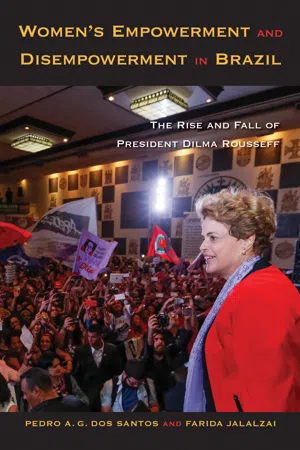
Women's Empowerment and Disempowerment in Brazil
eBook - PDF

Women's Empowerment and Disempowerment in Brazil

The Rise and Fall of President Dilma Rousseff

  1. English
  2. PDF
  3. Available on iOS & Android
eBook - PDF

Women's Empowerment and Disempowerment in Brazil

The Rise and Fall of President Dilma Rousseff

About this book

In 2010, Dilma Rousseff was the first woman to be elected President in Brazil. She was re-elected in 2014 before being impeached in 2016 for breaking budget laws. Her popularity and controversy both energized and polarized the country. In Women's Empowerment and Disempowerment in Brazil, dos Santos and Jalalzai examine Rousseff's presidency and what it means for a woman to hold (and lose) the country's highest power. 

The authors examine the ways Rousseff exercised dominant authority and enhanced women's political empowerment. They also investigate the extent her gender played a role in the events of her presidency, including the political and economic crises and her ensuing impeachment. Emphasizing women's political empowerment rather than representation, the authors assess the effects of women executives to more directly impact female constituencies—how they can empower women by appointing them to government positions; make policies that advance women's equality; and, through visibility, create greater support for female politicians despite rampant sexism. 

Women's Empowerment and Disempowerment in Brazil uses Rousseff's presidency as a case study to focus on the ways she succeeded and failed in using her authority to empower women. The authors' findings have implications throughout the world.

Frequently asked questions

Yes, you can cancel anytime from the Subscription tab in your account settings on the Perlego website. Your subscription will stay active until the end of your current billing period. Learn how to cancel your subscription.
No, books cannot be downloaded as external files, such as PDFs, for use outside of Perlego. However, you can download books within the Perlego app for offline reading on mobile or tablet. Learn more here.
Perlego offers two plans: Essential and Complete
  • Essential is ideal for learners and professionals who enjoy exploring a wide range of subjects. Access the Essential Library with 800,000+ trusted titles and best-sellers across business, personal growth, and the humanities. Includes unlimited reading time and Standard Read Aloud voice.
  • Complete: Perfect for advanced learners and researchers needing full, unrestricted access. Unlock 1.4M+ books across hundreds of subjects, including academic and specialized titles. The Complete Plan also includes advanced features like Premium Read Aloud and Research Assistant.
Both plans are available with monthly, semester, or annual billing cycles.
We are an online textbook subscription service, where you can get access to an entire online library for less than the price of a single book per month. With over 1 million books across 1000+ topics, we’ve got you covered! Learn more here.
Look out for the read-aloud symbol on your next book to see if you can listen to it. The read-aloud tool reads text aloud for you, highlighting the text as it is being read. You can pause it, speed it up and slow it down. Learn more here.
Yes! You can use the Perlego app on both iOS or Android devices to read anytime, anywhere — even offline. Perfect for commutes or when you’re on the go.
Please note we cannot support devices running on iOS 13 and Android 7 or earlier. Learn more about using the app.
Yes, you can access Women's Empowerment and Disempowerment in Brazil by Pedro A. G. dos Santos,Farida Jalalzai in PDF and/or ePUB format, as well as other popular books in Politics & International Relations & Global Politics. We have over one million books available in our catalogue for you to explore.
TABLE 
5.3 
PERCENTAGE 
OF 
WOMEN’S 
PRESENCE 
IN 
BRAZILIAN 
POLITICS, 
1986–2018
State 
Elections
Governor
Senator
Federal 
Deputy
State 
Deputy
Candidates
Elected
Candidates
Elected
Candidates
Elected
Candidates
Elected
1986
0.0
0.0
5.3
3.3
1990
0.0
6.5
5.8
5.5
1994
9.7
3.7
7.3
7.4
6.2
6.2
7.2
7.8
1998
8.1
3.7
14.0
7.4
10.4
5.7
12.9
10.0
2002
9.9
7.4
11.9
14.8
11.4
8.2
14.7
12.7
2006
12.7
11.1
15.9
14.8
12.7
8.8
13.9
11.4
2010
11.0
7.4
13.3
14.8
19.1
8.8
20.9
13.0
2014
12.1
3.7
20.4
18.5
29.3
9.9
29.1
11.3
2018
15.4
3.7
17.6
12.9
31.7
15.0
30.7
15.2
Local 
Elections
Mayor
Municipal 
Councilor
Candidates
Elected
Candidates
Elected
1992
3.4
7.4
1996
5.3
5.5
10.9
11.0
2000
7.6
5.7
19.1
11.6
2004
9.5
7.4
22.1
12.7
2008
11.2
9.1
21.6
12.5
2012
13.4
11.8
31.9
13.3
2016
12.6
11.6
32.8
14.6
Source:
Adapted 
from 
“The 
Representation 
of 
Women” 
by 
Pedro 
A. 
G. 
dos 
Santos 
and 
Kristin 
N. 
Wylie 
from 
Routledge 
Handbook 
of 
Brazilian 
Politics
, 
edited 
by 
Barry 
Ames. 
© 
2018 
Taylor 
and 
Francis. 
Reproduced 
with 
permission 
of 
the 
Licensor 
through 
PLSclear.

Table of contents

  1. Contents
  2. Acknowledgments
  3. Introduction
  4. 1. From Guerrilheira to Presidenta: The Rise of Dilma Rousseff
  5. 2. Tchau, Querida: Empowerment, Disempowerment, and Misogyny in the Impeachment of Dilma Rousseff
  6. 3. Empowering Women through Appointment
  7. 4. Losing It All: Policymaking and Women’s Empowerment under Rousseff and Beyond
  8. 5. The First Presidenta: Empowering through Symbolizing
  9. Conclusion
  10. Appendix
  11. References
  12. Index