This fascinating book looks at the phenomenon of murder and poisoning in the nineteenth century. Focusing on the case of William Palmer, a medical doctor who in 1856 was convicted of murder by poisoning, it examines how his case baffled toxicologists, doctors, detectives and judges. The investigation commences with an overview of the practice of toxicology in the Victorian era, and goes on to explore the demands imposed by legal testimony on scientific work to convict criminals. In addressing Palmer's trial, Burney focuses on the testimony of Alfred Swaine Taylor, a leading expert on poisons, and integrates the medical, legal and literary evidence to make sense of the trial itself and the sinister place of poison in wider Victorian society.
Ian Burney has produced an exemplary work of cultural history, mixing a keen understanding of the contemporary social and cultural landscape with the scientific and medical history of the period.
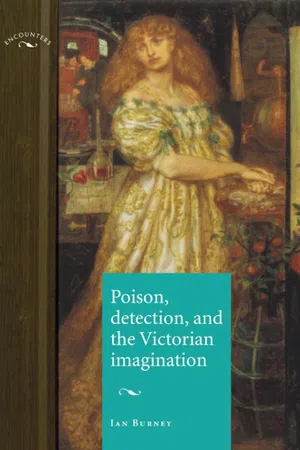
eBook - ePub
Poison, detection and the Victorian imagination
- 194 pages
- English
- ePUB (mobile friendly)
- Available on iOS & Android
eBook - ePub
Poison, detection and the Victorian imagination
About this book
Information
Poison and the Victorian imagination
Thomas de Quincey, in his 1827 essay ‘On Murder, considered as one of the fine arts’, adopted the role of connoisseur of this most peculiar of art forms. Selecting exemplary instances from the recent annals of British crime, de Quincey’s murder critic professed a clear preference for shedders of blood, condemning less sanguinary methods in forthright terms: ‘Fie on these dealers in poison, say I: can they not keep to the old honest way of cutting throats, without introducing such abominable innovations from Italy?’1
De Quincey, himself no stranger to the allure of noxious substances, surely did not intend to have his essay taken at face value. Yet within three decades commentators were doing just that, professing a profound lack of comprehension of de Quincey’s aesthetic sensibility. If one were to discuss murder as a fine art, they argued, surely so discerning an observer would not single out crude physical assault. He would instead focus on what mid-nineteenth century commentators insisted was the archetypal instrument of modern violence. Looking back on de Quincey’s essay, an 1859 editorial in the progressive weekly, Leader, declared that he had failed to recognize the delights of ‘a good poisoning case’, in which the criminal ‘moves through circumstances of mystery, . . . and keeps brains puzzling, and hearts throbbing, and betting books going, until the verdict is given’. A Times editorial in the following year agreed, confessing that it had ‘always been surprised’ at de Quincey’s analysis: ‘The poetry of homicide’, it declared, ‘belongs in a special degree to poisoning’.2
A decade later, the cultural critic Leslie Stephen penned an updated analysis of the homicidal arts, which appeared as ‘The decay of murder’ in a Cornhill magazine essay signed by ‘A cynic’. In this revisitation of de Quincey, Stephen’s cynic comments on those who professed to mourn the passing of an era of ‘heroic’ murder. According to this view, de Quincey’s cut-throat was symptomatic of a more direct era of ‘picturesque’ individuality and authentic action. Yet for Stephen’s cynic, this lament had less to do with homicide itself, than with the uneasy recognition of a more fundamental social shift constitutive of the modern world: ‘We are fallen’, he complains, ‘upon the days of petty passions and commonplace characters. Our modern heroes are marked by an absence of the ancient energy. One man is more and more like his neighbour. The object of our costume is no longer to set off the personal advantages which our figures may possess, but to enable them to escape all notice in a crowd’.3
The decline of violent crime, in this analysis, is the product of civilized refinement, though not necessarily a measure of progress: ‘That we do not commit great crimes is owing less to any positive advance in virtue than to a general desire to conform to the average standard’. The ‘enervating polish of civilization’, Stephen concluded, has ‘insidiously transform[ed] us into a very dull, highly respectable, and intensely monotonous collection of insignificant units’.4
Taken together, these re-readings of de Quincey delineate a modern aesthetics of criminal violence, in which bold physicality had been displaced by a more insidious form of subterranean (or sub-cutaneous) violation. In the interval between de Quincey and Stephen, criminal poisoning had come to be recognized as a distinctly modern phenomenon. It was, as the Illustrated times declared in 1856, at once the ‘crime of the age’, and ‘the crime of civilization’.5 The aim of this chapter is to examine the interlocking elements out of which Victorian commentators constructed an understanding of poisoning as, in important respects, a specifically modern concern. This identification of poisoning as modern relied upon a conceptual framework forged from an inherited (and nurtured) politico-historical narrative; a contemporary examination of the nature of ‘civilization’; and the cultural, historical, and material meanings attributable to poison as an instrument of crime. This ‘public’ discourse on poison reached out to broader contemporary concerns, stimulating reflection on the attainments and shortcomings of modern society.
In singling out secret poisoning as ‘the crime of civilization’, the Illustrated times and others like it were at once providing a diagnosis of contemporary society, and a comparison with specific historical antecedents. In such analyses, poison figured as a self-consciously historicized phenomenon, by means of which the peculiarities of the modern world came into sharp relief. Indeed, the journal announced that it had adapted its term ‘crime of the age’ from one of the leading political and historical commentators of the day, Thomas Babington Macaulay. The phrase, appropriately enough, was drawn from Macaulay’s essay analysing Machiavelli’s legacy for a modern conception of politics. Although a term of vilification in the nineteenth-century political lexicon, ‘Machiavellianism’, Macaulay observed, had been in its own time a legitimate tool of political art. This was due to the state of civilization to which Machiavelli’s Italy had risen (or fallen), where duplicity was not considered a vice, but an acceptable means to an end. For the Renaissance statesman, Macaulay explained, ‘to do an injury openly is . . . as wicked as to do it secretly, and far less profitable. With him the most honourable means are – the surest, the speediest, and the darkest . . . He would think it madness to declare open hostilities against a rival whom he might stab in a friendly embrace, or poison in a consecrated wafer’.6 Macaulay’s invocation of poison as a once appropriate but now unacceptable tool of political art, tapped into a rich and complex vein of associations between poison and crime familiar to his contemporaries. Poison was Italian, dangerously refined, and, in its historical incarnation, an instrument of high politics.
Italian political history, encompassing both classical Roman and Renaissance courts, served as an instructive touchstone for Victorian commentary on poison. Locating poison in space and time as ‘Italian’ was, of course, nothing new, as Victorian commentators were able to draw on a long line of associations transmitted through influential representational genres of past epochs. In medieval saint’s lives, corrupt Italian monks might resort to the poisoned chalice to stave off externally imposed programmes of reform.7 Poisoned bibles, portraits, and candles at work in imperial and Renaissance courts littered the Elizabethan and Jacobean stage. For the likes of Ben Jonson, Christopher Marlowe, and John Webster, such poisonous practices could serve a number of figurative purposes: as a comment on the decadent Italianate and papist English court rife with poison intrigue; and as a metaphor for social ‘falseness’ more generally, in which the pursuit of self-interest and greed by the manipulation of appearance threatened to undermine traditional, native values.8 The sweeping narratives of eighteenth-century historians invoked poison as a prism through which to view the implosion of past civilizations. ‘The effeminate luxury, which infected the manners of [Roman] courts and cities’, Edward Gibbon remarked, ‘had instilled [in them] a secret and destructive poison’, while for John Millar the ‘the decay of the military spirit’ in the Italian city-states of the Renaissance ‘was manifest from their disuse of duelling, . . . and from their substituting in place of it the more artful but cowardly practice of poisoning’.9
Victorians adapted this long-standing politico-historical narrative of poisoning for their own purposes. As Norman Vance has shown, the Victorian age witnessed a flowering of interest in ancient Rome, and in the numerous histories written in the mid-nineteenth century the link between poison and imperial decline was kept alive.10 Liddell’s 1855 History of Rome, to take but one example, contrasts a ‘republican simplicity of manners’ with an imperial decay exemplified by ‘wives poisoning their husbands, and . . . the discovery of secret associations of men and women where some new and licentious worship of Bacchus was introduced’.11 Although in some sense merely re-warming a venerable trope, stories of imperial decline took on new significance in the context of a Britain in the process of fashioning its own imperial self.12
Poison could serve other contemporary political projects, that of constructing a history of Whig progressivism, for example. For Macaulay, the corrupt, poison-drenched Stuart courts provided a narrative anchor on which to secure an account of the triumph of reason and morality. James I, Macaulay starkly asserted, was the first English monarch for whom the nation felt active contempt. The reason was not hard to discern: ‘the perjuries, the sorceries, the poisonings’ which permeated his court made James a seventeenth-century Claudius. That England as a whole did not descend into a Claudian bacchanalia was due to the solid virtues of the country, the very force that would soon arise in virtuous indignation to re-assert native (Whig) values: ‘England’, Macaulay rejoiced, ‘was no place, the seventeenth century no time, for Sporus and Locusta’.13 In defying the poisonous Stuart court, England had commenced a journey of re-asserting its true self, a journey which, in the Whig historical schema, had led to the virtuous present.14
As a historical phenomenon, then, poisoning figured within a dominant and easily recognizable account of the genealogy of a rational and virtuous civil society, a celebration of civilization in its modern English form. Yet the concept of civilization was by no means a straightforward one for Victorian commentators. For John Stuart Mill, civilization stood, on the one hand, in contrast to savagery or barbarism, characterized by forms of association that softened and curbed the brute state of nature. But, Mill asserts, ‘civilized’ social forms also begot what he terms ‘the vices or miseries of civilization’, vices that stemmed from the very same cooperative interdependence that made civilization possible. In the example most relevant to our concerns, Mill notes (following Locke) that a consequence of the marginalization of private violence attendant on civilized interdependence was the attenuation of bold action as a feature of modern sensibility, experience, and even capacity: ‘The heroic’, Mill observed, ‘essentially consists in being ready, for a worthy object, to do and to suffer, but especially to do, what is painful or disagreeable . . . There has crept over the refined classes, over the whole class of gentlemen in England, a moral effeminacy, an inaptitude for every kind of struggle’.15
Mill’s doubts about civilized society were widely shared, as contemporaries surveyed the challenges thrown up by their imperial and industrial present. Anxieties about the potential pitfalls of Britain’s global reach were clearly discernible even in the heyday of empire. From this perspective, the histories of classical decline spoke to a very present concern, serving less to distinguish modern from classical civilization than to suggest possible parallels. A similar point can be made for critics of Britain’s industrial order. For Carlyle, industrial civilization was an oxymoron, the worship of Mammon dissolving the bonds that support a virtuous community: ‘We call it a Society’, he raged in Past and present, ‘and go about professing openly the totalist separation, isolation’. For Matthew Arnold, ‘depression and ennui’ constituted a characteristic modern product – symptoms ‘of the disease of the most modern societies, the most advanced civilizations’.16
Modern civilization also entailed a loss of legibility, the result of a physical and social mobility driven, ultimately, by the demands of the marketplace. In modern society, Mill observed, ‘the individual becomes lost in the crowd . . . An established character becomes at once more difficult to gain, and more easily to be dispensed with’.17 This plasticity of character, a dark side of the civilizing process, was a theme enthusiastically embraced in contemporary literature as well as in social and political commentary. G. W. M. Reynolds, in his bestselling exposé of contemporary moral disorder, The mysteries of London, linked civilization to concealed, characterless criminality:
The more civilization progresses, the more refined becomes the human intellect, so does human iniquity increase. It is true that heinous and appalling crimes are less frequent; – but every kind of social, domestic, political, and commercial intrigue grows more into vogue, . . . hypocrisy is the cloak which conceals modern acts of turpitude, as dark nights were trusted to for the concealment of the bloody deeds of old.18
It would have come as no surprise to readers of The mysteries that one of its prime hypocrites, a lustful cleric, guards against exposure by means of secret poison. Poison, in a world of anonymity, deception, and calculation, was a singularly appropriate modern tool.
It is this sense of the ambiguities of modern civilization that made poisoning appear as its emblematic crime. Crimes of a ruder age, or of a ruder society, were first and foremost crimes that were ‘direct’. Direct in the psychology of their execution: they were spontaneous, unpremeditated, perpetrated with passion, the transparent expression of an authentic mental state. Direct, moreover, in that they used instruments of overt physicality. Bludgeons and knives depended on unmediated contact between assailant and victim and, working from the outside in, left physical traces ...
Table of contents
- Cover
- Half Title Page
- Title Page
- Copyright Page
- Contents
- List of plates
- Acknowledgements
- Introduction
- 1 Poison and the Victorian imagination
- 2 Disciplining poison
- 3 Plain matters of fact: making and representing toxicological knowledge
- 4 The crime of the age: the case of William Palmer
- 5 The travails of poison hunting
- Index
Trusted by 375,005 students
Access to over 1.5 million titles for a fair monthly price.
Study more efficiently using our study tools.
Frequently asked questions
Yes, you can cancel anytime from the Subscription tab in your account settings on the Perlego website. Your subscription will stay active until the end of your current billing period. Learn how to cancel your subscription
No, books cannot be downloaded as external files, such as PDFs, for use outside of Perlego. However, you can download books within the Perlego app for offline reading on mobile or tablet. Learn how to download books offline
Perlego offers two plans: Essential and Complete
- Essential is ideal for learners and professionals who enjoy exploring a wide range of subjects. Access the Essential Library with 800,000+ trusted titles and best-sellers across business, personal growth, and the humanities. Includes unlimited reading time and Standard Read Aloud voice.
- Complete: Perfect for advanced learners and researchers needing full, unrestricted access. Unlock 1.5M+ books across hundreds of subjects, including academic and specialized titles. The Complete Plan also includes advanced features like Premium Read Aloud and Research Assistant.
We are an online textbook subscription service, where you can get access to an entire online library for less than the price of a single book per month. With over 1.5 million books across 990+ topics, we’ve got you covered! Learn about our mission
Look out for the read-aloud symbol on your next book to see if you can listen to it. The read-aloud tool reads text aloud for you, highlighting the text as it is being read. You can pause it, speed it up and slow it down. Learn more about Read Aloud
Yes! You can use the Perlego app on both iOS and Android devices to read anytime, anywhere — even offline. Perfect for commutes or when you’re on the go.
Please note we cannot support devices running on iOS 13 and Android 7 or earlier. Learn more about using the app
Please note we cannot support devices running on iOS 13 and Android 7 or earlier. Learn more about using the app
Yes, you can access Poison, detection and the Victorian imagination by Ian Burney, Bertrand Taithe, Roger Cooter, Carolyn Steedman, Bertrand Taithe,Roger Cooter,Carolyn Steedman in PDF and/or ePUB format, as well as other popular books in History & 19th Century History. We have over 1.5 million books available in our catalogue for you to explore.