Tanzania has been independent in 2011 for 50 years. While most neighbouring states have gone through violent conflicts, Tanzania has managed to implement extensive reforms without armed political conflicts, Hence, Tanzania is an interesting case for Peace and Development research. This dissertation analyses the political development in Tanzania since the introduction of the multiparty system in 1992, with a focus on the challenges for the democratisation process in connection with the 2000 and 2005 elections. The question of to what extent Tanzania had moved towards a consolidation of democracy, is analysed by looking at nine different institutions of importance for democratisation grouped in four spheres: the state, the political, civil and economic society. Focus is on the development of the political society, and the role of the opposition in particular. The analysis is based on secondary and primary material collected between September 2000 to April 2010. The main conclusion is that even if the institutions of liberal democracy have gradually developed, in practice single-party rule has continued, manifested in the 2005 election when the CCM won 92% of seats. Despite impressive economic growth, poverty remains deep and has not been substantially reduced. On a theoretical level this brings the old debate between liberal and substantive democracy back to the fore. Neither the economic nor the political reforms have brought about a transformation of the political and economic system resulting in the poor majority gaining substantially more political influence and improved economic conditions. Hence, it is argued that the interface between the economic, political and administrative reforms has not been sufficiently considered in the liberal democratic tradition. Liberal democracy is necessary for a democratic development, but not sufficient for democracy to be consolidated. For that a substantive democratic development is necessary.
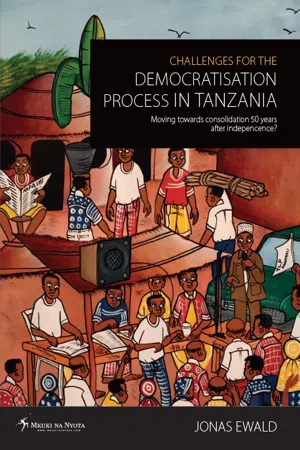
eBook - PDF
Challenges for the Democratisation Proce
Moving towards consolidation years after independence?
- 378 pages
- English
- PDF
- Available on iOS & Android
eBook - PDF
Challenges for the Democratisation Proce
Moving towards consolidation years after independence?
About this book
Information
Table of contents
- Cover
- Title page
- Copyright page
- Dedication
- Abstract
- Contents
- List of tables
- List of figures
- List of boxes
- List of maps
- Preface and acknowledgements
- List of Acronyms
- 1. Introduction
- 2. Theoretical framework: Democracy, democratisation and development
- 3. Methodology
- 4. Statism and development from above - Tanzanian development 1961-2010 A brief context
- 5. Sphere 1. State/state capacity. The political institutions and challenges for democratisation within the stat
- 6. Sphere 3 and 4:Political Institutions outside the state. Media, NGOs, democratic culture and economic development
- 7. Sphere 3: Political Parties—challenges for the opposition
- 8. Political reforms and the 2000 and 2005 elections—the consolidation of electionalism, but not of democracy?
- 9. Concluding discussion
- List of references (selected)
- Selected list of interviews 2000-2007/2010
- Appendix 1. A profile of the political Parties in Tanzania
- Sammanfattning på svenska
- Back cover
Trusted by 375,005 students
Access to over 1.5 million titles for a fair monthly price.
Study more efficiently using our study tools.
Frequently asked questions
Yes, you can cancel anytime from the Subscription tab in your account settings on the Perlego website. Your subscription will stay active until the end of your current billing period. Learn how to cancel your subscription
No, books cannot be downloaded as external files, such as PDFs, for use outside of Perlego. However, you can download books within the Perlego app for offline reading on mobile or tablet. Learn how to download books offline
Perlego offers two plans: Essential and Complete
- Essential is ideal for learners and professionals who enjoy exploring a wide range of subjects. Access the Essential Library with 800,000+ trusted titles and best-sellers across business, personal growth, and the humanities. Includes unlimited reading time and Standard Read Aloud voice.
- Complete: Perfect for advanced learners and researchers needing full, unrestricted access. Unlock 1.5M+ books across hundreds of subjects, including academic and specialized titles. The Complete Plan also includes advanced features like Premium Read Aloud and Research Assistant.
We are an online textbook subscription service, where you can get access to an entire online library for less than the price of a single book per month. With over 1.5 million books across 990+ topics, we’ve got you covered! Learn about our mission
Look out for the read-aloud symbol on your next book to see if you can listen to it. The read-aloud tool reads text aloud for you, highlighting the text as it is being read. You can pause it, speed it up and slow it down. Learn more about Read Aloud
Yes! You can use the Perlego app on both iOS and Android devices to read anytime, anywhere — even offline. Perfect for commutes or when you’re on the go.
Please note we cannot support devices running on iOS 13 and Android 7 or earlier. Learn more about using the app
Please note we cannot support devices running on iOS 13 and Android 7 or earlier. Learn more about using the app
Yes, you can access Challenges for the Democratisation Proce by Jonas Ewald in PDF and/or ePUB format, as well as other popular books in Politics & International Relations & African Politics. We have over 1.5 million books available in our catalogue for you to explore.