eBook - ePub
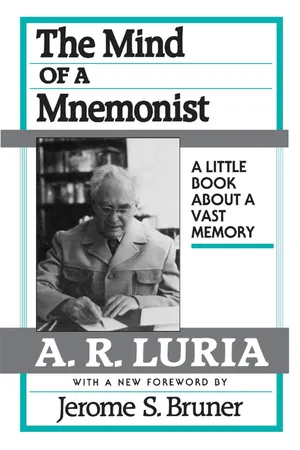
The Mind of a Mnemonist
A Little Book about a Vast Memory, With a New Foreword by Jerome S. Bruner
- English
- ePUB (mobile friendly)
- Available on iOS & Android
eBook - ePub
The Mind of a Mnemonist
A Little Book about a Vast Memory, With a New Foreword by Jerome S. Bruner
About this book
This study explores the inner world of a rare human phenomenon—a man who was endowed with virtually limitless powers of memory. From his intimate knowledge of S., the mnemonist, gained from conversations and testing over a period of almost thirty years, A. R. Luria is able to reveal in rich detail not only the obvious strengths of S.'s astonishing memory but also his surprising weaknesses: his crippling inability to forget, his pattern of reacting passively to life, and his uniquely handicapped personality.
Information
1
Introduction
This brief account of a man’s vast memory has quite a history behind it. For almost thirty years the author had an opportunity systematically to observe a man whose remarkable memory was one of the keenest the literature on the subject has ever described.
During this time the enormous amount of material which was assembled made it possible not only to explore the main patterns and devices of the man’s memory (which for all practical purposes was inexhaustible), but to delineate the distinct personality features this extraordinary person revealed.
Unlike other psychologists who have done research on people with an exceptional gift for memory, the author did not confine himself to measuring the capacity and stability of the subject’s memory, or to describing the devices used by the latter to recall and reproduce material. He was far more interested in studying certain other issues: What effect does a remarkable capacity for memory have on other major aspects of personality, on an individual’s habits of thought and imagination, on his behavior and personality development? What changes occur in a person’s inner world, in his relationships with others, in his very life style when one element of his psychic makeup, his memory, develops to such an uncommon degree that it begins to alter every other aspect of his activity?
Such an approach to the study of psychic phenomena is hardly typical of scientific psychology, which deals for the most part with sensation and perception, attention and memory, thinking and emotion, but only rarely considers how the entire structure of an individual’s personality may hinge on the development of one of these features of psychic activity.
Nonetheless, this approach has been in use for some time. It is the accepted method in clinical medicine, where the thoughtful physician is never interested merely in the course of a disease he happens to be studying at the moment, but tries to determine what effect a disturbance of one particular process has on other organic processes; how changes in the latter (which ultimately have one root cause) alter the activity of the entire organism, thus giving rise to the total picture of disease, to what medicine commonly terms a syndrome.
The study of syndromes, however, need not be restricted to clinical medicine. By the same token, one can analyze how an unusually developed feature of psychic makeup produces changes, which are causally related to it, in the entire structure of psychic life, in the total personality. In the latter instance, too, we would be dealing with “syndromes” having one causal factor, except that these would be psychological rather than clinical syndromes.
It is precisely with the emergence of such a syndrome, one produced by an exceptional memory, that this book is concerned. The author hopes that by reading it psychologists may be prompted to investigate and describe other psychological syndromes: the distinct personality features which emerge when there is heightened development of an individual’s sensitivity or imagination, his power of observation or capacity for abstract thought, or the will power he exerts in the pursuit of a particular idea. This would mark the beginning of a concrete (but nonetheless scientifically valid) psychology.
That an analysis of an exceptional memory, of the role it played in shaping an individual’s psychic makeup, should initiate this type of research has certain distinct advantages. Memory studies, which had been at a standstill for so many years, have once again become a subject of vital research, leading to rapid growth in our knowledge of this particular phenomenon. This progress is bound up with the development of a new branch of technology, bionics, which has forced us to take a closer look at every possible indication of how the human memory operates: the devices it uses as a basis for the mental “notes” people take on their impressions of things; the “readings” the mind takes of memory traces that have been retained. At the same time, recent work on memory is related to advances in our knowledge made possible through current theories of the brain, its physiological and biochemical structure.
Nevertheless, in this book we will not be drawing either on information acquired in these fields or on the vast literature available on memory. This book is devoted to the study of one man, and the author will venture no further than what observations on this remarkable “experiment of nature” themselves provided.
2
The Beginning of the Research
The actual beginning of this account dates back to the 1920’s, when I had only recently begun to do work in psychology. It was then that a man came to my laboratory who asked me to test his memory.
At the time the man (let us designate him S.) was a newspaper reporter who had come to my laboratory at the suggestion of the paper’s editor. Each morning the editor would meet with the staff and hand out assignments for the day—lists of places he wanted covered, information to be obtained in each. The list of addresses and instructions was usually fairly long, and the editor noted with some surprise that S. never took any notes. He was about to reproach the reporter for being inattentive when, at his urging, S. repeated the entire assignment word for word. Curious to learn more about how the man operated, the editor began questioning S. about his memory. But S. merely countered with amazement: Was there really anything unusual about his remembering everything he’d been told? Wasn’t that the way other people operated? The idea that he possessed certain particular qualities of memory which distinguished him from others struck him as incomprehensible.
The editor sent him to the psychology laboratory to have some studies done on his memory, and thus it was that I found myself confronted with the man.
At the time S. was just under thirty. The information I got on his family background was that his father owned a bookstore, that his mother, an elderly Jewish woman, was quite well-read, and that of his numerous brothers and sisters (all of them conventional, well-balanced types) some were gifted individuals. There was no incidence of mental illness in the family.
S. had grown up in a small Jewish community and had attended elementary school there. Later, when it was discovered that he had musical ability, he was enrolled in a music school, where he studied in the hope that he might some day become a professional violinist. However, after an ear disease had left his hearing somewhat impaired, he realized he could hardly expect to have a successful career as a musician. During the time he spent looking for the sort of work that would best suit him he happened to visit the newspaper, where he subsequently began work as a reporter.
S. had no clear idea what he wanted out of life, and his plans were fairly indefinite. The impression he gave was of a rather ponderous and at times timid person who was puzzled at having been sent to the psychology laboratory. As I mentioned, he wasn’t aware of any peculiarities in himself and couldn’t conceive of the idea that his memory differed in some way from other people’s. He passed on his editor’s request to me with some degree of confusion and waited curiously to see what, if anything, the research might turn up. Thus began a relationship of almost thirty years, filled with experiments, discussions, and correspondence.
When I began my study of S. it was with much the same degree of curiosity psychologists generally have at the outset of research, hardly with the hope that the experiments would offer anything of particular note. However, the results of the first tests were enough to change my attitude and to leave me, the experimenter, rather than my subject, both embarrassed and perplexed.
I gave S. a series of words, then numbers, then letters, reading them to him slowly or presenting them in written form. He read or listened attentively and then repeated the material exactly as it had been presented. I increased the number of elements in each series, giving him as many as thirty, fifty, or even seventy words or numbers, but this, too, presented no problem for him. He did not need to commit any of the material to memory; if I gave him a series of words or numbers, which I read slowly and distinctly, he would listen attentively, sometimes ask me to stop and enunciate a word more clearly, or, if in doubt whether he had heard a word correctly, would ask me to repeat it. Usually during an experiment he would close his eyes or stare into space, fixing his gaze on one point; when the experiment was over, he would ask that we pause while he went over the material in his mind to see if he had retained it. Thereupon, without another moment’s pause, he would reproduce the series that had been read to him.
The experiment indicated that he could reproduce a series in reverse order—from the end to the beginning—just as simply as from start to finish; that he could readily tell me which word followed another in a series, or reproduce the word which happened to precede one I’d name. He would pause for a minute, as though searching for the word, but immediately after would be able to answer my questions and generally made no mistakes.
It was of no consequence to him whether the series I gave him contained meaningful words or nonsense syllables, numbers or sounds; whether they were presented orally or in writing. All he required was that there be a three-to-four-second pause between each element in the series, and he had no difficulty reproducing whatever I gave him.
As the experimenter, I soon found myself in a state verging on utter confusion. An increase in the length of a series led to no noticeable increase in difficulty for S., and I simply had to admit that the capacity of his memory had no distinct limits; that I had been unable to perform what one would think was the simplest task a psychologist can do: measure the capacity of an individual’s memory. I arranged a second and then a third session with S.; these were followed by a series of sessions, some of them days and weeks apart, others separated by a period of several years.
But these later sessions only further complicated my position as experimenter, for it appeared that there was no limit either to the capacity of S.’s memory or to the durability of the traces he retained. Experiments indicated that he had no difficulty reproducing any lengthy series of words whatever, even though these had originally been presented to him a week, a month, a year, or even many years earlier. In fact, some of these experiments designed to test his retention were performed (without his being given any warning) fifteen or sixteen years after the session in which he had originally recalled the words. Yet invariably they were successful. During these test sessions S. would sit with his eyes closed, pause, then comment: “Yes, yes … This was a series you gave me once when we were in your apartment …You were sitting at the table and I in the rocking chair … You were wearing a gray suit and you looked at me like this … Now, then, I can see you saying …” And with that he would reel off the series precisely as I had given it to him at the earlier session. If one takes into account that S. had by then become a well-known mnemonist, who had to remember hundreds and thousands of series, the feat seems even more remarkable.
All this meant that I had to alter my plan and concentrate less on any attempt to measure the man’s memory than on some way to provide a qualitative analysis of it, to describe the psychological aspects of its structure. Subsequently I undertook to explore another problem, as I said, to do a close study of the peculiarities that seemed an inherent part of the psychology of this exceptional mnemonist.
I devoted the balance of my research to these two tasks, the results of which I will try to present systematically here, though many years have passed since my work with S.
3
His Memory
This study of S.’s memory was begun in the mid-1920’s, when he was still working as a newspaper reporter. It continued for many years, during which S. changed jobs several times, finally becoming a professional mnemonist who gave performances of memory feats. Although the procedures S. used to recall material retained their original pattern throughout this time, they gradually became enriched with new devices, so that ultimately they presented quite a different picture psychologically.
In this section we will consider the peculiar features his memory exhibited at successive stages.
THE INITIAL FACTS
Throughout the course of our research S.’s recall was always of a spontaneous nature. The only mechanisms he employed were one of the following: either he continued to see series of words or numbers which had been presented to him, or he converted these elements into visual images.
The simplest structure was one S. used to recall tables of numbers written on a blackboard. S. would study the material on the board, close his eyes, open them again for a moment, turn aside, and, at a signal, reproduce one series from the board. Then he would fill in the empty squares of the next table, rapidly calling off the numbers. It was a simple matter for him to fill in the numbers for the empty squares of the table either when asked to do this for certain squares I chose at random, or when asked to fill in a series of numbers successively in reverse order. He could easily tell me which numbers formed one or another of the vertical columns in the table and could “read off” to me numbers that formed the diagonals; finally, he was able to compose a multi-digit number out of the one-digit numbers in the entire table.
In order to imprint an impression of a table consisting of twenty numbers, S. needed only 35–40 seconds, during which he would examine the chart closely several times. A table of fifty numbers required somewhat more time, but he could easily fix an impression of it in his mind in 2.5–3 minutes, staring at the chart a few times, then closing his eyes as he tested himself on the material in his mind.
The following is a typical example of one of dozens of experiments that were carried out with him (Experiment of May 10, 1939):

He spent three minutes examining the table I had drawn on a piece of paper (Table 1), stopping intermittently to go over what he had seen in his mind. It took him 40 seconds to reproduce this table (that is, to call off all the numbers in succession). He did this at a rhythmic pace, scarcely pausing between numbers. His reproduction of the numbers in the third vertical column took somewhat longer—1 minute, 20 seconds—whereas he reproduced those in the second vertical column in 25 seconds, and took 30 seconds to reproduce this column in reverse order. He read off the numbers which formed the diagonals (the groups of four numbers running zigzag through the chart) in 35 seconds, and within 50 seconds ran through the numbers that formed the horizontal rows. Altogether he required 1 minute, 30 seconds to convert all fifty numbers into a single fifty-digit number and read this off.
As I have already mentioned, an experiment designed to verify S.’s “reading” of this series, which was not carried out until after several months had elapsed, indicated that he could reproduce the table he had “impressed” in his mind just as fully as in the first reproduction and at about the same rates. The only difference in the two performances was that for the later one he needed more time to “revive” the entire situation in which the experiment had originally been carried out: to “see” the room in which we had been sitting; to “hear” my voice; to “reproduce” an image of himself looking at the board. But the actual process of “reading” the table required scarcely any more time than it had earlier.
Similar data were obtained in experiments in which we presented S. with a table of letters written either on a blackboard or on a sheet of paper. It took him roughly the same amount of time both to register an impression of these meaningless series of letters and to read them off as he had needed for the table of numbers. (See Table 2: experimental material given S. during a session at which the academician L. A. Orbeli was present.) S. reproduced this material with the same ease he had demonstrated earlier, there being no distinct limits, apparently...
Table of contents
- Cover
- Title
- Copyright
- Dedication
- Contents
- Foreword to the 1987 Edition
- Foreword to the First Edition
- Preface
- 1 Introduction
- 2 The Beginning of the Research
- 3 His Memory
- 4 His World
- 5 His Mind
- 6 His Control of Behavior
- 7 His Personality
Trusted by 375,005 students
Access to over 1.5 million titles for a fair monthly price.
Study more efficiently using our study tools.
Frequently asked questions
Yes, you can cancel anytime from the Subscription tab in your account settings on the Perlego website. Your subscription will stay active until the end of your current billing period. Learn how to cancel your subscription
No, books cannot be downloaded as external files, such as PDFs, for use outside of Perlego. However, you can download books within the Perlego app for offline reading on mobile or tablet. Learn how to download books offline
Perlego offers two plans: Essential and Complete
- Essential is ideal for learners and professionals who enjoy exploring a wide range of subjects. Access the Essential Library with 800,000+ trusted titles and best-sellers across business, personal growth, and the humanities. Includes unlimited reading time and Standard Read Aloud voice.
- Complete: Perfect for advanced learners and researchers needing full, unrestricted access. Unlock 1.5M+ books across hundreds of subjects, including academic and specialized titles. The Complete Plan also includes advanced features like Premium Read Aloud and Research Assistant.
We are an online textbook subscription service, where you can get access to an entire online library for less than the price of a single book per month. With over 1.5 million books across 990+ topics, we’ve got you covered! Learn about our mission
Look out for the read-aloud symbol on your next book to see if you can listen to it. The read-aloud tool reads text aloud for you, highlighting the text as it is being read. You can pause it, speed it up and slow it down. Learn more about Read Aloud
Yes! You can use the Perlego app on both iOS and Android devices to read anytime, anywhere — even offline. Perfect for commutes or when you’re on the go.
Please note we cannot support devices running on iOS 13 and Android 7 or earlier. Learn more about using the app
Please note we cannot support devices running on iOS 13 and Android 7 or earlier. Learn more about using the app
Yes, you can access The Mind of a Mnemonist by A. R. Luria, Lynn Solotaroff in PDF and/or ePUB format, as well as other popular books in Psychology & Psychiatry & Mental Health. We have over 1.5 million books available in our catalogue for you to explore.