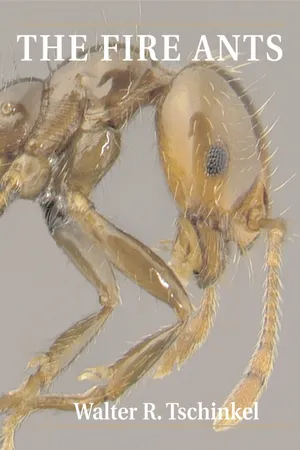
Walter Tschinkel's passion for fire ants has been stoked by over thirty years of exploring the rhythm and drama of Solenopsis invicta's biology. Since South American fire ants arrived in Mobile, Alabama, in the 1940s, they have spread to become one of the most reviled pests in the Sunbelt.
In Fire Ants Tschinkel provides not just an encyclopedic overview of S. invicta--how they found colonies, construct and defend their nests, forage and distribute food, struggle among themselves for primacy, and even relocate entire colonies--but a lively account of how research is done, how science establishes facts, and the pleasures and problems of a scientific career.
Between chapters detailed enough for experts but readily accessible to any educated reader, "interludes" provide vivid verbal images of the world of fire ants and the people who study them. Early chapters describe the several failed, and heavily politically influenced, eradication campaigns, and later ones the remarkable spread of S. invicta's "polygyne" form, in which nests harbor multiple queens and colonies reproduce by "budding." The reader learns much about ants, the practice of science, and humans' role in the fire ant's North American success.
eBook - PDF
The Fire Ants
About this book
Information
Table of contents
- Cover
- Title Page
- Copyright
- Contents
- Foreword by Edward O.Wilson
- I. Origin and Spread, Present and Future Range
- II. Basic Needs and the Monogyne Colony Cycle
- III. Family Life
- IV. Polygyny
- V. Populations and Ecology
- References
- Acknowledgments
- Index
- Color plates follow page
Trusted by 375,005 students
Access to over 1.5 million titles for a fair monthly price.
Study more efficiently using our study tools.
Frequently asked questions
Yes, you can cancel anytime from the Subscription tab in your account settings on the Perlego website. Your subscription will stay active until the end of your current billing period. Learn how to cancel your subscription
No, books cannot be downloaded as external files, such as PDFs, for use outside of Perlego. However, you can download books within the Perlego app for offline reading on mobile or tablet. Learn how to download books offline
Perlego offers two plans: Essential and Complete
- Essential is ideal for learners and professionals who enjoy exploring a wide range of subjects. Access the Essential Library with 800,000+ trusted titles and best-sellers across business, personal growth, and the humanities. Includes unlimited reading time and Standard Read Aloud voice.
- Complete: Perfect for advanced learners and researchers needing full, unrestricted access. Unlock 1.5M+ books across hundreds of subjects, including academic and specialized titles. The Complete Plan also includes advanced features like Premium Read Aloud and Research Assistant.
We are an online textbook subscription service, where you can get access to an entire online library for less than the price of a single book per month. With over 1.5 million books across 990+ topics, we’ve got you covered! Learn about our mission
Look out for the read-aloud symbol on your next book to see if you can listen to it. The read-aloud tool reads text aloud for you, highlighting the text as it is being read. You can pause it, speed it up and slow it down. Learn more about Read Aloud
Yes! You can use the Perlego app on both iOS and Android devices to read anytime, anywhere — even offline. Perfect for commutes or when you’re on the go.
Please note we cannot support devices running on iOS 13 and Android 7 or earlier. Learn more about using the app
Please note we cannot support devices running on iOS 13 and Android 7 or earlier. Learn more about using the app
Yes, you can access The Fire Ants by Walter R. Tschinkel in PDF and/or ePUB format, as well as other popular books in Biological Sciences & Entomology. We have over 1.5 million books available in our catalogue for you to explore.