In The Descent of Man, Charles Darwin proposed that an ant's brain, no larger than a pin's head, must be sophisticated to accomplish all that it does. Yet today many people still find it surprising that insects and other arthropods show behaviors that are much more complex than innate reflexes. They are products of versatile brains which, in a sense, think.
Fascinating in their own right, arthropods provide fundamental insights into how brains process and organize sensory information to produce learning, strategizing, cooperation, and sociality. Nicholas Strausfeld elucidates the evolution of this knowledge, beginning with nineteenth-century debates about how similar arthropod brains were to vertebrate brains. This exchange, he shows, had a profound and far-reaching impact on attitudes toward evolution and animal origins. Many renowned scientists, including Sigmund Freud, cut their professional teeth studying arthropod nervous systems. The greatest neuroanatomist of them all, Santiago Ramón y Cajal—founder of the neuron doctrine—was awed by similarities between insect and mammalian brains.
Writing in a style that will appeal to a broad readership, Strausfeld weaves anatomical observations with evidence from molecular biology, neuroethology, cladistics, and the fossil record to explore the neurobiology of the largest phylum on earth—and one that is crucial to the well-being of our planet. Highly informative and richly illustrated, Arthropod Brains offers an original synthesis drawing on many fields, and a comprehensive reference that will serve biologists for years to come.
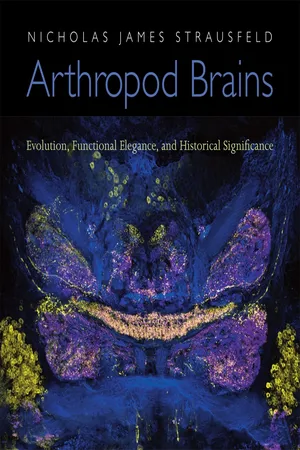
eBook - PDF
Arthropod Brains
Evolution, Functional Elegance, and Historical Significance
- 849 pages
- English
- PDF
- Available on iOS & Android
eBook - PDF
Arthropod Brains
Evolution, Functional Elegance, and Historical Significance
About this book
Information
Table of contents
- Cover
- Title Page
- Copyright
- Dedication
- Contents
- Prologue
- Chapter 1. The Polymath of Rennes
- Chapter 2. Discoveries and Losses
- Chapter 3. Ramón y Cajal’s Hunting Case Watch
- Chapter 4. Beneath the Faceted Eye
- Chapter 5. In the Air and under Water: The Olfactory Brain
- Chapter 6. The Mushroom Body Enigma
- Chapter 7. The Brain within the Brain
- Chapter 8. Eight Legs and More: Chelicerates, Myriapods, and Some Distant Relatives
- Chapter 9. Reiterations, Appendages, and the Ancient Brain
- Chapter 10. Philosophical Anatomy, Swedish Pioneers, and Neuronal Systematics
- Chapter 11. Convergence or Common Descent?
- Chapter 12. The Origin of Insects
- Glossary
- Notes
- Acknowledgments
- Credits
- Index
Trusted by 375,005 students
Access to over 1.5 million titles for a fair monthly price.
Study more efficiently using our study tools.
Frequently asked questions
Yes, you can cancel anytime from the Subscription tab in your account settings on the Perlego website. Your subscription will stay active until the end of your current billing period. Learn how to cancel your subscription
No, books cannot be downloaded as external files, such as PDFs, for use outside of Perlego. However, you can download books within the Perlego app for offline reading on mobile or tablet. Learn how to download books offline
Perlego offers two plans: Essential and Complete
- Essential is ideal for learners and professionals who enjoy exploring a wide range of subjects. Access the Essential Library with 800,000+ trusted titles and best-sellers across business, personal growth, and the humanities. Includes unlimited reading time and Standard Read Aloud voice.
- Complete: Perfect for advanced learners and researchers needing full, unrestricted access. Unlock 1.5M+ books across hundreds of subjects, including academic and specialized titles. The Complete Plan also includes advanced features like Premium Read Aloud and Research Assistant.
We are an online textbook subscription service, where you can get access to an entire online library for less than the price of a single book per month. With over 1.5 million books across 990+ topics, we’ve got you covered! Learn about our mission
Look out for the read-aloud symbol on your next book to see if you can listen to it. The read-aloud tool reads text aloud for you, highlighting the text as it is being read. You can pause it, speed it up and slow it down. Learn more about Read Aloud
Yes! You can use the Perlego app on both iOS and Android devices to read anytime, anywhere — even offline. Perfect for commutes or when you’re on the go.
Please note we cannot support devices running on iOS 13 and Android 7 or earlier. Learn more about using the app
Please note we cannot support devices running on iOS 13 and Android 7 or earlier. Learn more about using the app
Yes, you can access Arthropod Brains by Nicholas James Strausfeld in PDF and/or ePUB format, as well as other popular books in Biological Sciences & Evolution. We have over 1.5 million books available in our catalogue for you to explore.