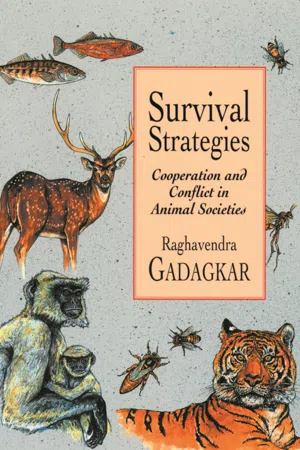
Did you know that Tasmanian hens have two husbands? That cellular slime molds commit suicide? That vampire bats will share food with hungry fellow bats and that hanuman langurs commit infanticide? Why creatures great and small behave in such fascinating and seemingly perplexing ways is explained in this delightful account of the evolutionary foundations of animal social behavior.
Only in recent years have biologists and ethologists begun to apply careful evolutionary thinking to the study of animal societies--and with spectacular results. This book presents the choicest of these findings, with a remarkable wealth of insights into the myriad strategies that animals have developed to perpetuate their kind. In an irresistible style, Raghavendra Gadagkar explores the strategies of cooperation and conflict adopted by animals--from the lordly lion to the primitive wasp worker--as they choose mates, raise their young, communicate with others, and establish the division of labor necessary to feed and protect the group and safeguard their territory.
Whether focusing on the birds or the bees, this book offers both superb descriptions and lucid explanations of many different behaviors encountered in the animal world: why a ground squirrel will sound an alarm--even risk its own safety--to warn fellow squirrels of impending danger; why weaver ant larvae donate silk for nest building; why house mice raise their offspring in a communal nursery; and how animals can recognize the relatives they want to favor--or avoid.
Illustrated with both photographs and explanatory diagrams, this expert and inviting tour of the social world of animals will inform and charm anyone curious about the motivations behind the amazing range of activity in the animal kingdom.
- 209 pages
- English
- PDF
- Available on iOS & Android
eBook - PDF
About this book
Information
Publisher
Harvard University PressYear
2001Print ISBN
9780674005570
9780674170551
eBook ISBN
9780674260856
Table of contents
- Cover
- Title Page
- Copyright
- Dedication
- Contents
- Preface
- Chapter 1. What Are Social Animals?
- Chapter 2. Evolution, the Eternal Tinkerer
- Chapter 3. It’s in the Genes
- Chapter 4. What Do Social Animals Do to Each Other?
- Chapter 5. The Paradox of Altruism
- Chapter 6. Do Animals Favor Their Relatives?
- Chapter 7. A Primitive Wasp Society
- Chapter 8. Games Animals Play
- Chapter 9. The Fine Balance between Cooperation and Conflict
- Chapter 10. Some Caveats and Conclusions
- Suggested Readings
- References
- Index
Trusted by 375,005 students
Access to over 1.5 million titles for a fair monthly price.
Study more efficiently using our study tools.
Frequently asked questions
Yes, you can cancel anytime from the Subscription tab in your account settings on the Perlego website. Your subscription will stay active until the end of your current billing period. Learn how to cancel your subscription
No, books cannot be downloaded as external files, such as PDFs, for use outside of Perlego. However, you can download books within the Perlego app for offline reading on mobile or tablet. Learn how to download books offline
Perlego offers two plans: Essential and Complete
- Essential is ideal for learners and professionals who enjoy exploring a wide range of subjects. Access the Essential Library with 800,000+ trusted titles and best-sellers across business, personal growth, and the humanities. Includes unlimited reading time and Standard Read Aloud voice.
- Complete: Perfect for advanced learners and researchers needing full, unrestricted access. Unlock 1.5M+ books across hundreds of subjects, including academic and specialized titles. The Complete Plan also includes advanced features like Premium Read Aloud and Research Assistant.
We are an online textbook subscription service, where you can get access to an entire online library for less than the price of a single book per month. With over 1.5 million books across 990+ topics, we’ve got you covered! Learn about our mission
Look out for the read-aloud symbol on your next book to see if you can listen to it. The read-aloud tool reads text aloud for you, highlighting the text as it is being read. You can pause it, speed it up and slow it down. Learn more about Read Aloud
Yes! You can use the Perlego app on both iOS and Android devices to read anytime, anywhere — even offline. Perfect for commutes or when you’re on the go.
Please note we cannot support devices running on iOS 13 and Android 7 or earlier. Learn more about using the app
Please note we cannot support devices running on iOS 13 and Android 7 or earlier. Learn more about using the app
Yes, you can access Survival Strategies by Raghavendra Gadagkar in PDF and/or ePUB format, as well as other popular books in Biological Sciences & Biology. We have over 1.5 million books available in our catalogue for you to explore.