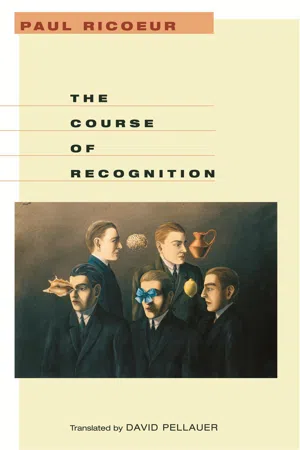
Recognition, though it figures profoundly in our understanding of objects and persons, identity and ideas, has never before been the subject of a single, sustained philosophical inquiry. This work, by one of contemporary philosophy's most distinguished voices, pursues recognition through its various philosophical guises and meanings—and, through the "course of recognition," seeks to develop nothing less than a proper hermeneutics of mutual recognition.
Originally delivered as lectures at the Institute for the Human Sciences at Vienna, the essays collected here consider recognition in three of its forms. The first chapter, focusing on knowledge of objects, points to the role of recognition in modern epistemology; the second, concerned with what might be called the recognition of responsibility, traces the understanding of agency and moral responsibility from the ancients up to the present day; and the third takes up the problem of recognition and identity, which extends from Hegel's discussion of the struggle for recognition through contemporary arguments about identity and multiculturalism. Throughout, Paul Ricoeur probes the significance of our capacity to recognize people and objects, and of self-recognition and self-identity in relation to the gift of mutual recognition. Drawing inspiration from such literary texts as the Odyssey and Oedipus at Colonus, and engaging some of the classic writings of the Continental philosophical tradition—by Kant, Hobbes, Hegel, Augustine, Locke, and Bergson—The Course of Recognition ranges over vast expanses of time and subject matter and in the process suggests a number of highly insightful ways of thinking through the major questions of modern philosophy.
- 316 pages
- English
- PDF
- Available on iOS & Android
eBook - PDF
The Course of Recognition
About this book
Information
Publisher
Harvard University PressYear
2007Print ISBN
9780674025646
9780674019256
eBook ISBN
9780674260719
Topic
PhilosophySubtopic
Epistemology in PhilosophyTable of contents
- Cover
- Title Page
- Copyright
- Dedication
- Contents
- Preface
- Introduction
- Chapter 1. Recognition as Identification
- Chapter 2. Recognizing Oneself
- Chapter 3. Mutual Recognition
- Conclusion: A Review
- Acknowledgments
- Notes
- Works Cited
- Index
Trusted by 375,005 students
Access to over 1.5 million titles for a fair monthly price.
Study more efficiently using our study tools.
Frequently asked questions
Yes, you can cancel anytime from the Subscription tab in your account settings on the Perlego website. Your subscription will stay active until the end of your current billing period. Learn how to cancel your subscription
No, books cannot be downloaded as external files, such as PDFs, for use outside of Perlego. However, you can download books within the Perlego app for offline reading on mobile or tablet. Learn how to download books offline
Perlego offers two plans: Essential and Complete
- Essential is ideal for learners and professionals who enjoy exploring a wide range of subjects. Access the Essential Library with 800,000+ trusted titles and best-sellers across business, personal growth, and the humanities. Includes unlimited reading time and Standard Read Aloud voice.
- Complete: Perfect for advanced learners and researchers needing full, unrestricted access. Unlock 1.5M+ books across hundreds of subjects, including academic and specialized titles. The Complete Plan also includes advanced features like Premium Read Aloud and Research Assistant.
We are an online textbook subscription service, where you can get access to an entire online library for less than the price of a single book per month. With over 1.5 million books across 990+ topics, we’ve got you covered! Learn about our mission
Look out for the read-aloud symbol on your next book to see if you can listen to it. The read-aloud tool reads text aloud for you, highlighting the text as it is being read. You can pause it, speed it up and slow it down. Learn more about Read Aloud
Yes! You can use the Perlego app on both iOS and Android devices to read anytime, anywhere — even offline. Perfect for commutes or when you’re on the go.
Please note we cannot support devices running on iOS 13 and Android 7 or earlier. Learn more about using the app
Please note we cannot support devices running on iOS 13 and Android 7 or earlier. Learn more about using the app
Yes, you can access The Course of Recognition by Paul Ricoeur, David Pellauer in PDF and/or ePUB format, as well as other popular books in Philosophy & Epistemology in Philosophy. We have over 1.5 million books available in our catalogue for you to explore.