Designing Interaction and Interfaces for Automated Vehicles
User-Centred Ecological Design and Testing
- 503 pages
- English
- ePUB (mobile friendly)
- Available on iOS & Android
Designing Interaction and Interfaces for Automated Vehicles
User-Centred Ecological Design and Testing
About this book
Driving automation and autonomy are already upon us and the problems that were predicted twenty years ago are beginning to appear. These problems include shortfalls in expected benefits, equipment unreliability, driver skill fade, and error-inducing equipment designs. Designing Interaction and Interfaces for Automated Vehicles: User-Centred Ecological Design and Testing investigates the difficult problem of how to interface drivers with automated vehicles by offering an inclusive, human-centred design process that focusses on human variability and capability in interaction with interfaces.
This book introduces a novel method that combines both systems thinking and inclusive user-centred design. It models driver interaction, provides design specifications, concept designs, and the results of studies in simulators on the test track, and in road going vehicles.
This book is for designers of systems interfaces, interactions, UX, Human Factors and Ergonomics researchers and practitioners involved with systems engineering and automotive academics._
"In this book, Prof Stanton and colleagues show how Human Factors methods can be applied to the tricky problem of interfacing human drivers with vehicle automation. They have developed an approach to designing the human-automation interaction for the handovers between the driver and the vehicle. This approach has been tested in driving simulators and, most interestingly, in real vehicles on British motorways. The approach, called User-Centred Ecological Interface Design, has been validated against driver behaviour and used to support their ongoing work on vehicle automation. I highly recommend this book for anyone interested, or involved, in designing human-automation interaction in vehicles and beyond."
Professor Michael A. Regan, University of NSW Sydney, AUSTRALIA
Frequently asked questions
- Essential is ideal for learners and professionals who enjoy exploring a wide range of subjects. Access the Essential Library with 800,000+ trusted titles and best-sellers across business, personal growth, and the humanities. Includes unlimited reading time and Standard Read Aloud voice.
- Complete: Perfect for advanced learners and researchers needing full, unrestricted access. Unlock 1.4M+ books across hundreds of subjects, including academic and specialized titles. The Complete Plan also includes advanced features like Premium Read Aloud and Research Assistant.
Please note we cannot support devices running on iOS 13 and Android 7 or earlier. Learn more about using the app.
Information
Part I
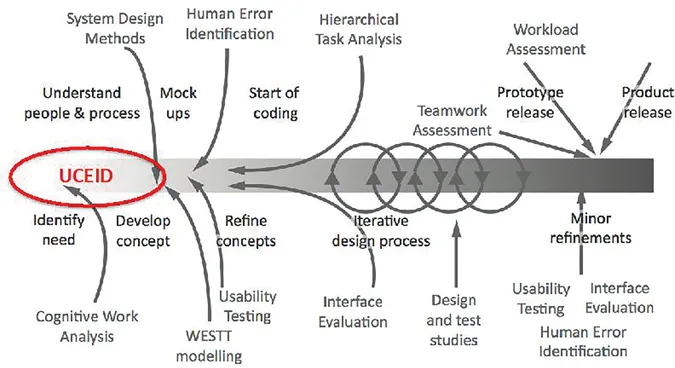
1 UCEID â The Best of Both Worlds
CONTENTS
1.1 Introduction

1.1.1 Why Use UCEID?
1.2 The UCEID Method
Table of contents
- Cover
- Half Title
- Series Page
- Title Page
- Copyright Page
- Table of Contents
- Preface
- Acknowledgements
- Editors
- Contributors
- Abbreviations
- Part I Modelling
- Part II Lo-Fi and Hi-Fi Simulators
- Part III Benchmarking
- Part IV HMI Simulator
- Part V On-Road and Design Guidelines
- Chapter 17 Can Allowing Interface Customisation Increase Driver Confidence and Safety Levels in Automated Vehicle TORs?
- Chapter 18 Effects of Customisable HMI on Subjective Evaluation of Takeover Experience on the Road
- Chapter 19 Accommodating Driversâ Preferences Using a Customised Takeover Interface on UK Motorways
- Chapter 20 Validating OESDs in an On-Road Study of Semi-Automated Vehicle-to-Human Driver Takeovers
- Chapter 21 Design Constraints and Guidelines for the AutomationâHuman Interface
- Author Index
- Subject Index
- Inclusivity Index