Six containers of heirloom tomatoes, miniature squashes, and herbs on your back patio or six acres of beets, cabbages, and strawberries? Five chickens and a honey bee hive or a small farm with three dozen sheep and a couple of quarter horses?
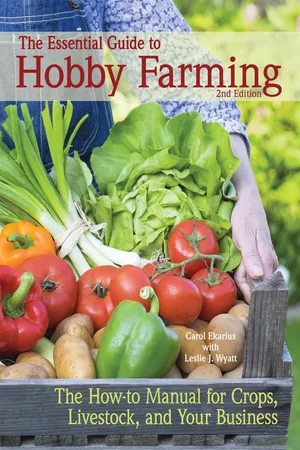
Regardless of the size of your "field of dreams," Essential Guide to Hobby Farming is your best first step to making that hobby-farm aspiration a pleasurable and profitable reality. A hobby farmer for the past thirty years, Carol Ekarius shares the joys, challenges, and rewards of living the rural life. Hobby farming is as much a state of mind as it is an address in the country, and this instructive, beautifully photographed manual addresses every topic beginning hobby farmers need to know, from purchasing the right land and equipment to choosing and maintaining crops and livestock to marketing and selling your hobby farm's yield.
TOPICS DISCUSSED INSIDE:
-Assessing finances and resources—land, water, tools of the trade (trucks, tractors, various implements)
-Choosing the best crops for your land, climate, hardiness, and profitability
-Selecting and caring for the livestock—chickens, goats, cows, sheep, etc.—that best fits your hobby farm
-Protecting crops and livestock against predators, pests, and disease
-Business and marketing options for selling your "local food" directly to restaurants and farmers' markets and through CSA programs
-Preserving the harvest, through canning, drying, and freezing, plus over two dozen original recipes for your homegrown produce
NEW FOR THE SECOND EDITION:
Expanded section on chickens, including urban and suburban accommodations; honey bee keeping; adding a barn or annex building to the farm; trends in planting, including miniature vegetables, heirloom varieties, and "hot" new vegetables and hybrids; adding flower beds to the property; getting involved with a CSA
eBook - ePub
The Essential Guide to Hobby Farming
A How-To Manual for Crops, Livestock, and Your Business
- 304 pages
- English
- ePUB (mobile friendly)
- Available on iOS & Android
eBook - ePub
The Essential Guide to Hobby Farming
A How-To Manual for Crops, Livestock, and Your Business
About this book
Information
Print ISBN
9781620081440
Subtopic
Horticulture
7
Farm Animals
A farm hardly seems like a farm without some animals. For many people—including some hobby farmers—animals are mostly companions, and this is enough in itself. There is no rule that says that you can’t raise or own an animal merely to give you pleasure. For example, although farmers sometimes use horses for work or raise them for profit, a horse’s predominant role on the farm tends to be as a recreational pastime and/or a majestic lawn/field ornament. Something about gazing into the dark brown depths of a horse’s eyes or watching two or three charge across an open field draws time to a halt. Even chickens, useful as they are, can double as farmyard therapists. Leaning against a tree, listening to the contented clucking of hens as they scratch for whatever they may find, is rarefied treatment indeed.
Most farmers understand that while animals are comforting, companionable, and enjoyable, they are also a means of food and products: in exchange for a bit of food and shelter, a few chickens can contribute eggs for the family. A cow or a goat can provide milk and meat. Sheep and goats can help control weeds and supplement the yearly meat supply, and their wool/hair can be used in handcrafts.
If you didn’t grow up on a farm, it can be hard to understand how this year’s batch of darling little chickies can be dispatched for next winter’s chicken soup, or how ol’ Rosie’s rollicking steer calf could be slated for the freezer next year. But this is the reality that farmers hold in balance, and those who raise animals for commercial purposes understand this as well.

A young Holstein calf.
If you have small children and plan on “multipurpose” livestock, Charlotte’s Web, E. B. White’s beloved childhood book, is not going to be the best reading material to help them deal with this aspect of farm life! It’s best to talk about this as a matter of course, so that they grow to expect this year’s pigs, calves, chickens, and the like to give place to next year’s crop. Many families have helped lessen their young ones’ sadness by making sure that certain long-term animals—cats, dogs, horses, milk cow or goat—are named and celebrated, but they tend to let the piglets, chickens, turkeys, and calves go unnamed and unsocialized, merely fed and cared for, but not bonded with. In the case of turkeys, chickens, and pigs, the animals themselves help in this regard. Wilbur in Charlotte’s Web may have been one impressive porker, but, in reality, as a woman who grew up on a small Montana farm said, “I’m sorry to break the ideal picture, but pigs just plain stink. When you want to move them anywhere, they squeal. The ones I fed growing up were forever breaking out of their pens and we had to chase them for ages to get them back in. And they’ll run right over you if you’re in the way.”
One hobby-farm kid in California had this to say about chickens: “They’re dumb. They smell, and I’ll never, never make my kids take care of them.” But that same youngster, who helped in the yearly chicken harvest, would sit for hours on the back of her pony, reading books and just enjoying life.
To do justice to the subject of farm animals and animal husbandry would take at least one entire book, if not several, but perhaps this chapter will serve as an overview and can steer you toward delving deeper into whichever areas you desire to explore further.
The Menagerie
The farmyard is a cacophonous, wild, and joyous place. You may be greeted by the neigh of a horse or the bray of a donkey, the gentle lowing of a mother cow talking to her calf, or the hissing of a gaggle of geese warning a visitor. A llama may guard the flock of sheep that are playing king-of-the-hill on a pile of manure. Life is abundant and entertaining. What kind of animals do you want? The possibilities are wide open.
Horses, Chickens . . . Llamas?
Horses are often the first animals that new farmers get, as a result of either their children’s pleading or their own dreams. Horses have worked for people for thousands of years—providing power and yielding progress. Horses are expensive pets, but they can earn their keep by providing recreation or working in the field and forest.
Chickens are almost a must-have farm animal. They are economical, supplying meat and eggs that taste so much better than grocery-store fare, and they require little effort. Chicken meat and eggs from small flocks are relatively easy to market. Other members of the bird clan include turkeys (which are smarter than most people give them credit for), guinea fowl, pigeons, peacocks, ducks, and geese. You can often purchase baby birds at feed stores in the spring, or you can order them from hatcheries, which ship them to you as day-old chicks (or poults or ducklings). It is always a great day when your baby birds arrive. You can also purchase your own incubator and eggs to incubate, or, from time to time, you may find someone willing to sell a few adults from his or her flock.
Need it be said that cows are wonderful animals? Beef cattle require no housing unless calves will be born in the winter, and dairy animals do fine with minimal housing. For a homestead approach, one dual-purpose animal, such as a Jersey cow, can raise a calf and supply milk for the family.

With machinery available to do much of a horse’s work, many hobby farmers enjoy their horses simply for recreation.

Children are often fascinated by hatching and raising chicks.
Pigs have personality plus. They are very intelligent and entertaining, but they can also be challenging. They are very curious, so they often get into things that you don’t necessarily want them into (the garden, for example). And, since they are omnivores, they may eat things you don’t want them to consume (such as one of your chickens).
Goats are the magicians of the farmstead—able to escape from enclosures like the legendary Houdini. Contrary to popular myth, they don’t eat tin cans, but they can wreak havoc on things. For example, given the opportunity, they will climb all over your vehicles, leaving dainty little hoof dents on the roof, the hood, or the trunk. However, goat milk is very healthy, and goat meat has good market potential, especially in certain ethnic communities.
Sheep are sweet-tempered and vulnerable but can also high-strung, making them somewhat difficult to handle. They tend to move like a school of fish, in a tight bunch, so working with them requires patience. Yet it is inexpensive to start sheep; you can raise them in a small area and build an impressive-sized flock pretty quickly from a few animals. Research genetics and talk to sheep farmers in your area who have already ascertained which breeds do best in your part of the country. It matters—sheep that are of more tropical descent will not thrive in the colder regions.
Llamas and alpacas are members of the camel family. Farmers raise them primarily for their fleece, which hand-spinners and weavers crave, although you can also train them as pack animals. Llamas also make good guardian animals for sheep and great conversation-starters.

Pigs can be a lot of fun but can be challenging to care for.
Shopping for Animals
Buying your first animals is an adventure. Unless animal husbandry and farm life is in your background, you’ll need to learn about markets, conformation, disposition, and the like. Know what you want to buy and how important it is to you that the animal you’re going to see matches that ideal, because it’s difficult to look into an animal’s eyes and say no. Another caution: Unless you’ve had experience or you have a neighboring experienced farmer who can accompany you, you might want to avoid sale barns. Although many animals that go through the barns are healthy, some are being sold because they have failed to breed, because they are older, or because of some other aspect that may make them a less-than-optimal choice for your farm. In most cases, you will probably have the best luck buying through a “private treaty” deal, which means directly from the animal’s current owner instead of at an auction or through a broker. Owners selling directly are more likely to be honest about the animal’s disposition and health, but remember that when buying any animal from anyone, there is a certain amount of “buyer beware”—once in a while, you may find an owner who isn’t totally above board about an animal’s qualities.

Goats are popular and personable members of the hobby-farm menagerie.
Some of the best advice I’ve gotten about going to view animals is to arrive anywhere from five minutes to an hour earlier (apologizing profusely, of course!) than the seller is expecting you. Mark Rashid, the author of three of my favorite horse-related books, including A Good Horse is Never a Bad Color (Johnson Printing, 1996), makes the following observation: “By ‘accidentally’ arriving early when looking to buy a horse, I’ve seen supposedly quiet and gentle horses that kicked when you walked behind them, bit or bolted when you tried to cinch them, pulled back when you tried to tie them, and threw their heads when you tried to bridle them. In one case, I even walked in on a fellow as he was injecting the horse he wanted to sell me with a sedative.”
If you have a friend or acquaintance familiar with the type of animals you are looking at, ask him or her to go with you. That person will be able to help you evaluate the animals’ health, condition, and suitability for your needs. Also, if you are buying expensive animals (breeding stock, show animals), I strongly recommend having a veterinarian check out the animals before you close the deal. The money you spend on a prepurchase exam could save you not only dollars but also heartache down the line.

Alpacas, close relatives of llamas, are prized for their beautiful fur and gentle personalities.

Horses are herbivores that obtain a portion of their feed from grazing.
Feeding Animals
One of the most important roles you will play in the lives of your animals is meeting their nutritional needs. The majority of farmyard animals are herbivores, so plants should be the exclusive source of their nutrients. Pigs and poultry are omnivores, so at least a portion of their natural diet is composed of nonvegetable protein.
Even within species, food needs vary with the animals’ ages, the amount of work or production they perform, and the seasons. As anyone who has owned animals great or small knows, you must develop an eye for their condition.
The good news is that feeding your animals properly does not take a degree in veterinary science. It’s a skill acquired naturally as, day after day, you check on your animals. Seeing them whole and healthy is the best way to educate yourself, so that if one day you see something out of the ordinary, you’ll be able to spot it immediately. And another thing: Although you’ll need to adjust feeding regimens according to the ever-changing needs of your stock, there’s no need to discover throug...
Table of contents
- Cover
- Copyright
- Contents
- Acknowledgments
- Back to the Farm
- Are You Ready for the Country?
- Jumping In
- Nature’s Troublemakers and Farm Safety
- Gardening: The Land
- Gardening: The Planting
- Farm Animals
- Beekeeping
- Preserving the Harvest: Fruits and Vegetables
- Preserving the Harvest: Dairy and Meat
- Agripreneurship
- Resources
- Index
- Photo Credits
- About the Authors
Trusted by 375,005 students
Access to over 1.5 million titles for a fair monthly price.
Study more efficiently using our study tools.
Frequently asked questions
Yes, you can cancel anytime from the Subscription tab in your account settings on the Perlego website. Your subscription will stay active until the end of your current billing period. Learn how to cancel your subscription
No, books cannot be downloaded as external files, such as PDFs, for use outside of Perlego. However, you can download books within the Perlego app for offline reading on mobile or tablet. Learn how to download books offline
Perlego offers two plans: Essential and Complete
- Essential is ideal for learners and professionals who enjoy exploring a wide range of subjects. Access the Essential Library with 800,000+ trusted titles and best-sellers across business, personal growth, and the humanities. Includes unlimited reading time and Standard Read Aloud voice.
- Complete: Perfect for advanced learners and researchers needing full, unrestricted access. Unlock 1.5M+ books across hundreds of subjects, including academic and specialized titles. The Complete Plan also includes advanced features like Premium Read Aloud and Research Assistant.
We are an online textbook subscription service, where you can get access to an entire online library for less than the price of a single book per month. With over 1.5 million books across 990+ topics, we’ve got you covered! Learn about our mission
Look out for the read-aloud symbol on your next book to see if you can listen to it. The read-aloud tool reads text aloud for you, highlighting the text as it is being read. You can pause it, speed it up and slow it down. Learn more about Read Aloud
Yes! You can use the Perlego app on both iOS and Android devices to read anytime, anywhere — even offline. Perfect for commutes or when you’re on the go.
Please note we cannot support devices running on iOS 13 and Android 7 or earlier. Learn more about using the app
Please note we cannot support devices running on iOS 13 and Android 7 or earlier. Learn more about using the app
Yes, you can access The Essential Guide to Hobby Farming by Carol Ekarius,Leslie J Wyatt in PDF and/or ePUB format. We have over 1.5 million books available in our catalogue for you to explore.