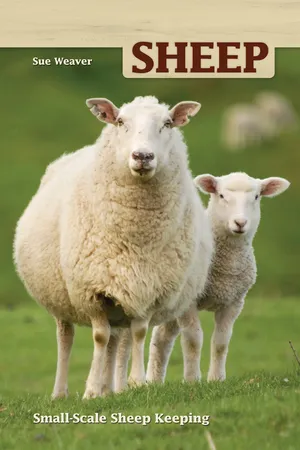
Hobby farmer Sue Weaver provides a perfect primer in Sheep, ideal for novice or experienced sheep keepers looking to expand their hobby farm with a flock of wooly wonders. Illustrated with instructive and beautiful color photographs and loaded with charts and sidebars, this Hobby Farms title will make even newcomers feel comfortable choosing, caring for, and even sheering and milking their own sheep. Weaver begins, "Be they pets or profit makers, sheep should be part of every small-farm scene. They are inexpensive to buy and keep, easy to care for, and relatively long lived, making them great investments." While sheep dotting a green meadow add beauty—and a possible tax write-off—to any pastoral setting, hobby farmers can choose whether their sheep will be sold as pets, used as providers of milk, cheese, or wool, or raised as livestock for their much sought-after mutton.
As a subject, sheep have a fascinating history to tell, as Weaver does in the opening chapter "Sheep from the Beginning," but once we get through the mythology, biology, and anatomical lessons, the farming begins. Sheep will assist the reader in buying the right sheep for his or her farm or land, based on availability, conformation, health, and so forth. The book offers practical advice, including how to move sheep from one locale to another (with a "ewe haul"). Sheep farming involves the housing, feeding, and guarding of the sheep, all detailed in the book. Weave discusses the use of fences, shelters, pens, and stalls as well as the purchase of the right hay. She also addresses the use of working dogs to control and guard the flock.
Understanding sheep behavior is the subject of the chapter "Sheepish Behavior and Safe Handling," in which the author discusses flocking dynamics, fleeing instinct, and sheep body and vocal language, leading to practical advice about how to handle and move sheep safely and with minimal fuss. The old adage "A sick sheep is a dead sheep" may not hold completely true in modern times, but it does underscore how important the health of a flock is to a responsible sheep keeper. The chapter "Health, Maladies, and Hooves" (and the appendix "A Glance at Sheep Afflictions") offers farmers vital information about vaccinations, parasites, and hoof care to be proactive in the flock's health.
For hobby farmers interested in expanding their flocks, the chapter "The Importance of Proper Breeding" is a mini course in breeding and lambing, including bottle feeding, tail banding, and more. All of the joys of wool are captured in the chapter "Fleece: Shearing, Selling, Spinning," in which the author discusses the tools, skills, and fees required to fleece the flock. The chapter also discusses spinning your own wool and selling the fleece. The final chapter, "Mutton or Milk?" discusses the advantages and desirability of sheep's milk and the possible markets for milk, cheese, and meat. A glossary of over 100 terms, an extensive resources section (sheep-pertinent organizations, websites, and publications), and an index complete the volume.
- 160 pages
- English
- ePUB (mobile friendly)
- Available on iOS & Android
eBook - ePub
About this book
Information

CHAPTER ONE
Sheep from the Beginning
In the beginning, there were majestic wild sheep called mouflons. Hunters stalked the wily sheep to dine on their tasty flesh and to craft cozy clothing from their hides. About 11,000 years ago—probably near Zawi Chemi Shanidar, in what is now northern Iraq—a hunter stopped fiddling with his spear point, kicked a log onto the fire, and said to a friend, “Wouldn’t it be smarter to snatch some lambs and raise them here by camp?”
So humans and sheep formed an alliance. People protected sheep from wolves, bears, and mountain lions; sheep reciprocated by developing wool. About 3500 BC, women puzzled out how to weave sheep’s woolly covering into fine, sturdy cloth that kept wearers toasty in the wintertime and cool under the blazing summer sun. Decked out in woolen garments, men said to one another, “We don’t have to stay here on the Mesopotamian plains where it’s always pretty warm; we could go out and conquer the world!”
Sheep were already out in the world. Domestic sheep had reached parts of Europe by 5000 BC, having been carried west by intrepid Neolithic farmers. (Sheep remains have been recovered from a Swiss New Stone Age dig circa 2000 BC.) Swedish farmers began raising northern short-tailed sheep between 4000 and 3000 BC. Between 1000 BC and AD 1, Persians, Greeks, and Romans labored to develop new and better sheep. The Romans brought their revamped woollies along (a walking food supply) when they conquered Europe and North Africa; by AD 50, the Romans had erected a wool-processing plant near Winchester, England.
Historically, the greatest sheep was the mighty Merino. Some researchers think it sprang from a genetic mutation some 3,000 years ago; others believe it was developed during the reign of Queen Claudia of Spain (AD 41–54). Whatever the case, income from the Spanish Merino wool trade transformed Spain into a world power and financed its New World voyages. Until the mid-eighteenth century, in fact, Spain so hoarded Merinos that it made smuggling sheep out of the country punishable by death.
When Columbus embarked on his second voyage, in 1493, he packed along big, meaty Spanish Churra sheep. He left some in Cuba and more in Santo Domingo. Their descendants trailed Cortez and his conquistadors as they pillaged their way across the New World.

This vintage European Easter card is filled with historical symbols of the season: children in traditional dress, pussy willow boughs, springtime flowers, and fluffy sheep.
Meanwhile, another wave of sheep arrived by way of the North American colonies. Fifteen years after settling Plymouth Colony, the Pilgrims purchased sheep from Dutch dealers on Manhattan Island. By 1643, there were 1,000 sheep in Massachusetts Bay Colony alone. Records show that Governor Winthrop, of the Connecticut colony, acquired a handsome flock of Southdown sheep in 1646. By 1664, an estimated 100,000 sheep called the thirteen colonies home.
Trafficking in sheep or wool was risky business. By 1698, Americans were peddling their wool abroad—much to the consternation of the British king William III. William ultimately outlawed the production of sheep and wool in the colonies. Miscreants caught engaging in the trade had their right hands amputated.
Yet intrepid shepherds continued raising sheep before, during, and after the American Revolution. George Washington and Thomas Jefferson were inaugurated in suits crafted of pure American wool. Both presidents were, in fact, avid sheepmen. Washington raised English Leicesters at Mount Vernon; Jefferson bred English Leicester and Tunis sheep at Monticello.
During the nineteenth century, a slew of European breeds appeared on the American scene. Coveted Spanish Merinos (1808), Lincolns (1825), Cotswolds (1832), Shropshires (1855), and Hampshires (1885) arrived and flourished. In 1912, the first all-American breed, the Columbia, was developed.
dp n="14" folio="13" ?Sheep in Myths

Back to the Dawn of time:
It stands to reason, considering humanity’s long association with sheep, that myth and religion embrace them, too. The Egyptian sun god, Amon-Ra, was depicted as either a ram-headed deity or a sun disc with ram’s horns. Other ramhorned deities include the Middle Eastern great goddess Ishtar; the Phoenician sun god Baal-Hamon; and Ea-Oannes, the Babylonian god of the deeps.
The Greek goddess of crossroads, Hecate, is associated with sheep—especially black ewe lambs. Pan was the god of sheep and flocks. A famous mythical sheep was the golden ram, Khrysomallos, a wooly son of Neptune and Theophane, conceived when they appeared in the forms of a ram and a ewe. Flying Khrysomallos carried the children Phrixos and Helle to Kolkhis, where Phrixos sacrificed Khrysomallos to the gods and hung his fleece in the holy grove of Ares. It became the object of Jason and the Argonauts’ quest for the golden fleece.
The Romans had Palas, the guardian of their flocks. On his feast day (the Parilia, April 21) sheepfolds were decked with greenery, and a wreath was placed on every entrance. Chuku, supreme deity of the Ibo in Nigeria, once sent a messenger sheep to tell humans that the dead should be placed on the earth and have ashes sprinkled over them; then, they would come back to life. But the sheep forgot the message and decided to wing it, directing instead that the dead should be buried in the ground.
Fairy lore is rife with sheepy connections. The Scots-Irish shape-shifting buachailleen play pranks on shepherds, such as spooking the sheep or smearing their fleeces with muck the night before shearing. Iron bells suspended from collars around sheep’s necks protect them from the buachailleen. According to Welsh fairy folk, sheep are the only creatures allowed to graze the grass growing in fairy rings. That, according to legend, is what makes Welsh mutton the best in the world.

America’s sheep population peaked in 1942, at a mind-boggling 56.2 million head. Today there are 6.35 million head, and that’s down a hefty 14 percent since 2001. The good news is that although large-scale commercial sheep operations are faltering, there is a burgeoning unmet market for specialty products such as handspinners’ fleece, gourmet sheep’s milk cheeses, and certified organic lamb—products raised on, and marketed from, today’s small farms.
Sheep come in many sizes, shapes, colors, and temperaments. They can be classified by type of fleece produced, appearance, or place of origin.
Consequently, they offer a wide variety of characteristics to breeders and consumers alike. However, supplies are not unlimited, and some breeds are considered endangered.
SHEEP AT A GLANCE
Domestic sheep (Ovis aries) belong to the Bovidae family, along with other hollowhorned, cloven-hoofed ruminants such as cattle, and to the Caprinae subfamily, in the company of their cousins, the goats. There are more than 1,000 breeds of domesticated sheep in the world today—more than three score of them in North America alone. While size, shape, type of fleece (or lack thereof), and disposition vary greatly, all domestic sheep have certain traits in common. We’ll discuss many of these items later. For now, here are sheep at a glance.
SHEEP IQ
The University of Illinois monograph “An Introduction to Sheep Behavior” ranks sheep IQ a smidge below that of the pig and on a level with cattle. Researchers at the Babraham Institute in Cambridge, England, trained twenty sheep to recognize pictures of other sheep faces. Electrodes measuring their brain activity proved that some remembered at least fifty of the faces for up to two years. “It’s a very sophisticated memory system,” explains Dr. Keith Kendrick. “They are showing similar abilities in many ways to humans.”

Packaged as tightly as canned sardines, these white-faced sheep are comforted by their close quarters. Sheep have a natural flocking tendency and stick together as means of protection.
dp n="16" folio="15" ?Sheep also learn and respond to their names. Club lambs and exhibition sheep lead, stand tied, allow extensive grooming, and pose in the show ring. Pet sheep learn to pull carts; some even do tricks. Sheep, intelligently and quietly handled, are very trainable.
Sheep are not stupid; they are reactive. Their only means of survival is to band together for protection, then to run. Frightened, stressed sheep flee blindly, pack into corners, and get wedged behind gates. Quietly handled sheep generally do not.
FLOCKING INSTINCT AND SOCIAL STRUCTURE
Sheep are gregarious, meaning they crowd together for reassurance and protection. They have a strong inner compulsion to follow a leader. These traits compose their flocking instinct. In most cases, the leader is simply the first sheep that starts moving in a given direction; flock hierarchy rarely enters the picture.
White-faced (wool) sheep are more gregarious than are black-faced (meat) breeds. When stressed, huge flocks of Australian Merinos can pack so tightly that humans swept up in the crush are injured or killed. Weakly gregarious breeds include the Suffolk, Hampshire, Corriedale, Cheviot, Leicester, and Dorset. Because strongly gregarious breeds tend to move as a group instead of scattering, herding them is easier than mustering breeds that are not gregarious, especially when using a herding dog.
Biological Traits
Temperature: 102.5 degrees Farenheit
Pulse: 75 beats per minute
Respiration: 16 breaths per minute
Chromosome count: 54
Adult body weight: 65-475 pounds
Natural life span: 6-14 years (well-kept sheep have lived 20 years or more)
Sight: Although they have poor depth perception, sheep see in modified color and, unless wool on their faces obstructs their vision, they have a 270-to 320-degree visual field.
Smell: Sheep have a keen sense of smell. Rams determine which ewes are in standing heat by sniffing them; ewes identify new lambs by scent.
Hearing: Sheep...
Table of contents
- Dedication
- Introduction
- CHAPTER ONE - Sheep from the Beginning
- CHAPTER TWO - Buying the Right Sheep for You
- CHAPTER THREE - Housing, Feeding, and Guarding Your New Flock
- CHAPTER FOUR - Sheepish Behavior and Safe Handling
- CHAPTER FIVE - Health, Maladies, and Hooves
- CHAPTER SIX - The Importance of Proper Breeding
- CHAPTER SEVEN - Fleece: Shearing, Selling, Spinning
- CHAPTER EIGHT - Mutton or Milk?
- Acknowledgements
- Appendix: A Glance at Sheep Afflictions
- Glossary
- Resources
- Photo Credits
- Index
- ABOUT THE AUTHOR
- Copyright Page
Trusted by 375,005 students
Access to over 1.5 million titles for a fair monthly price.
Study more efficiently using our study tools.
Frequently asked questions
Yes, you can cancel anytime from the Subscription tab in your account settings on the Perlego website. Your subscription will stay active until the end of your current billing period. Learn how to cancel your subscription
No, books cannot be downloaded as external files, such as PDFs, for use outside of Perlego. However, you can download books within the Perlego app for offline reading on mobile or tablet. Learn how to download books offline
Perlego offers two plans: Essential and Complete
- Essential is ideal for learners and professionals who enjoy exploring a wide range of subjects. Access the Essential Library with 800,000+ trusted titles and best-sellers across business, personal growth, and the humanities. Includes unlimited reading time and Standard Read Aloud voice.
- Complete: Perfect for advanced learners and researchers needing full, unrestricted access. Unlock 1.5M+ books across hundreds of subjects, including academic and specialized titles. The Complete Plan also includes advanced features like Premium Read Aloud and Research Assistant.
We are an online textbook subscription service, where you can get access to an entire online library for less than the price of a single book per month. With over 1.5 million books across 990+ topics, we’ve got you covered! Learn about our mission
Look out for the read-aloud symbol on your next book to see if you can listen to it. The read-aloud tool reads text aloud for you, highlighting the text as it is being read. You can pause it, speed it up and slow it down. Learn more about Read Aloud
Yes! You can use the Perlego app on both iOS and Android devices to read anytime, anywhere — even offline. Perfect for commutes or when you’re on the go.
Please note we cannot support devices running on iOS 13 and Android 7 or earlier. Learn more about using the app
Please note we cannot support devices running on iOS 13 and Android 7 or earlier. Learn more about using the app
Yes, you can access Sheep by Sue Weaver in PDF and/or ePUB format, as well as other popular books in Technology & Engineering & Animal Husbandry. We have over 1.5 million books available in our catalogue for you to explore.