eBook - ePub
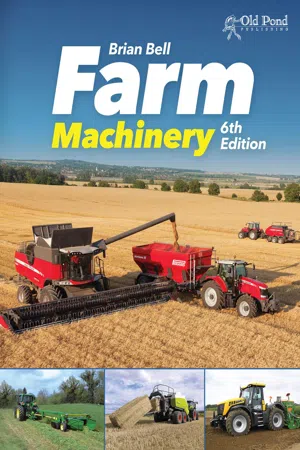
Farm Machinery
About this book
Farm Machinery is the standard book on the current theory and practice of farm mechanisation for students and farmers. First published in 1979, this new sixth edition incorporates much new text together with 280 new colour photographs illustrating the steady flow of developments in farm mechanisation that have taken place over the past decade. Recent advances in computer technology and satellite field mapping are included and new content enriches the earlier material dealing with the working principles and operation of the vast array of the somewhat less sophisticated farm tractors and machines still in use on British farms. There are chapters on tractors, cultivation and drilling equipment, crop care and harvest machinery. Further chapters deal with farmyard and estate maintenance equipment, mechanical handlers, dairy equipment, irrigation farm power and the farm workshop. References are made to the UK Health & Safety at Work Act and other safety regulations. These summarise their main requirements, but they should only be taken as a guide. Brian Bell has had a long involvement with farm machinery that started with an apprenticeship in a tractor dealership. After a teaching career on farm machinery at Otley College in Suffolk he retired as Vice Principal in 1993 when he was awarded the MBE for services to agriculture. Brian Bell has written a number of books and made seventeen DVDs on modern and vintage tractors and machinery.
Information
Subtopic
AgricultureChapter 1
Farm Tractors
Tractors have been used on British farms since the early part of the twentieth century. They were already replacing horses on some farms by 1920, when tractors were used to pull implements from the drawbar and drive stationary equipment, such as a threshing machine, by means of a belt pulley.

Plate 1.1 Powershift transmission, front axle suspension, category II or III hydraulic linkage, front power take-off and a suspended cab are some of the features of this 170 hp tractor. (Massey Ferguson)
By the early 1940s, tractor design had progressed to the stage where a hydraulic lift system had been developed, as had the power take-offshaft used to drive trailed implements such as a self-binder or a manure spreader. During the immediate post-war years, the tractor population on British farms exploded. There were numerous improvements in design: diesel engines, the differential lock, four-wheel drive and cabs to protect the driver from the weather are just a few examples.
Today, many tractors used on arable farms have in-cab electronic controls which allow the driver to carry out various operations from the comfort of an air-conditioned safety cab, and some have front- and rear-mounted cameras to warn the driver of any unseen hazards. Other less sophisticated models with mainly manual controls are used on stock and mixed farms, where higher specifications are not required and their cost cannot be justified.
Electronically controlled hydraulic systems with sensors linked to the control unit, which raise and lower mounted implements to maintain constant draft, are often found on tractors which also feature automatic gear changing systems to achieve optimum performance and economy. Some tractors have a headland management system that automatically carries out the complete sequence of lifting the implement, disengaging the power take-off – when it is being used – and switching off four-wheel drive. After the driver has turned the tractor at the headland turn, the management system reverses the process and returns the implement to its working position. Some management systems also turn the tractor at the headland.
For many years farm tractors had engines of no more than 15–45 kW (20–60 hp), but engine power has steadily increased and the average engine size of tractors now sold to British farmers is in excess of 100 kW (135 hp). Four-wheel drive tractors with engines in the 110–220 kW (150–300 hp) range or more are used on large-scale arable farms. Tractors used on predominately livestock farms are usually less powerful, typically with an engine in the 45–75 kW (60–100 hp) range.
In the early days of farm mechanisation, tractors were used to pull an implement from a fixed or swinging drawbar. The introduction of the hydraulic system in the 1940s brought the versatility we expect of the modern farm tractor, with the ability to lift implements, operate external hydraulic rams and drive machines with hydraulic motors. As well as providing power for everything from the starter motor to in-cab electronic control systems, the tractor electrical system can be used to make adjustments to implements with solenoids and small electric motors.
Types of Tractor

Plate 1.2 Two-wheel drive tractors were in almost universal use until the introduction of four-wheel drive conversion kits in the mid-1960s, but within twenty years four-wheel drive was available for almost all new tractors. (Case IH)
Wheeled tractors range from small two-wheel drive models for market gardens to huge four-wheel drive and rubber-tracked machines with engines developing 150–300 kW (200–400 hp) or more.

Plate 1.3 Some small farm tractors with a low noise level have a safety roll bar which can be folded when used in low farm buildings. (John Deere)
Rowcrop Tractors
Mainly used by farmers and market gardeners for vegetable and root crop production, rowcrop tractors have a small turning circle, easily adjusted wheel track settings and provide the driver with a full view of the crop when inter-row hoeing and for rowcrop work. Few modern tractors meet these features, as they are too large and powerful for this type of work, but many older models of rowcrop tractor are still in use.
Compact tractors with a diesel engine in the 15–30 kW (20–40 hp) range are ideal for working in rowcrops. A typical model has a three-cylinder diesel engine with a manual or optional hydrostatic transmission, power take-offand hydraulics and manual or power steering. A typical compact tractor with a manual gearbox has twelve forward and four reverse gears. Some rowcrop tractors may have four-wheel drive, a low-speed creeper gearbox and a safety cab or frame. Small, narrow track row-crop tractors with an overall width of 52 in. or less are used for orchard and vineyard work.

Plate 1.4 General-purpose tractors with 60–150 kW (80–200 hp) engines do much of the general work on arable and livestock farms. (New Holland)
General-Purpose Tractors
As the name suggests, these tractors are used for most of the day-to-day work on arable and livestock farms. Engine power ranges from 60–150 kW (80–200 hp) or more depending on the size and type of tractor. They are capable of pulling heavy loads from the hydraulic linkage, pick-up hitch or drawbar and have high capacity hydraulic systems and powerful power take-off shafts.
Almost all modern general-purpose tractors have four-wheel drive, but small two-wheel drive models are still in widespread use, especially in mixed farming areas. To aid steering, the front wheels on most four-wheel drive tractors are smaller in diameter than the rear wheels, but some older four-wheel drive models have front and rear wheels of equal size or front wheels that are much smaller than those at the rear.
Many of the more powerful general-purpose tractors have front and rear hydraulic linkage, power take-off shafts, disc brakes on all four wheels, diff-locks on both axles and some have a pneumatic or a mechanical suspension system. Some very high power four-wheel drive models with 250–390 kW (340–530 hp) engines, infinitely variable speed transmissions and a top speed of 50 kph (30 mph) have a cab which the driver can rotate from the driving seat so that the tractor can be driven in either direction.
High mobility tractors with similar specifications to general-purpose models may have a load carrying platform at the rear, which can be used with a de-mountable crop sprayer or fertiliser spreader. Suitable for both fieldwork and high-speed road haulage, these tractors have transmission systems with top road speeds of 64–80 kph (40–50 mph) when equipped with suitable tyres and an approved braking system.

Plate 1.5 The cab on this multi-purpose tractor can be turned round to face the required direction of travel. This tractor is pushing a large set of mounted mowers. (Claas)

Plate 1.6 Four-wheel steering, suspension on all four wheels and a turbocharged diesel engine are features of this high-speed four-wheel drive tractor.
Tracklayers
Small tracklayers or crawlers with 45–60 kW (60–80 hp) diesel engines and steel tracks are still used on some heavy land farms. Track-layers have the advantage of a large footprint area and cause less soil compaction than an equivalent-size wheeled tractor. However, most farmers wishing to reduce soil compaction now use a rubber-tracked tracklayer or a four-wheel drive tractor.
Although some large steel-tracked track-layers with diesel engines in the 67–100 kW (85–150 hp) power range are owned by farmers, most of them are used by contractors for land drainage work. While this type of tractor has rather low operating speeds, the tracks exert very low ground pressure compared with wheels, which means soil compaction is reduced to a minimum. However, steel-tracked models may only be driven on public roads after street plates have been fitted to the tracks. Alternatively, they must be transported between sites on a trailer.

Plate 1.7 Track plates have to be fitted to crawler tractors with steel tracks before they can be driven short distances on the public highway, a sight now seldom seen.

Plate 1.8 The first crawler tractors with rubber tracks had equal-sized drive sprockets and idler wheels. (Gregoire-Besson)

Plate 1.9 This rubber-tracked crawler with a 16-speed powershift transmission has a top road speed of 30 kph (20 mph). (John Deere)
Rubber-tracked crawler tractors can be driven on the public highway. They have top speeds of up to 40 kph (25 mph) and, depending on model, have a six-cylinder engine in the 150–450 kW (200–600 hp) power range. The tracks are driven by sprockets which engage with lugs on the inside of the tracks. Diagonal lugs on the outer surface of the tracks give maximum power transmission. Rubber-tyred track rollers and a front idler wheel support the track. Some rubber-tracked models have a conventional gear-based powershift transmission; others have an infinitely variable hydrostatic drive to each track.
The very large footprint area of both rubber and steel tracks compared with a four-wheel drive tractor gives more efficient use of engine power at the drawbar and improved traction.

Plate 1.10 With a six-cylinder 335 kW (450 hp) engine, this tractor is a wheeled, articulated alternative to the rigid-frame, rubber-tracked crawler shown in Plate 1.11. (Gregoire-Besson)

Plate 1.11 A powershift transmission, four independently driven rubber tracks and articulated centre-pivot steering make this tractor easy to manoeuvre on headlands.
Controls and Instruments
The Driving Controls
Although some tractors have only a basic set of manual instruments and controls, most modern tractors have various switches, buttons, gauges and levers for operation, control and monitoring, and some have an on-board computer which carries out the same functions.
Controls and instruments vary in ...
Table of contents
- Cover
- Half Title
- Title
- Copyright
- CONTENTS
- Preface to Sixth Edition
- Acknowledgements
- 1 Farm Tractors
- 2 Tractor Engines
- 3 Tractor Electrical Systems
- 4 Tractor Transmission Systems
- 5 Tractor Hydraulic Systems
- 6 Wheels, Tracks and Steering
- 7 Tractor Cabs
- 8 Small Engines
- 9 Ploughs
- 10 Cultivation Machinery
- 11 Drills
- 12 Manure and Fertiliser Distribution Machinery
- 13 Ground Crop Sprayers
- 14 Haymaking Machinery
- 15 Silage Making Machinery
- 16 Balers
- 17 Combine Harvesters
- 18 Root Crop Machinery
- 19 Mechanical Handling
- 20 Farmyard and Estate Machinery
- 21 Farm Power
- 22 The Farm Workshop
- Index
Trusted by 375,005 students
Access to over 1.5 million titles for a fair monthly price.
Study more efficiently using our study tools.
Frequently asked questions
Yes, you can cancel anytime from the Subscription tab in your account settings on the Perlego website. Your subscription will stay active until the end of your current billing period. Learn how to cancel your subscription
No, books cannot be downloaded as external files, such as PDFs, for use outside of Perlego. However, you can download books within the Perlego app for offline reading on mobile or tablet. Learn how to download books offline
Perlego offers two plans: Essential and Complete
- Essential is ideal for learners and professionals who enjoy exploring a wide range of subjects. Access the Essential Library with 800,000+ trusted titles and best-sellers across business, personal growth, and the humanities. Includes unlimited reading time and Standard Read Aloud voice.
- Complete: Perfect for advanced learners and researchers needing full, unrestricted access. Unlock 1.5M+ books across hundreds of subjects, including academic and specialized titles. The Complete Plan also includes advanced features like Premium Read Aloud and Research Assistant.
We are an online textbook subscription service, where you can get access to an entire online library for less than the price of a single book per month. With over 1.5 million books across 990+ topics, we’ve got you covered! Learn about our mission
Look out for the read-aloud symbol on your next book to see if you can listen to it. The read-aloud tool reads text aloud for you, highlighting the text as it is being read. You can pause it, speed it up and slow it down. Learn more about Read Aloud
Yes! You can use the Perlego app on both iOS and Android devices to read anytime, anywhere — even offline. Perfect for commutes or when you’re on the go.
Please note we cannot support devices running on iOS 13 and Android 7 or earlier. Learn more about using the app
Please note we cannot support devices running on iOS 13 and Android 7 or earlier. Learn more about using the app
Yes, you can access Farm Machinery by Brian Bell in PDF and/or ePUB format, as well as other popular books in Technology & Engineering & Agriculture. We have over 1.5 million books available in our catalogue for you to explore.